VO₂ max sounds like a term reserved for elite athletes, but it’s among the most accurate measures of your lifetime and general condition. Moreover, it goes beyond performance. Monitoring your VO₂ max will help you to ascertain your body’s capacity to control stress, its oxygen consumption efficiency, and your internal ageing process.
If you have never heard of it or never had it tested, this page details exactly what VO₂ max is, why it is important, and what testing entails.
What Is VO₂ Max?
Maximum oxygen uptake is referred to as VO₂ max. It calculates how much oxygen your body can use at its maximum during vigorous exercise. Your body can generate more energy and have a higher aerobic capacity if you can use more oxygen.
Millilitres of oxygen per kilogramme of body weight per minute (ml/kg/min) is the unit of measurement. Higher scores indicate greater cardiovascular fitness. For example, elite endurance athletes can score above 70, while the average adult typically scores between 30 and 50, depending on age and fitness level.
Consider VO₂ max to be the size of your engine. A larger engine is not only faster; it is also more resilient, efficient, and ready to handle life’s challenges.
Why VO₂ Max Matters for Your Health
Although VO₂ max is frequently used in sports science, it is equally significant for general health. Indeed, research indicates that it is among the most reliable indicators of future health outcomes, surpassing even blood pressure and cholesterol levels.
Here’s why VO₂ max matters:
- Cardiovascular Health: A higher VO₂ max means that your heart and lungs are more effectively pumping oxygen to the appropriate locations.
- Longevity: Studies have shown that those with higher VO₂ max scores have fewer chronic illnesses and live longer.
- Metabolic Function: More stable blood sugar levels and fat metabolism are supported by improved oxygen utilisation.
- Daily Energy: VO₂ max influences not only how well you perform during workouts but also how easily you manage stairs, carry groceries, and recover from physical activities.
Simply put, having a higher VO₂ max means that you are more resilient on all levels—cognitive, metabolic, and physical.
How Is VO₂ Max Tested?
A graded exercise test is the most accurate way to measure VO₂ max in a clinical or performance lab setting.
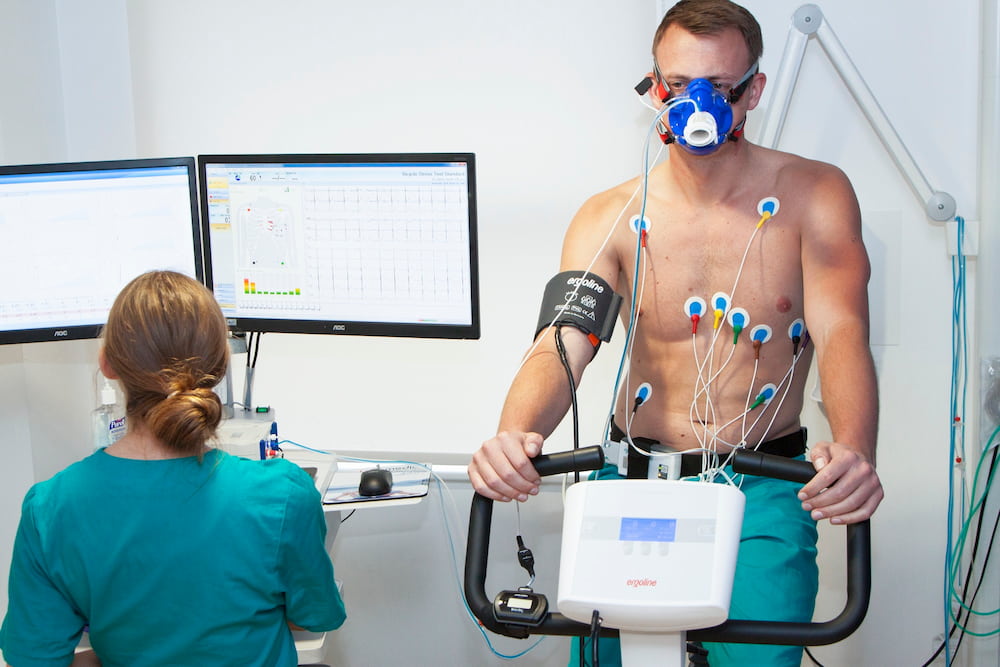
While exercising, usually on a stationary bike or treadmill, you will wear a face mask that is connected to a device that analyses your breathing. Until you achieve your maximum effort, the intensity progressively increases.
By monitoring your heart rate, breathing rate, and oxygen/carbon dioxide levels throughout the test, your true VO₂ max is calculated. It takes about ten to fifteen minutes to complete a comprehensive test.
It’s short, intense, and highly informative.
What You’ll Learn From a VO₂ Max Test
There is more to your results than a single figure. You can get a comprehensive picture of your cardiorespiratory function with a VO₂ max test, which includes:
- Your thresholds for anaerobic and aerobic processes
- Training and fat-burning heart rate zones
- Burned calories at varying intensities
- Perspectives on recovery and endurance capacity
Whether your objective is weight loss, performance, or just maintaining your health as you age, it also offers a standard by which to gauge your progress over time.
Can You Improve Your VO₂ Max?
Yes, and quite rapidly.
Although genetics plays a role, VO₂ max can be trained. Most people can raise their VO₂ max in 6–12 weeks with regular effort, particularly in the appropriate heart rate zones.
Among the most effective methods for raising VO₂ max are:
- Zone 2 training (longer periods of low to moderate effort)
- High-intensity intervals (brief, near-max effort bursts followed by recovery)
- Maintaining consistency over time—progressively increasing aerobic base
- Strength training promotes the use of oxygen by muscles.
It’s important to train wisely, advance gradually, and recover well rather than trying to crush yourself every day.
Who Should Get a VO₂ Max Test?
Competitive athletes are not the only ones who should take a VO₂ max test. It’s perfect for anyone who wishes to:
- Monitor your aerobic fitness over time.
- Improve your cardiovascular health
- Use heart rate zones to maximise your workouts.
- Boost energy levels, metabolism, or endurance
- Track the changes in fitness as you age
A VO₂ max test gives you useful information that can help you improve your daily mood, lower your risk of injury, and mould your exercise habits—even if you’re not training for an event.
Final Thoughts
If your health is more important to you than your appearance or running speed, you should be aware of your VO₂ max.
It demonstrates how well your muscles, heart, and lungs are cooperating. It forecasts your chance of getting sick. Additionally, it enables you to customise your lifestyle and training for tangible outcomes.
You don’t need to be a cyclist or a marathon runner. All you need to do is be interested in your body and prepared to use actual data to take control of your health.
Sources and Further Reading
- Greenbell Clinic – VO2 Max: What Is It & Why It Matters for Fitness
https://greenbellclinic.com/en/medical-blog-en/vo2-max-what-is-it-why-it-matters-for-fitness/ - Harvard Health Publishing – VO2 max: What is it and how can you improve it?
https://www.health.harvard.edu/staying-healthy/vo2-max-what-is-it-and-how-can-you-improve-it - Healthline – Everything to Know About VO₂ Max
https://www.healthline.com/health/vo2-max
- PubMed – Cardiorespiratory fitness as a quantitative predictor of all-cause mortality and cardiovascular events in healthy men and women: a meta-analysishttps://pubmed.ncbi.nlm.nih.gov/19454641/
Did you find this helpful? Check out our other helpful articles on our website.
Read Also
- Trust Signals Families and Referrals Expect in Home-Based Care
 Choosing a home-based care provider is rarely a simple decision. For families, it is often emotional and urgent. For referral sources, it is operational, clinical, and reputational. Both groups want the same outcome: a safe, dependable care setting that supports the individual’s needs without creating unnecessary risk, confusion, or disruption. Trust is the deciding factor.… Read more: Trust Signals Families and Referrals Expect in Home-Based Care
 - IVF in Later Life: Opportunities, Risks, and Modern Strategies for SuccessIs it worth considering IVF after age 40? In today’s world, the boundaries of reproductive age are gradually shifting, adapting to social changes. More and more women aged 40 and older are making a conscious decision to become mothers once they have achieved career stability, established a solid financial foundation, and attained deep psychological maturity.… Read more: IVF in Later Life: Opportunities, Risks, and Modern Strategies for Success
- How to Choose a Pediatrician: What Parents Should Look For Before the First VisitChoosing a pediatrician is one of the first major healthcare decisions parents make — and one of the most important. Your child’s doctor will be a consistent presence through well-child visits, illnesses, developmental milestones, and sometimes difficult conversations. Getting this choice right from the start sets the foundation for your child’s long-term health. Start Looking… Read more: How to Choose a Pediatrician: What Parents Should Look For Before the First Visit
- Ankle Injuries in Athletes: When to Push Through and When to See a SpecialistAnkle injuries are among the most common in sports, from weekend warriors to competitive athletes. The challenge is that the ankle’s complexity means what feels like a simple sprain might actually involve a fracture, torn ligament, or cartilage damage beneath the joint. Knowing when to rest at home versus when to seek professional evaluation can… Read more: Ankle Injuries in Athletes: When to Push Through and When to See a Specialist
- What to Expect When Seeing an Orthopedic Surgeon for Knee or Joint PainKnee and joint pain affects millions of Americans each year, ranging from minor discomfort after exercise to debilitating conditions that limit daily movement. Knowing when to see a specialist — and what to expect when you do — can make the entire experience less intimidating and more productive. When Should You See an Orthopedic Surgeon?… Read more: What to Expect When Seeing an Orthopedic Surgeon for Knee or Joint Pain
- Real Health Risks of Mold Exposure in South Florida HomesAlthough I’m not a doctor, having lived through enough post-hurricane mold outbreaks to know which symptoms send people to the ER in Miami, Fort Lauderdale, and West Palm Beach—and which ones linger for years. Immediate Reactions (hours to days) Allergic-type response (most common): Runny nose, red itchy eyes, sneezing, sinus pressure that feels like a… Read more: Real Health Risks of Mold Exposure in South Florida Homes
- Discover the Benefits of Secure Dental for Your Oral HealthThe Undeniable Link Between Oral Health and Overall Well-Being Oral health is much more than just a hygiene issue; it plays a crucial role in your overall health. Research has repeatedly shown that what happens in your mouth can significantly influence your body as a whole. The mouth is the gateway to the rest of… Read more: Discover the Benefits of Secure Dental for Your Oral Health
- The Role of Ingredients in Your Skincare: What to Look ForSkincare works best when you understand what goes into the products you use daily. Ingredients form the foundation of every formula and determine how the skin reacts over time. Each cream, cleanser, or serum has its own role, determined by its ingredients. Learning what to look for helps you pick products that help skin and… Read more: The Role of Ingredients in Your Skincare: What to Look For