VO₂ max sounds like a term reserved for elite athletes, but it’s among the most accurate measures of your lifetime and general condition. Moreover, it goes beyond performance. Monitoring your VO₂ max will help you to ascertain your body’s capacity to control stress, its oxygen consumption efficiency, and your internal ageing process.
If you have never heard of it or never had it tested, this page details exactly what VO₂ max is, why it is important, and what testing entails.
What Is VO₂ Max?
Maximum oxygen uptake is referred to as VO₂ max. It calculates how much oxygen your body can use at its maximum during vigorous exercise. Your body can generate more energy and have a higher aerobic capacity if you can use more oxygen.
Millilitres of oxygen per kilogramme of body weight per minute (ml/kg/min) is the unit of measurement. Higher scores indicate greater cardiovascular fitness. For example, elite endurance athletes can score above 70, while the average adult typically scores between 30 and 50, depending on age and fitness level.
Consider VO₂ max to be the size of your engine. A larger engine is not only faster; it is also more resilient, efficient, and ready to handle life’s challenges.
Why VO₂ Max Matters for Your Health
Although VO₂ max is frequently used in sports science, it is equally significant for general health. Indeed, research indicates that it is among the most reliable indicators of future health outcomes, surpassing even blood pressure and cholesterol levels.
Here’s why VO₂ max matters:
- Cardiovascular Health: A higher VO₂ max means that your heart and lungs are more effectively pumping oxygen to the appropriate locations.
- Longevity: Studies have shown that those with higher VO₂ max scores have fewer chronic illnesses and live longer.
- Metabolic Function: More stable blood sugar levels and fat metabolism are supported by improved oxygen utilisation.
- Daily Energy: VO₂ max influences not only how well you perform during workouts but also how easily you manage stairs, carry groceries, and recover from physical activities.
Simply put, having a higher VO₂ max means that you are more resilient on all levels—cognitive, metabolic, and physical.
How Is VO₂ Max Tested?
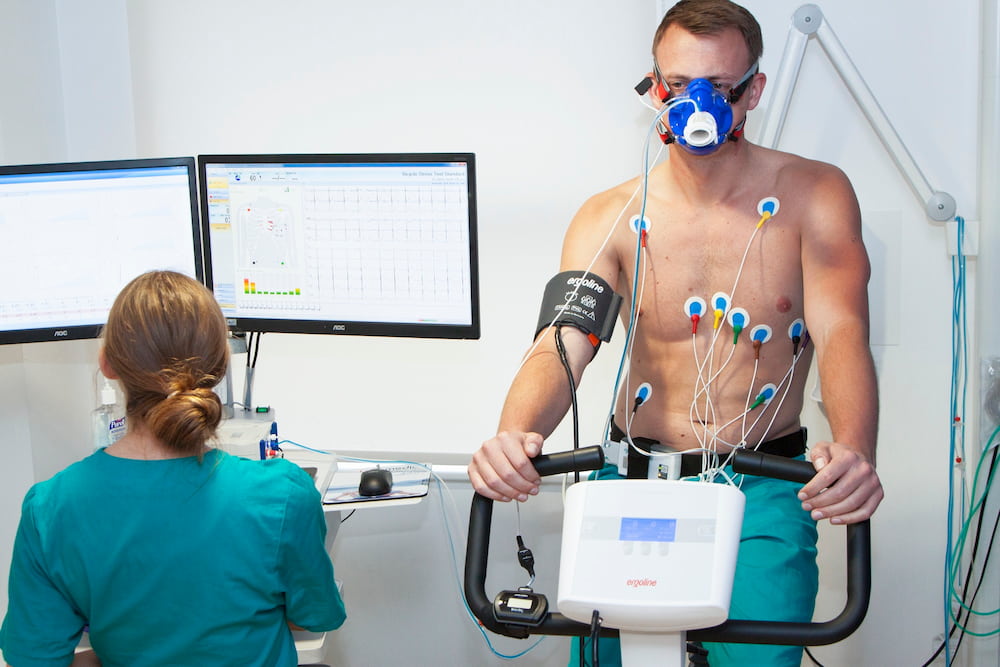
A graded exercise test is the most accurate way to measure VO₂ max in a clinical or performance lab setting.
While exercising, usually on a stationary bike or treadmill, you will wear a face mask that is connected to a device that analyses your breathing. Until you achieve your maximum effort, the intensity progressively increases.
By monitoring your heart rate, breathing rate, and oxygen/carbon dioxide levels throughout the test, your true VO₂ max is calculated. It takes about ten to fifteen minutes to complete a comprehensive test.
It’s short, intense, and highly informative.
What You’ll Learn From a VO₂ Max Test
There is more to your results than a single figure. You can get a comprehensive picture of your cardiorespiratory function with a VO₂ max test, which includes:
- Your thresholds for anaerobic and aerobic processes
- Training and fat-burning heart rate zones
- Burned calories at varying intensities
- Perspectives on recovery and endurance capacity
Whether your objective is weight loss, performance, or just maintaining your health as you age, it also offers a standard by which to gauge your progress over time.
Can You Improve Your VO₂ Max?
Yes, and quite rapidly.
Although genetics plays a role, VO₂ max can be trained. Most people can raise their VO₂ max in 6–12 weeks with regular effort, particularly in the appropriate heart rate zones.
Among the most effective methods for raising VO₂ max are:
- Zone 2 training (longer periods of low to moderate effort)
- High-intensity intervals (brief, near-max effort bursts followed by recovery)
- Maintaining consistency over time—progressively increasing aerobic base
- Strength training promotes the use of oxygen by muscles.
It’s important to train wisely, advance gradually, and recover well rather than trying to crush yourself every day.
Who Should Get a VO₂ Max Test?
Competitive athletes are not the only ones who should take a VO₂ max test. It’s perfect for anyone who wishes to:
- Monitor your aerobic fitness over time.
- Improve your cardiovascular health
- Use heart rate zones to maximise your workouts.
- Boost energy levels, metabolism, or endurance
- Track the changes in fitness as you age
A VO₂ max test gives you useful information that can help you improve your daily mood, lower your risk of injury, and mould your exercise habits—even if you’re not training for an event.
Final Thoughts
If your health is more important to you than your appearance or running speed, you should be aware of your VO₂ max.
It demonstrates how well your muscles, heart, and lungs are cooperating. It forecasts your chance of getting sick. Additionally, it enables you to customise your lifestyle and training for tangible outcomes.
You don’t need to be a cyclist or a marathon runner. All you need to do is be interested in your body and prepared to use actual data to take control of your health.
Sources and Further Reading
- Greenbell Clinic – VO2 Max: What Is It & Why It Matters for Fitness
https://greenbellclinic.com/en/medical-blog-en/vo2-max-what-is-it-why-it-matters-for-fitness/ - Harvard Health Publishing – VO2 max: What is it and how can you improve it?
https://www.health.harvard.edu/staying-healthy/vo2-max-what-is-it-and-how-can-you-improve-it - Healthline – Everything to Know About VO₂ Max
https://www.healthline.com/health/vo2-max
- PubMed – Cardiorespiratory fitness as a quantitative predictor of all-cause mortality and cardiovascular events in healthy men and women: a meta-analysishttps://pubmed.ncbi.nlm.nih.gov/19454641/
Did you find this helpful? Check out our other helpful articles on our website.
Read Also
- Full-Arch Dental Tourism: Why UK Patients With Severe Bone Loss Are Looking Abroad
 Dental implants have become one of the fastest-growing segments of private dentistry. Within that market, one patient group behaves very differently from the rest: people who have been told they do not have enough upper jawbone for conventional implants. For these patients, the choice is rarely between one clinic and another. It is between a… Read more: Full-Arch Dental Tourism: Why UK Patients With Severe Bone Loss Are Looking Abroad
 - Levels of Mental Health Care and When to Seek SupportMental health care can range from occasional outpatient appointments to 24-hour hospital treatment. The appropriate level depends on safety, symptom severity, daily functioning, medical needs, available support, treatment history and personal preferences. A licensed clinician should assess these factors rather than relying on a symptom list alone. Need help now? In the United States, call… Read more: Levels of Mental Health Care and When to Seek Support
- How to Choose a Shilajit Brand Based on the ResearchIn a randomized trial published in the Journal of the International Society of Sports Nutrition in 2019, 63 active men took 250 mg of standardized shilajit, 500 mg, or a placebo every day for eight weeks, and the benefit for strength retention after a fatiguing workout appeared only at 500 mg. For anyone choosing a… Read more: How to Choose a Shilajit Brand Based on the Research
- How to Incorporate Relaxation into Your Busy ScheduleFinding balance when you have a packed daily agenda often feels out of reach. Between work duties, family obligations, and personal projects, personal rest usually gets pushed to the bottom of the list. Small, intentional shifts in daily habits can help restore calm without requiring hours of extra free time. Continue reading to discover everything… Read more: How to Incorporate Relaxation into Your Busy Schedule
- Red Light Therapy for Skin and Wellness: Meet Vital Red Light TherapyModern wellness is not always about complicated treatments or long routines. Many people are now looking for simple, convenient ways to support their skin, recovery, and overall wellness at home. One technology getting more attention is red light therapy. Red light therapy uses specific wavelengths of red and near-infrared light to support the body’s natural… Read more: Red Light Therapy for Skin and Wellness: Meet Vital Red Light Therapy
- Managing Shock Loss After a Hair Transplant: The Financial and Clinical Imperative of Post-Op CareIn the rapidly evolving landscape of private healthcare, executive leadership within cosmetic and restorative surgery clinics faces a dual challenge: maintaining strict clinical standards while maximizing patient lifetime value (LTV) and brand advocacy. As the global medical tourism and elective procedure markets expand, clinical outcome quality alone is no longer the sole differentiator for premium… Read more: Managing Shock Loss After a Hair Transplant: The Financial and Clinical Imperative of Post-Op Care
- Transform Your Skin Health: Premier Gluta IV Therapy in DubaiThis comprehensive guide explores how modern intravenous wellness treatments can help revitalize your complexion, boost immune function, and support overall cellular health. By incorporating modern IV therapy Dubai services into a routine health regimen, individuals can achieve direct nutrient absorption for optimal results. Selecting a customized gluta IV drip Dubai treatment provides targeted antioxidant defense,… Read more: Transform Your Skin Health: Premier Gluta IV Therapy in Dubai
- The Evolution of Dental Prosthetics: Innovation in Oral HealthDental replacements have improved a lot over time. Smiling, chewing, and speaking depend on having healthy teeth. When teeth break or go missing, today’s options can restore both function and confidence. Modern techniques make these replacements feel and look completely natural. Ancient Roots Of Tooth Replacement People have tried to replace lost teeth for thousands… Read more: The Evolution of Dental Prosthetics: Innovation in Oral Health