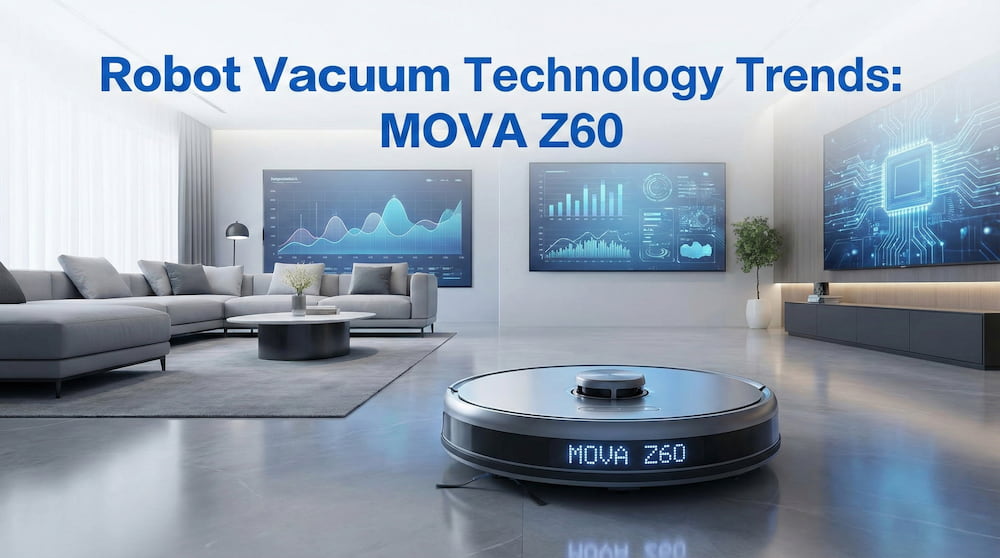
The robot vacuum market has evolved rapidly over the past few years. What began as simple automated sweepers has transformed into a new generation of intelligent, all-in-one cleaning systems that vacuum, mop, self-clean, and adapt to complex home environments. In 2025, the most important robot vacuum technology trends focus on stronger suction, smarter mopping, better edge coverage, and truly hands-free maintenance. Among these innovations, the MOVA Z60 stands out as a strong example of where robot vacuum technology is heading.
Trend 1: Ultra-High Suction Meets Anti-Tangle Design
One of the clearest trends in robot vacuum development is the push toward higher suction power without sacrificing usability. Modern homes, especially those with pets, demand deep cleaning performance that can handle fine dust, embedded debris, and hair.
The MOVA Z60 delivers 28,000Pa of ultra-powerful suction, placing it among the strongest robot vacuums in its class. However, raw power alone is no longer enough. Hair tangling has long been a pain point for users, particularly pet owners who find themselves stopping the robot mid-cycle to cut hair from brushes.
To address this, MOVA pairs its suction with an Anti-Tangle DuoBrush system. The dual rollers are engineered to actively reduce hair wrap, allowing the vacuum to maintain peak performance without frequent manual maintenance. This combination reflects a broader industry shift: suction power must be intelligent, not just aggressive.
Trend 2: Advanced Carpet Protection for Vacuum-Mop Combos
Hybrid vacuum-mop robots are now the standard, but carpet protection remains one of the biggest technical challenges. Traditional robots rely on basic mop lifting, which doesn’t always prevent moisture from transferring onto carpets or rugs.
MOVA takes a more advanced approach with AutoShield Carpet Protection. Instead of simply lifting the mop, the Z60 deploys a physical shield that blocks moisture from reaching carpeted surfaces. This dual-layer protection system goes beyond what many competitors offer and reflects a growing trend toward smarter, more context-aware cleaning.
As robot vacuums increasingly replace separate vacuum and mop devices, these kinds of intelligent safeguards are becoming essential for mixed-floor homes.
Trend 3: Real-Time Mop Washing for Consistently Clean Floors
Another major innovation trend is continuous mop cleaning. Older robot mops often spread dirty water across floors, reducing cleaning effectiveness and leaving streaks behind.
The MOVA Z60 introduces HydroForce Real-Time Mop Washing, featuring a 12-nozzle system that continuously rinses the roller mop while extracting dirty water. This ensures the mop stays clean throughout the cleaning cycle, delivering consistently fresh results from the first room to the last.
This technology reflects a broader shift in the industry: mopping systems are no longer passive accessories. They are becoming active, self-cleaning components designed to match the performance of manual mopping—without the effort.
Trend 4: Edge-to-Edge Cleaning Without Compromise
Consumers increasingly expect robot vacuums to clean every visible surface, not just open floor areas. Edges, corners, and baseboards are common weak spots for traditional round robots.
The MOVA Z60 addresses this with MaxiReach Edge-to-Edge Cleaning, combining a 25.6cm extended roller mop with a smart side brush. This design achieves up to 99.99% coverage, significantly improving performance along walls and in corners where debris often accumulates.
This trend highlights a shift away from gimmicky edge modes toward physical design improvements that genuinely expand cleaning reach.
Trend 5: All-Terrain Mobility for Real Homes
Modern homes are rarely flat, open spaces. Door thresholds, uneven flooring, rugs, and tight furniture clearances all present obstacles for robot vacuums.
The MOVA Z60 showcases the industry’s move toward adaptive mobility with StepMaster 2.0 and LiftPro Chassis, allowing it to climb thresholds up to 8cm. At the same time, its ultra-slim 96mm body and FlexScope Navigation enable it to glide under sofas, beds, and cabinets that bulkier robots can’t reach.
This balance between obstacle-climbing power and low-profile design reflects a key technology trend: robots must adapt to homes as they are, not force homeowners to rearrange their space.
Trend 6: Truly Hands-Free Automation with Self-Care Base Stations
Perhaps the most important trend in robot vacuum technology is the move toward complete automation. Users no longer want to empty dustbins, wash mop pads, or refill water tanks every day.
The MOVA Z60 features an All-in-One Self-Care Base Station that automates nearly every maintenance task. It supports:
- Auto-emptying dust collection
- Hot water mop washing
- Dual-solution refilling
- Hot-air drying to prevent odors and bacteria
This level of automation represents the future of robotic cleaning—where human involvement is minimal and convenience is maximized.
Why MOVA Z60 Represents the Future of Robot Vacuum Technology
Taken together, these features reflect the most important trends shaping the robot vacuum industry today: intelligent power, smarter mopping, enhanced coverage, adaptive mobility, and hands-free operation. Rather than focusing on a single standout feature, MOVA integrates multiple advanced technologies into a cohesive system designed for real-world use.
For homeowners looking to invest in next-generation cleaning automation, the MOVA Z60 Ultra Roller Complete Robot Vacuum exemplifies how modern robot vacuums are evolving beyond basic floor cleaners into comprehensive, self-managing home appliances.
As robot vacuum technology continues to advance, models like the MOVA Z60 set a clear benchmark for what users should expect: deeper cleaning, less maintenance, and smarter adaptation to everyday living spaces.
Did you find this helpful? Check out our other helpful articles on our website.
Read Also
- Innovative Technologies in Oncology: The Future of Cancer Treatment
 Have you ever wondered how far cancer treatment has come in recent years? Advances in technology are making a real difference in the fight against cancer. Today, more people are living longer and healthier lives after a cancer diagnosis. This is all thanks to new and groundbreaking medical advancements. The future of cancer care looks… Read more: Innovative Technologies in Oncology: The Future of Cancer Treatment
 - Cloud-Based Healthcare Administration Solutions: A Guide for Payers, TPAs, and Provider NetworksHealthcare administration has become too complex for disconnected spreadsheets, aging on-premise applications, and manual handoffs between departments. Organizations need technology that can manage claims, enrollment, billing, provider relationships, and member data as connected parts of the same operation. MCSI – Visova is one example, offering a cloud-native vpaas designed to support HIPAA-compliant healthcare administration. Its… Read more: Cloud-Based Healthcare Administration Solutions: A Guide for Payers, TPAs, and Provider Networks
- How Intelligent Invoice Processing Is Reshaping Healthcare AP WorkflowsWhat happens when healthcare invoice volumes outpace the AP team’s ability to review, validate, and route them, while cost per invoice keeps rising? That gap is pushing finance leaders past basic digitization. Supplier invoices across formats, systems, departments, and approval paths, and holding speed, accuracy, compliance, and visibility together gets harder at scale. Intelligent invoice… Read more: How Intelligent Invoice Processing Is Reshaping Healthcare AP Workflows
- From 1905 to 2026: How German Legacy Manufacturers Power Deutsche Dental Technologien’s SuccessFrom 1905 to 2026: How Busch & Co.’s Legacy Powers Deutsche Dental Technologien’s Success In an era where dental technology advances at breakneck speed, few companies embody the perfect blend of historic craftsmanship and modern business agility quite like Busch & Co. and its strategic partner Deutsche Dental Technologien. What began as a small dental bur factory in… Read more: From 1905 to 2026: How German Legacy Manufacturers Power Deutsche Dental Technologien’s Success
- Why the Future of Healthcare Administration is Cloud-NativeThe operational demands placed on modern healthcare administrators have officially outpaced the capabilities of traditional IT infrastructure. While clinical medicine continues to advance at breakneck speed, the back-office systems required to support it often remain painfully stagnant. Today’s insurers, Third-Party Administrators (TPAs), and provider networks are forced to navigate an avalanche of daily claims, aggressive… Read more: Why the Future of Healthcare Administration is Cloud-Native
- The Digital Overhaul: Why Modern Healthcare Administration Demands Advanced Technology SolutionsLet’s be honest about the current state of healthcare administration: it is staggering under its own complexity. The days of managing patient populations, claims, and provider networks with spreadsheets and disjointed legacy systems are long gone. Today, the sheer volume of data processing required just to keep a healthcare organization afloat is enough to paralyze… Read more: The Digital Overhaul: Why Modern Healthcare Administration Demands Advanced Technology Solutions
- Tech-Enabled Healthcare Innovation in Physical Therapy CarePhysical therapy is changing with the help of new technology. Digital tools are now used to support recovery and improve care. These tools help therapists track progress in a better way. Explore how technology is reshaping physical therapy with innovative digital tools. It highlights smarter recovery and patient outcomes in healthcare. Continue reading to discover… Read more: Tech-Enabled Healthcare Innovation in Physical Therapy Care
- 5 Best Payroll Error Detection Software for Healthcare in 2026Healthcare organizations operate some of the most complex payroll environments in any industry. Hospitals, skilled nursing facilities, rehabilitation centers, physician groups, and home healthcare providers must manage thousands of employees working across different shifts, departments, facilities, and compensation structures. Payroll teams are expected to process this information accurately while complying with labor regulations, organizational policies,… Read more: 5 Best Payroll Error Detection Software for Healthcare in 2026