What happens when healthcare invoice volumes outpace the AP team’s ability to review, validate, and route them, while cost per invoice keeps rising?
That gap is pushing finance leaders past basic digitization. Supplier invoices across formats, systems, departments, and approval paths, and holding speed, accuracy, compliance, and visibility together gets harder at scale. Intelligent invoice processing addresses the gap by combining OCR, IDP, AI-based validation, workflow routing, ERP and EHR integration, and human review on exceptions.
This blog explains the gap between traditional and intelligent invoice processing, how intelligent invoice processing is reshaping healthcare workflows, and how invoice processing services help.
The Gap: Where Traditional Invoice Processing Falls Short
1. Re-entering the line items on paper invoices or PDFs into ERP takes a long time and is not fun at all to do. In healthcare accounts payable (AP) volume cases (the equivalent of thousands of supplier invoices per month across clinical, pharmacy, and facilities categories) as AP volume increases the typos, transposed digits, and duplicate entries, increase.
2. Paper sign-offs or email-based approval routing leaves invoices idle on desks and buried in inboxes. Payment cycles stretch, vendor relationships strain, and a significant loss of time for AP team.
3. Manual processing has no built-in validation against the PO, the receiving report, or the active vendor master. Fake invoices, duplicate submissions, and bank-detail changes slip through more easily than the audit trail can catch them.
4. Finance leadership can’t track real-time invoice status across the AP pipeline, and accurate liability forecasting becomes impossible. As a result, cash forecasts end up running on ledger snapshots rather than actual invoice flow.
5. As monthly transaction volume grows, manual exception handling for unmatched POs, mismatched receiving reports, and vendor disputes eats more administrative hours and inflates labor cost faster than the AP function can absorb.
Core Technologies Behind Intelligent Healthcare Invoice Processing
Advanced Capture and Recognition
- Optical Character Recognition (OCR): OCR invoice processing converts scanned, image-based, and PDF invoices into machine-readable text. Engines tuned to healthcare AP have been trained on vendor-specific templates. A GS1-coded pharmacy invoice, a lot-serial medical-device invoice, and a consumption-based facilities bill all come out clean from the same pipeline.
- Intelligent Document Processing (IDP): Where OCR reads, IDP reasons. AI classifies, categorizes, and extracts data from semi-structured and unstructured layouts. A first-time vendor invoice with no template behind it still parses cleanly.
- Intelligent Character Recognition (ICR) and Optical Mark Recognition (OMR): ICR reads handwritten approvals and packing-slip annotations. OMR catches marked checkboxes and clinical sign-off boxes still in circulation.
Cognitive AI
- Natural Language Processing (NLP): Interprets free-text fields, supplier notes, and line-item descriptions. The layer reads context, not just characters, which matters whenever a contractual note or a clinical reference shows up in the body of an invoice.
- Machine Learning (ML): Cross-references line items against POs, flags anomalies, and lifts extraction accuracy with every cycle. ML trains on historical invoice and vendor data. Every reviewer correction loops back into the model.
- Computer Vision: Before OCR runs, computer vision maps the document’s visual structure, including tables, headers, totals blocks, and remittance fields. The engine then extracts each region in context rather than running blind across the page.
Workflow and Integration
- Robotic Process Automation (RPA): Software bots take over the repetitive, rules-based work downstream of validation. PO matching, ledger updates, approved-file transfers into the ERP. No keystrokes required.
- Integration Platform as a Service (iPaaS): Middleware that links the invoice automation layer to EHR and ERP systems. Healthcare-specific targets include Oracle Health (formerly Cerner) and Epic; finance targets include Workday, SAP, Infor, and PeopleSoft.
- Predictive Analytics: Pulls signal out of historical invoice and payment data. Cycle times forecast forward. Vendor SLAs get monitored. Cash flow needs surface earlier, which lets finance time disbursements against working-capital forecasts instead of reacting to monthly close.
Confidence scoring sits underneath all three categories. Every extracted field carries a score. Low-confidence outputs route for human review. Reviewer corrections feed back into the model until accuracy on new vendors and unusual layouts catches up.
How Intelligent Invoice Processing Is Reshaping Healthcare AP Workflows
1. Template-Based OCR to Context-Aware AI
The legacy approach used static, vendor-specific templates that mapped each field to a fixed position on the page. Any layout change forced a manual template rebuild before extraction could resume. Context-aware AI replaces the template library with NLP, computer vision, and trained ML models that read each invoice at runtime. Field positions get identified dynamically, and the engine extracts CPT and HCPCS codes, supplier IDs, line-item descriptions, and tax values without anyone touching the template library.
2. Autonomous PO Matching and Exception Triage
Manual workflows had AP staff comparing invoices against POs and receiving reports by hand, line by line. Two-way and three-way matching now runs automatically inside the platform. Invoices that match cleanly within the configured price and quantity tolerances post straight through to the ERP. Exceptions (mismatched receiver, tolerance breach, missing approver) route to a role-based queue. The operational shift is from working every invoice to working the queue.
3. Proactive Error Detection
In a manual workflow, errors typically surface only after posting or after a payer rejection: duplicate submissions, mismatched codes, missing documentation, price variances against contract. Machine learning runs the same checks before posting, validating each invoice against the live vendor master, active contracts, and the receiving log. Invoices that fail vendor-contract validation, GL coding rules, or duplicate screening get held back for review instead of flowing into the payment file.
4. Real-Time ERP and EMR Synchronization
Billing documents no longer remain isolated across disconnected EMRs, accounting platforms, and departmental drives. APIs push validated invoice data and remittance status into the ERP in real time. Finance executives gain cross-facility visibility into liabilities and cash position, instead of waiting on month-end close to reconcile.
5. Enhanced Compliance, Fraud Detection, and Auditability
Automated invoice processing systems in healthcare applies enterprise AP policies to every invoice as it moves through the pipeline. Unexpected price variances get flagged. Duplicate submissions get caught. Each transaction generates a time-stamped audit trail for governance reviewers, SOX walkthroughs, and cost-report auditors, who read the chain directly instead of reassembling it from email and shared drives.
As a result, AP teams see faster invoice flow, lower cost per invoice, fewer payment errors, and capacity redirected from document handling to higher-value finance work.
Best Practices for Intelligent Invoice Processing in Healthcare
1. Digitize and Standardize Intake
Pull every supplier invoice, EOB, and claim feed from EDI, supplier portals, email, and OCR-scanned paper into one structured digital format. Use IDP to extract the critical fields (CPT and ICD-10 codes, supplier IDs, line-item descriptions, tax values) at the point of entry, before anything routes downstream.
2. Automate Coding and Pre-Submission Validation
Apply AI-assisted coding to map invoice line items into the GL and clinical coding frameworks already in use. Scrub each invoice against the live vendor master, contracted prices, and active payer rules before it posts, not after. The clean-claim and clean-invoice rates rise as soon as the scrub runs upstream of posting.
3. Configure Smart Workflow Routing
Establish a rule-based routing method for all invoices and allow for tracking of branch-related invoices through a role-based queue (for example, Invoice Processing) instead of having to stop the entire invoice processing pipeline for one exception to be reviewed.
4. Require Bidirectional EHR and ERP Interoperability
Create a two-way integration between the new invoice processing platform with the provider’s EHR (Electronic Health Record) and ERP (Enterprise Resource Planning) management systems to ensure that updates are reflected in real-time, eliminate the need for duplicate data entry, and ensure that procurement-side invoices are subject to three-way matching – against the purchase order, invoice, and goods receipt (shipping manifests), before releasing payment (paying invoices with a single check).
5. Drive Proactive Exception and Denial Management
Predictive analytics score each invoice for likely downstream validation failure or payer denial, which lets staff close administrative gaps before submission. Real-time dashboards track invoice and claim status. Auto-generated follow-ups keep days payable outstanding and days in AR contained.
6. Enforce Compliance and Governance
Embed HIPAA-aligned audit trails and role-based access controls into the transaction path itself, not as a bolted-on log. Log every override decision. Monitor model performance for drift as payer rules and vendor pricing change.
The Human-in-the-Loop Framework: Where Automation Breaks in AP Workflows
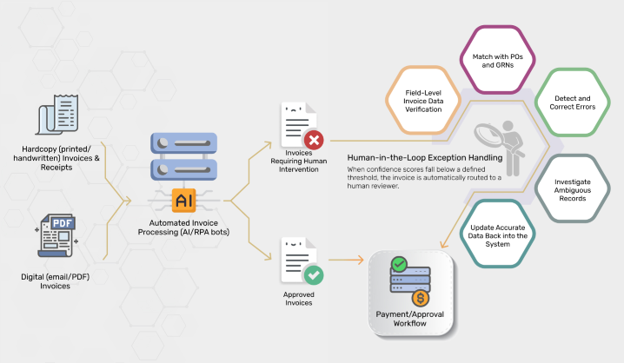
AP automation has transformed invoice intake, data extraction, and routing. Real-world healthcare AP, though, doesn’t run on uniform or predictable invoices. Automation breaks down at the same set of bottlenecks every time:
- Inconsistent vendor invoice formats. Layouts vary across thousands of suppliers. Individual vendors change their templates without notice.
- Non-PO and exception-heavy invoices. Utilities, service contracts, and recurring spend that bypass the standard PO model entirely.
- Poor scan quality or missing fields. Faxed or low-resolution paper invoices where OCR confidence drops below threshold.
- Contextual validation needs. A clinical-supply substitution or a contract carve-out that requires domain judgment before posting.
- Master data mismatches. Vendor records, GL codes, or pricing tables out of sync between the ERP and procurement systems.
- Compliance and audit risks. PHI-sensitive handling, override logging, and policy-interpretation calls that the platform routes to a reviewer.
The issue isn’t automation. The issue is exception handling at scale. The framework that organizes this work (confidence thresholds for what auto-posts, role-based queues for who reviews what, SLAs on resolution time, feedback loops back to the model) is what drives continued improvement as the deployment matures.
The Business Imperative: Building intelligent invoice processing in-house demands depth across the stack — OCR model training, exception workflow design, ERP integration, HIPAA-aligned audit infrastructure, and a reviewer roster sized for exception volume. Few finance organizations carry that bench as a permanent capability, and most don’t try.
At thousands of invoices a month against thousands of vendors, the gap compounds fast. Inconsistent capture becomes duplicate-payment exposure. Slow exception resolution becomes missed discount windows. Fragmented audit trails turn cost-report defense from a multi-hour task into a multi-week one.
Invoice processing services offers infrastructure tuned to healthcare AP formats, reviewer teams fluent in payer rules and clinical-supply coding, cost structures that scale with volume rather than headcount, and surge capacity that holds SLA through end-of-month, end-of-quarter, and audit-cycle peaks.
About Author

Brown Walsh is a content analyst, currently associated with SunTec India– a leading multi-process IT outsourcing company. Over a ten-year-long career, Walsh has contributed to the success of startups, SMEs, and enterprises by creating informative and rich content around data-specific topics, like data annotation, data processing, data mining and B2B data enrichment. Walsh also likes keeping up with the latest advancements and market trends and sharing the same with his readers.
Did you find this helpful? Check out our other helpful articles on our website.
Read Also
- Patient Engagement and Pharmaceutical Support Services: Building a Better Patient Journey
 Patients rarely experience healthcare as a simple, linear process. They may need to understand a diagnosis, determine whether they qualify for a clinical trial, gather medical records, navigate insurance requirements, arrange transportation, learn how to use a medication, and stay engaged with treatment for months or years. Serva Health is one example of a specialist… Read more: Patient Engagement and Pharmaceutical Support Services: Building a Better Patient Journey
 - Why Biotech Is Entering Its Most Exciting DecadeBiotech has always been an industry built on possibility. Every year brings discoveries, new technologies, and fresh optimism about what medicine might achieve next. What’s different today is that several of those advances are beginning to happen at once. Artificial intelligence is helping researchers analyse enormous amounts of data. Cell therapies are opening new ways… Read more: Why Biotech Is Entering Its Most Exciting Decade
- The Evolution of Patient Engagement: How Pharmaceutical Support Services Are Transforming CareThe journey from receiving a complex diagnosis to successfully managing a chronic condition is rarely a straight line. For many patients, being prescribed a specialty medication or a breakthrough biologic is only the first step in a daunting process filled with administrative hurdles, financial anxiety, and clinical uncertainty. Pharmaceutical companies are increasingly realizing that simply… Read more: The Evolution of Patient Engagement: How Pharmaceutical Support Services Are Transforming Care
- How to Navigate Executive Recruitment in the Pharmaceutical SectorSuccessful leadership hiring in life sciences requires a clear and structured approach. Companies need leaders who can support growth, innovation, and operational strength. Competition for top talent is high and decisions need to be precise. The process also demands a strong understanding of both science and business needs. Many organizations struggle with finding the right… Read more: How to Navigate Executive Recruitment in the Pharmaceutical Sector
- Compounding Pharmacy: Personalized Medication SolutionsA compounding pharmacy plays a vital role in modern healthcare by providing customized medications tailored to the specific needs of individual patients. Unlike mass-produced drugs manufactured by pharmaceutical companies, compounded medications are prepared by licensed pharmacists who carefully combine, adjust, or modify ingredients to create a formulation that best suits a patient’s unique medical requirements.… Read more: Compounding Pharmacy: Personalized Medication Solutions
- The Function of a CRO for Clinical Trials: Structure, Responsibilities, and Operational ImpactClinical trials rely on organized systems that ensure scientific validity, participant protection, and regulatory compliance. As protocols become more intricate and studies expand across multiple regions, many sponsors collaborate with specialized partners to manage key operational and methodological tasks. A CRO for clinical trials provides this structured support, coordinating the activities required to move a study from… Read more: The Function of a CRO for Clinical Trials: Structure, Responsibilities, and Operational Impact