Hair loss treatment is no longer limited to choosing between medication and surgery. Modern hair restoration clinics offer several options, including medical treatment, platelet-based procedures, laser therapy, scalp treatments and hair transplantation.
Having more options can be helpful, but it can also make the decision confusing. A person with early thinning may assume that a hair transplant will provide the fastest answer, while someone with an advanced bald area may continue spending on non-surgical treatments that cannot create meaningful coverage.
A responsible clinic does not begin by recommending its most expensive treatment. It begins by identifying the type of hair loss, assessing the condition of the follicles and understanding what outcome is realistically possible.
The Fundamental Difference Between the Two Approaches
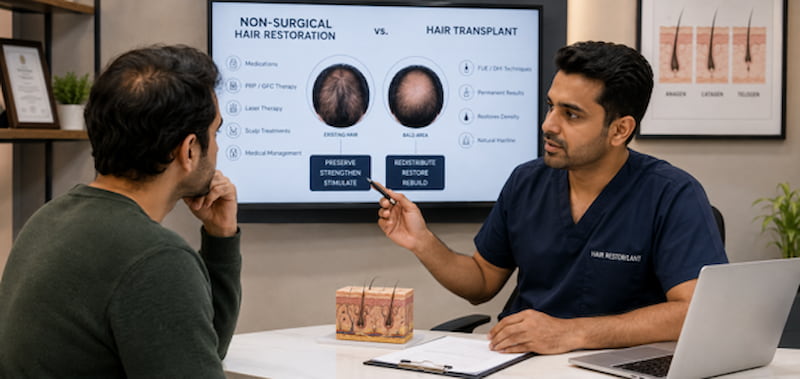
A hair transplant and a non-surgical hair restoration treatment serve different purposes.
A hair transplant redistributes existing hair follicles. Healthy follicles are extracted from a suitable donor area, usually the back or sides of the scalp, and implanted into areas affected by thinning or baldness.
Non-surgical treatments aim to protect, stimulate or strengthen follicles that are still present. Depending on the diagnosis, these may include prescription-based treatment, platelet-rich plasma therapy, growth factor concentrate therapy, low-level laser therapy, microneedling or other medically supervised procedures.
The important distinction is that non-surgical treatment works with existing follicles. A transplant can provide coverage in an area where the original follicles have become severely miniaturised or are no longer producing visible hair.
Neither approach is automatically better. The correct choice depends on what is happening beneath the visible hair loss.
Diagnosis Comes Before Treatment Selection
Clinics first need to determine why the patient is losing hair.
A receding hairline caused by androgenetic alopecia requires a different treatment strategy from diffuse shedding caused by stress, illness, nutritional deficiencies or hormonal changes. Patchy autoimmune hair loss and inflammatory scalp conditions also require separate medical evaluation.
This is why a transplant consultation should include more than a quick visual examination. A detailed assessment may involve:
- Reviewing the pattern and duration of hair loss
- Examining the scalp and follicle condition
- Assessing family history
- Reviewing medical conditions and medication use
- Checking the quality of the donor area
- Ordering blood investigations when clinically required
Without an accurate diagnosis, a clinic may recommend a procedure that addresses the appearance of hair loss without managing its underlying progression.
When Clinics Prefer Non-Surgical Hair Restoration
Non-surgical treatment is generally considered when the follicles are still active and there is a reasonable opportunity to preserve or improve the patient’s existing hair.
Early-stage pattern hair loss
A patient with mild thinning, a widening part or an early receding hairline may still have a large number of miniaturised follicles. These follicles may benefit from appropriate medical or regenerative treatment.
Starting with non-surgical care can help stabilise the condition and delay the need for surgery.
Diffuse hair shedding
When hair loss is spread across the scalp instead of being concentrated in a defined bald area, a transplant may not be the first choice. The clinic must investigate possible triggers such as illness, nutritional deficiency, hormonal imbalance, rapid weight change or prolonged stress.
Treating the trigger may be more appropriate than redistributing follicles.
Unstable or rapidly progressing hair loss
Performing a transplant while hair loss is actively progressing can create an uneven result later. The transplanted follicles may remain, while the untreated surrounding hair continues to thin.
Clinics may therefore recommend a period of medical management and monitoring before considering surgery.
Poor transplant candidacy
A patient may not have adequate donor density, may have unrealistic coverage expectations or may have a condition that makes transplantation unsuitable at that time.
In such situations, a clinic may discuss structured non-surgical hair loss treatments and explain which options are intended to control shedding, improve follicle activity or support scalp health.
When a Hair Transplant May Be More Appropriate
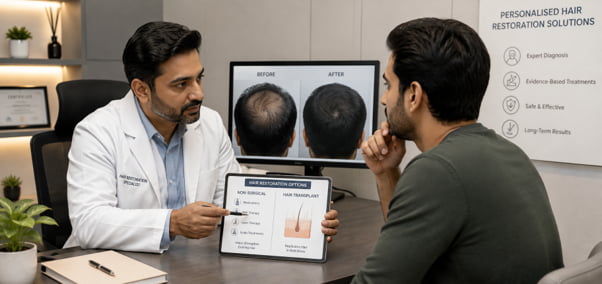
A transplant is more likely to be considered when hair loss has created a defined area that cannot be adequately restored through non-surgical treatment alone.
Established pattern baldness
Patients with a clearly receded hairline, bald temples or significant crown loss may have areas where the original follicles are no longer capable of producing meaningful visible growth.
Non-surgical treatment may help preserve the surrounding hair, but it cannot always rebuild a missing hairline or provide sufficient coverage over a bald area.
Stable hair-loss pattern
Clinics generally prefer to operate when the hair-loss pattern is reasonably predictable. Stability allows the surgeon to plan a hairline and graft distribution that should continue to look appropriate as the patient ages.
Adequate donor availability
A transplant can only use the patient’s available donor hair. The surgeon must assess donor density, hair calibre, follicular distribution and the number of grafts that can be safely extracted.
A large bald area does not automatically mean that a large transplant is possible. The treatment plan must balance the desired coverage with long-term donor preservation.
Realistic expectations
A transplant redistributes a limited number of follicles. It does not create an unlimited new supply of hair.
Patients with advanced hair loss may need to prioritise the frontal hairline and visible framing of the face instead of expecting equal density across the entire scalp. A good clinic explains these limitations before surgery.
The Patient’s Age Matters, but It Is Not the Only Factor
There is no single age at which every patient becomes suitable for a hair transplant.
A younger person with early and rapidly progressing hair loss may benefit from stabilisation before surgery. Creating a low or aggressive hairline too early could use valuable donor grafts and become difficult to maintain if further hair loss develops.
An older patient may have a more predictable pattern, but the clinic must still evaluate general health, donor quality and the extent of coverage required.
The decision should therefore be based on biological and clinical factors rather than age alone.
Why Clinics Sometimes Recommend Both
Hair transplantation and non-surgical treatment are not always competing choices. They may be used as parts of the same long-term strategy.
A clinic may recommend non-surgical treatment before surgery to:
- Stabilise ongoing hair loss
- Improve the condition of existing hair
- Manage scalp concerns
- Establish whether surgery is genuinely necessary
After a transplant, medically appropriate treatment may be used to protect the patient’s non-transplanted hair. Some clinics may also recommend selected supportive procedures as part of recovery or long-term maintenance.
The transplant provides coverage where follicles have been permanently affected, while ongoing treatment helps manage hair that remains vulnerable to future thinning.
How an Ethical Clinic Communicates the Decision
A responsible recommendation should answer four questions clearly:
- What type of hair loss does the patient have?
- Which follicles are still capable of responding to treatment?
- Is the donor area strong enough for safe transplantation?
- What can each proposed treatment realistically achieve?
A trustworthy clinic should also explain why an option is being recommended and why other options may be unsuitable.
For example, a patient should be told when surgery is premature, when non-surgical treatment is unlikely to restore a bald area and when donor limitations will restrict the final density.
When evaluating a doctor-led hair restoration clinic, patients should look for detailed scalp assessment, surgeon involvement, conservative donor planning, transparent expectations and a willingness to advise against surgery when it is not medically appropriate.
Warning Signs of Treatment-Led Rather Than Diagnosis-Led Care
Patients should be cautious when a clinic:
- Recommends surgery without examining the scalp or donor area
- Promises a fixed number of grafts before proper assessment
- Guarantees complete density regardless of the hair-loss stage
- Recommends the same non-surgical package to every patient
- Avoids discussing progressive loss of existing hair
- Does not identify who will perform the surgical steps
- Uses discounts to pressure the patient into making an immediate decision
Hair restoration is a medical process with long-term aesthetic consequences. The treatment should be selected according to the patient’s condition, not according to a standard sales package.
Questions Patients Should Ask During Consultation
Before agreeing to either approach, patients can ask:
- What is the diagnosed cause of my hair loss?
- Is my hair loss currently stable?
- Are the follicles in the thinning area still active?
- Can non-surgical treatment provide visible improvement in my case?
- What happens if I postpone surgery?
- How many grafts can be safely extracted from my donor area?
- Will I need treatment to protect my existing hair?
- Who will design the hairline and perform the procedure?
- What outcome is realistic after six, twelve and eighteen months?
Clear answers to these questions can help patients distinguish clinical planning from promotional promises.
Conclusion
The decision between a hair transplant and non-surgical hair restoration should not be made from photographs, advertisements or treatment prices alone.
Non-surgical treatment is generally more relevant when follicles are still active, hair loss is at an early stage or the underlying condition needs to be stabilised. A hair transplant becomes more relevant when permanent patterned hair loss has created an area that cannot be sufficiently restored through non-surgical methods and the patient has an adequate donor supply.
In many cases, the best strategy combines preservation of existing hair with carefully planned surgical restoration.
The most important factor is not choosing surgery or avoiding it. It is receiving an accurate diagnosis and a treatment plan that protects both the patient’s current hair and their future options.
This article is intended for general educational purposes and does not replace an examination or personalised advice from a qualified dermatologist or hair-transplant surgeon.
Did this article help you? Check out the rest of our site for more!
Read Also
- Full-Arch Dental Tourism: Why UK Patients With Severe Bone Loss Are Looking Abroad
 Dental implants have become one of the fastest-growing segments of private dentistry. Within that market, one patient group behaves very differently from the rest: people who have been told they do not have enough upper jawbone for conventional implants. For these patients, the choice is rarely between one clinic and another. It is between a… Read more: Full-Arch Dental Tourism: Why UK Patients With Severe Bone Loss Are Looking Abroad
 - Levels of Mental Health Care and When to Seek SupportMental health care can range from occasional outpatient appointments to 24-hour hospital treatment. The appropriate level depends on safety, symptom severity, daily functioning, medical needs, available support, treatment history and personal preferences. A licensed clinician should assess these factors rather than relying on a symptom list alone. Need help now? In the United States, call… Read more: Levels of Mental Health Care and When to Seek Support
- How to Choose a Shilajit Brand Based on the ResearchIn a randomized trial published in the Journal of the International Society of Sports Nutrition in 2019, 63 active men took 250 mg of standardized shilajit, 500 mg, or a placebo every day for eight weeks, and the benefit for strength retention after a fatiguing workout appeared only at 500 mg. For anyone choosing a… Read more: How to Choose a Shilajit Brand Based on the Research
- How to Incorporate Relaxation into Your Busy ScheduleFinding balance when you have a packed daily agenda often feels out of reach. Between work duties, family obligations, and personal projects, personal rest usually gets pushed to the bottom of the list. Small, intentional shifts in daily habits can help restore calm without requiring hours of extra free time. Continue reading to discover everything… Read more: How to Incorporate Relaxation into Your Busy Schedule
- Red Light Therapy for Skin and Wellness: Meet Vital Red Light TherapyModern wellness is not always about complicated treatments or long routines. Many people are now looking for simple, convenient ways to support their skin, recovery, and overall wellness at home. One technology getting more attention is red light therapy. Red light therapy uses specific wavelengths of red and near-infrared light to support the body’s natural… Read more: Red Light Therapy for Skin and Wellness: Meet Vital Red Light Therapy
- Managing Shock Loss After a Hair Transplant: The Financial and Clinical Imperative of Post-Op CareIn the rapidly evolving landscape of private healthcare, executive leadership within cosmetic and restorative surgery clinics faces a dual challenge: maintaining strict clinical standards while maximizing patient lifetime value (LTV) and brand advocacy. As the global medical tourism and elective procedure markets expand, clinical outcome quality alone is no longer the sole differentiator for premium… Read more: Managing Shock Loss After a Hair Transplant: The Financial and Clinical Imperative of Post-Op Care
- Transform Your Skin Health: Premier Gluta IV Therapy in DubaiThis comprehensive guide explores how modern intravenous wellness treatments can help revitalize your complexion, boost immune function, and support overall cellular health. By incorporating modern IV therapy Dubai services into a routine health regimen, individuals can achieve direct nutrient absorption for optimal results. Selecting a customized gluta IV drip Dubai treatment provides targeted antioxidant defense,… Read more: Transform Your Skin Health: Premier Gluta IV Therapy in Dubai
- The Evolution of Dental Prosthetics: Innovation in Oral HealthDental replacements have improved a lot over time. Smiling, chewing, and speaking depend on having healthy teeth. When teeth break or go missing, today’s options can restore both function and confidence. Modern techniques make these replacements feel and look completely natural. Ancient Roots Of Tooth Replacement People have tried to replace lost teeth for thousands… Read more: The Evolution of Dental Prosthetics: Innovation in Oral Health