


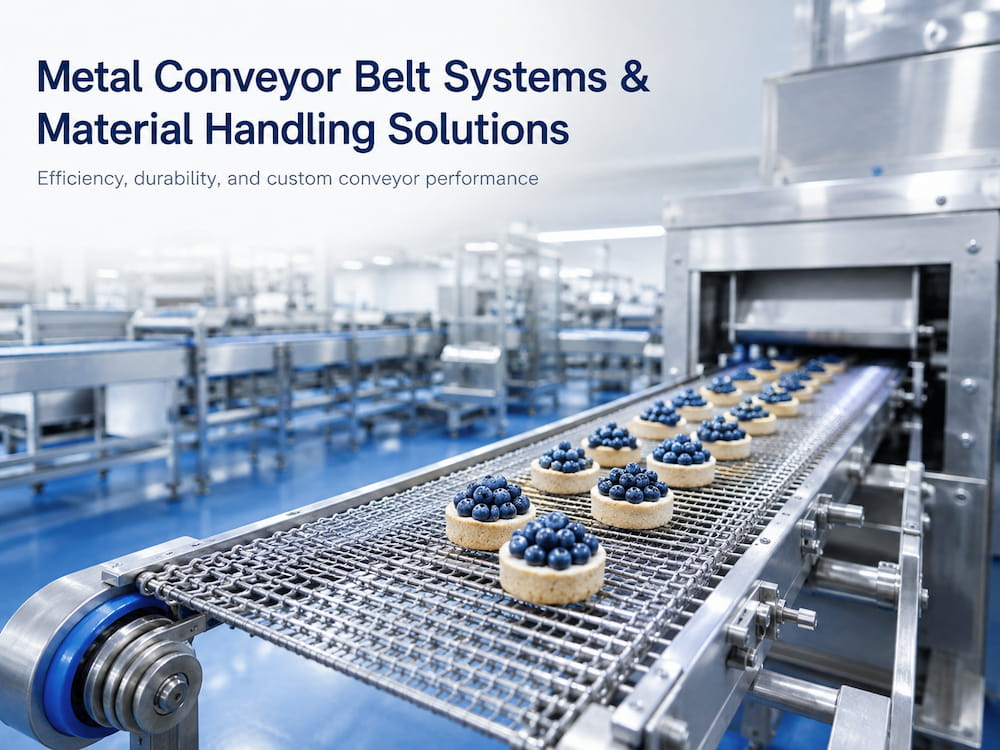
A conveyor belt can look like one of the simplest pieces of equipment on a production floor, yet a poorly matched belt can create problems across an entire line. Product jams, inconsistent spacing, difficult sanitation, premature belt failure, and repeated maintenance stops can all trace back to how a conveyor system was selected and configured. Wire Belt Company is an example of a specialist working with manufacturers to address these issues through custom wire mesh conveyor solutions. The company designs and manufactures specialized metal conveyor belts and supports their installation and setup for food processing and industrial applications, with systems tailored to factors such as product size, temperature, sanitation requirements, load, and line configuration. Beyond supplying belts, Wire Belt provides technical support, facility belt surveys, belt-joining and maintenance training, troubleshooting guidance, and specialized maintenance tools. The goal is practical: help businesses keep products moving, reduce avoidable downtime, extend equipment life, and get more consistent performance from their material handling systems.
For production managers, engineers, and maintenance teams, that last point matters. A conveyor system is rarely valuable because of the belt alone. Its real value comes from how reliably it moves a particular product through a particular process.
A bakery cooling line, for example, has very different requirements from a metal-parts washer. A frozen-food operation may need excellent airflow and resistance to moisture. An industrial heat-treatment process may need a belt that tolerates sustained high temperatures. A packaging line may care most about keeping small products aligned as they transfer between machines.
Choosing the right metal conveyor belt system therefore requires looking beyond belt width and speed. The application, product, environment, maintenance strategy, sanitation needs, and surrounding machinery all matter.
What Is a Metal Conveyor Belt System?
A metal conveyor belt system uses a belt manufactured from metal wire, links, rods, mesh, or other interconnected metallic components to transport products through a processing or material handling operation.
Stainless steel is common because it combines mechanical strength with resistance to corrosion, moisture, temperature changes, and repeated cleaning. Different belt constructions can create very different conveying characteristics.
Metal belts may have:
- Large open areas for airflow or drainage
- Closely spaced mesh for small products
- Raised flights for incline conveying
- Side guards for product containment
- Smooth surfaces for delicate products
- Heavy-duty structures for substantial loads
- Flexible designs for curves and turns
- Positive-drive configurations for accurate tracking
- Specialized edges designed to reduce snagging
This flexibility is one reason metal conveyor belts appear in industries ranging from food manufacturing and baking to electronics, automotive production, packaging, pharmaceuticals, and industrial processing. Wire Belt, for example, offers stainless steel, wire mesh, modular metal, and custom belt configurations intended for different operating conditions.
The belt, however, is only part of the system. Sprockets, rollers, support rails, motors, drives, tensioning arrangements, transfers, frames, guarding, sensors, and controls all influence performance.
A good belt installed on a poorly configured conveyor can still fail prematurely.
Why Material Handling Deserves More Attention
Conveyors sit between processes. That makes them easy to overlook.
A fryer may receive extensive engineering attention because it directly cooks the product. A packaging machine may be closely monitored because it controls the finished pack. The conveyor connecting those two machines can seem secondary.
Until it stops.
When a conveyor fails, upstream production may have nowhere to send product while downstream equipment sits idle. In food processing, a belt problem can also complicate product temperature control, cleaning schedules, and production timing.
This is why conveyor performance should be viewed as part of overall process reliability rather than simply a maintenance expense.
The right material handling solution can influence:
- Line throughput
- Product orientation
- Cooling and heating efficiency
- Drainage
- Coating consistency
- Product damage
- Sanitation time
- Labor requirements
- Changeover time
- Equipment availability
- Maintenance workload
Even small improvements can matter when a conveyor runs for multiple shifts every day.
Where Metal Conveyor Belts Are Used
Metal conveyor belts are particularly useful when a conventional rubber or plastic belt is not well suited to the process.
Food Processing
Food manufacturers use metal belts for applications such as baking, frying, cooling, freezing, breading, battering, washing, drying, enrobing, cooking, and packaging.
Open-mesh construction can allow air, water, oil, steam, or coatings to pass through the belt rather than remaining trapped on the conveying surface.
That can be useful in a cooling tunnel, where airflow must reach multiple sides of a product, or in a fryer, where hot oil needs to circulate efficiently.
Stainless steel also fits environments where frequent sanitation is required. The FDA’s guidance on Current Good Manufacturing Practices for food emphasizes appropriate plant and equipment design, maintenance, sanitary operations, and process controls as part of safe food production.
That does not mean that a stainless steel belt automatically makes a conveyor hygienic. The entire system must be designed so it can be accessed, cleaned, inspected, and maintained appropriately.
High-Temperature Processing
Metal belts can be advantageous when products move through ovens, dryers, heat-treatment equipment, or other high-temperature processes.
The specific alloy and belt design must still be matched to the operating temperature. Repeated thermal cycling can affect components differently, and high heat may influence belt expansion, tracking, lubrication requirements, and surrounding conveyor hardware.
Freezing and Cooling
Cold environments introduce another set of problems. Moisture, condensation, ice buildup, contraction, and frequent washdowns can be challenging for conveyor equipment.
Open metal mesh may help airflow move around a product more effectively in a freezer or cooler while also providing drainage during cleaning.
Industrial Manufacturing
Metal belts are also used to transport components through washing, coating, drying, curing, assembly, inspection, and packaging operations.
Depending on the application, the belt may need to resist oils, chemicals, abrasion, high loads, sharp components, or repeated heating and cooling.
Packaging and Small-Product Handling
Small or irregularly shaped products can become unstable during transfers between conveyors.
A belt with the right opening size, pitch, support structure, and transfer arrangement can help maintain product orientation and reduce the chance of items tipping, falling, or becoming trapped between machines.
Wire Mesh Conveyor Belts and Airflow
One of the most recognizable characteristics of a wire mesh conveyor is its open structure.
That open area can be extremely useful when the process depends on airflow or liquid movement.
Imagine freshly baked products entering a cooling section. A solid belt blocks much of the airflow from below. An open wire belt allows air to circulate around the product, helping the cooling process operate more efficiently.
The same idea applies to:
- Freezing
- Drying
- Frying
- Washing
- Coating
- Breading
- Glazing
- Draining
Wire Belt’s Versa-Link system, for example, is designed with high open area and is used in applications such as cooling, cooking, coating, baking, and protein processing.
Open area alone is not enough to select a belt, though. Increasing the opening size may improve airflow but provide less support for small or delicate products.
The design has to balance process flow with product support.
Custom Conveyor Belts for Difficult Products
Off-the-shelf belts work well for many applications, but difficult products often require customization.
Consider a line handling small components that must remain in evenly spaced rows. A conventional flat belt may allow products to drift sideways.
Another process might carry packaged goods up a steep incline. Without sufficient control, products can slide backward.
Custom belt features can help solve problems like these.
Possible modifications include:
- Flights
- Side guards
- Lane separators
- Different mesh openings
- Custom belt widths
- Specialized edges
- Product-support sections
- Unique rod or link arrangements
- Curved conveying configurations
Wire Belt’s specialty belts, for instance, can be designed for applications requiring steep inclines or declines, product separation, minimal contact points, or products that need to remain aligned in rows.
A custom solution should begin with the process problem, not with the belt catalog.
The supplier needs to understand what is happening to the product before, during, and after it reaches the conveyor.
Why Conveyor Transfers Cause So Many Problems
Many conveyor problems do not occur in the middle of a belt. They happen where one conveyor transfers a product to another machine.
The gap may be slightly too large. The receiving belt may run at a different speed. The product may rotate unexpectedly. A small item may drop into the transfer point.
These problems become more noticeable when products are:
- Small
- Soft
- Round
- Fragile
- Irregularly shaped
- Closely spaced
Transfer design should therefore be considered early rather than corrected after installation.
Engineers may adjust nose bars, roller diameters, belt geometry, speed relationships, support structures, or product guides to create a more controlled transition.
A conveyor that handles the product perfectly for 20 feet but drops it during the final six inches has not solved the material handling problem.
Conveyor Design for Food Safety and Sanitation
In food manufacturing, uptime and sanitation sometimes appear to be competing objectives.
Production wants equipment running. Sanitation needs access to clean it thoroughly.
A good conveyor design supports both.
Equipment should be arranged so food residue, moisture, and cleaning chemicals do not become trapped in difficult-to-access areas. Components should be accessible for inspection, and the belt itself should match the cleaning method used by the facility.
The FDA has discussed hygienic equipment principles that include cleanability, compatible construction materials, accessibility for inspection and maintenance, and avoidance of areas that collect product or liquids.
For a conveyor, practical design considerations may include:
- Belt openness
- Frame geometry
- Drainage
- Accessibility beneath the belt
- Ease of belt removal
- Sprocket accessibility
- Cleanable support rails
- Reduced product-trapping points
- Resistance to cleaning chemicals
- Ability to tolerate washdown temperatures
Maintenance practices matter as well. A damaged belt or worn conveyor component may create areas where debris accumulates or where the belt no longer tracks as intended.
Machine Guarding and Conveyor Safety
Conveyor reliability cannot be separated from worker safety.
Moving belts, sprockets, chains, rollers, shafts, and transfer points may create pinch, crush, entanglement, and nip-point hazards.
OSHA’s machine guarding requirements state that guarding methods should protect workers from hazards including ingoing nip points, rotating parts, and other moving machinery.
That principle is particularly relevant around conveyor drives and locations where employees may work close to moving equipment.
Facilities should evaluate:
- Drive sprockets
- Rollers
- Chains
- Shafts
- Transfer points
- Elevated conveyors
- Loading and unloading areas
- Maintenance access points
- Emergency stop devices
- Startup warning procedures
The exact requirements depend on the workplace and equipment involved, so facility-specific safety reviews remain important.
Operators should also be trained not to clear jams, reach into moving equipment, or perform maintenance without following the facility’s energy-control procedures.
Maintenance Is More Than Fixing Broken Belts
A conveyor maintenance program should not begin when a belt breaks.
By that point, production has already lost time.
Preventive maintenance looks for changes while the equipment is still operating. Maintenance staff may notice that the belt is beginning to track differently, a sprocket is wearing unevenly, tension has changed, or a belt joint no longer looks correct.
A useful routine can include checking:
- Belt tracking
- Belt tension
- Sprocket condition
- Roller alignment
- Drive components
- Belt edges
- Belt joints
- Product buildup
- Broken or distorted wires
- Transfer clearances
- Support rails
- Bearings
- Guards and emergency stops
The objective is not to replace parts unnecessarily. It is to identify predictable deterioration before it becomes an emergency.
Wire Belt’s own maintenance guidance recommends routine inspection, cleaning, documentation, worker training, and reviewing performance trends so maintenance teams can anticipate problems rather than simply respond after failure.
Belt Surveys Can Simplify Spare-Part Management
Large factories may operate dozens or even hundreds of conveyors.
That creates an inventory problem.
A facility may have several wire belts that appear almost identical while differing in width, pitch, wire diameter, edge design, or other specifications. If maintenance staff cannot quickly identify the correct replacement, downtime becomes longer.
A belt survey can solve this basic but expensive problem.
Wire Belt offers facility surveys in which technical personnel identify installed belts and create a reference showing which belt is fitted to each conveyor. That gives maintenance teams a clearer way to determine what replacement is required when a problem occurs.
This kind of documentation also helps facilities plan spare inventory.
Instead of discovering during a breakdown that the required belt is not in stock, the maintenance department can identify production-critical conveyors and keep appropriate replacement material available.
Training Improves Belt Life
Conveyor belts are sometimes damaged during maintenance rather than during production.
A technician may install a belt in the wrong orientation, join it incorrectly, use improper sprocket positioning, or apply too much tension.
These mistakes may not create immediate failure. The belt might run for hours or days before the damage becomes visible.
That makes training valuable.
Wire Belt provides on-site belt joining and maintenance training intended to help personnel understand belt setup, identification, joining, and troubleshooting.
The benefits extend beyond a single repair.
When maintenance employees understand why a belt failed, they become more capable of identifying warning signs throughout the plant.
Useful training subjects may include:
- Correct belt installation
- Splicing and joining methods
- Sprocket placement
- Belt orientation
- Tensioning
- Tracking
- Troubleshooting
- Safe maintenance procedures
- Identifying wear patterns
Standardizing these practices also reduces dependence on one highly experienced technician who may not always be available.
Maintenance Tools and Faster Repairs
Good tools do not eliminate the need for training, but they can make maintenance faster and more consistent.
Wire Belt offers specialized tools for removing, repairing, and installing metal conveyor belts, including equipment intended for straightening and cutting wire during belt maintenance.
The value of specialized tools becomes obvious during an unexpected shutdown.
A maintenance technician who has the right tool and knows the correct repair method can often restore the line much faster than someone improvising with whatever happens to be in the toolbox.
Facilities should consider keeping belt-specific repair equipment close to critical production areas, along with documented belt specifications and spare material.
Understanding Conveyor Downtime
Not all downtime is caused by catastrophic belt failure.
A line may stop repeatedly for short periods because:
- Products jam at a transfer
- The belt drifts sideways
- Sprockets do not engage correctly
- Product buildup interferes with tracking
- A repair joint repeatedly fails
- A belt was installed incorrectly
- Excessive tension damages the wire
- Components are misaligned
These short interruptions can be easy to accept as normal.
They should not be.
Recording downtime by reason can reveal patterns that individual operators may not notice. If the same conveyor stops for five minutes several times per shift, the cumulative loss can be significant.
Maintenance teams should document:
- Which conveyor stopped
- How long it stopped
- What caused the interruption
- Which repair was made
- Whether the failure has happened before
Over time, this creates evidence for deciding whether a belt, transfer, drive arrangement, or maintenance procedure should be redesigned.
How Metal Belts Can Support Longer Equipment Life
A conveyor belt does not operate independently of its drive components.
Poor engagement can damage sprockets. Misaligned sprockets can damage the belt. Excessive tension can increase stress on shafts and bearings.
This is why replacing a failed belt without investigating the cause can lead to repeated failures.
When a belt shows premature wear, maintenance teams should ask:
- Is the correct belt installed?
- Is it running in the correct direction?
- Are sprockets properly positioned?
- Is tension appropriate?
- Are shafts aligned?
- Are transfers creating excessive bending?
- Has the product load changed?
- Are components damaged?
- Has cleaning affected the drive system?
- Was the belt joined correctly?
Wire Belt’s technical guidance identifies issues such as excessive tension, incorrect sprockets, improper installation, unsuitable bend radii, accidents, and poor belt joining as potential contributors to downtime and belt damage.
Solving the root cause generally provides more value than simply increasing spare-belt inventory.
Choosing the Right Metal Conveyor Belt
There is no universally best conveyor belt.
The right design is the one that works for the product and process.
Before selecting a belt, gather basic application information.
Product Characteristics
Consider:
- Product dimensions
- Weight
- Shape
- Surface texture
- Fragility
- Temperature
- Whether the product is wet, dry, oily, or sticky
A soft bakery product has different support requirements from a steel component.
Operating Temperature
Determine both normal temperature and extremes.
A belt used in an oven may require different materials and expansion allowances from one used in a freezer.
Process Requirements
Ask what must pass through the belt.
Does the process need airflow, oil circulation, water drainage, coating penetration, or debris removal?
This can affect the amount of open area required.
Sanitation
Determine how frequently the conveyor will be cleaned and which chemicals, water pressures, and temperatures are used.
Load
Look beyond total weight. A heavy load spread evenly across a wide belt may behave differently from a concentrated load placed in one small area.
Speed
High-speed conveying can amplify tracking, transfer, and product-orientation problems.
Product Orientation
Some products can move randomly. Others need to remain in specific rows or positions for downstream equipment.
Space
The conveyor may need to fit between existing machines, climb an incline, descend, or turn through limited floor space.
When to Consider a Custom Conveyor Solution
Customization may be worthwhile when a facility is repeatedly adapting its process to accommodate the conveyor.
That is usually backwards.
The conveyor should support the process.
Signs that a custom solution may be justified include:
- Frequent product jams
- Product damage
- Persistent tracking issues
- Excessive cleaning time
- Poor airflow
- Products slipping on inclines
- Difficult conveyor-to-conveyor transfers
- Frequent belt replacement
- Problems maintaining product spacing
- New products being added to an existing line
- Throughput increases beyond the original conveyor design
The cost of customization should be compared with the ongoing cost of operating around the problem.
If employees stop the line every hour to reposition products manually, the inexpensive conveyor may not actually be inexpensive.
Questions to Ask a Conveyor Belt Supplier
Before choosing a metal conveyor belt or material handling partner, ask practical questions.
What experience do you have with our product and process?
Relevant application experience can shorten troubleshooting and design time.
Can the belt be customized?
Ask about width, mesh opening, material, flights, side guards, edges, and product-handling features.
Can you review the existing conveyor?
The problem may be related to sprockets, transfers, tension, or support geometry rather than the belt itself.
What installation support is available?
Request setup guidance, joining instructions, and technical assistance.
Do you provide training?
Training may reduce repeat failures and help internal teams make repairs correctly.
Can you perform a belt survey?
This can be especially useful for facilities with many conveyors.
What maintenance tools should we keep onsite?
Ask which tools and spare parts are appropriate for the belt.
How easy is the belt to repair?
A production belt should not become a major maintenance project every time a small section is damaged.
How should the belt be cleaned?
Food processors should evaluate cleaning access and sanitation requirements before installation.
Building a More Reliable Material Handling Strategy
Improving conveyor performance does not necessarily require replacing every conveyor in a plant.
Start with the lines causing the most disruption.
Track breakdown frequency, maintenance hours, lost production time, belt replacement cost, sanitation time, and product damage.
Then inspect the entire conveyor system rather than focusing only on the belt.
A practical improvement program might involve:
- Correcting sprocket alignment
- Changing belt construction
- Redesigning a transfer
- Updating cleaning procedures
- Training maintenance personnel
- Stocking the correct replacement belt
- Creating standardized inspection schedules
- Purchasing dedicated belt-maintenance tools
- Documenting each conveyor’s belt specifications
The best result is usually not a conveyor that never needs maintenance. Every mechanical system requires attention.
The objective is predictable maintenance instead of emergency maintenance.
Frequently Asked Questions
What is a wire mesh conveyor belt?
A wire mesh conveyor belt is made from interconnected metal wires or links that create an open conveying surface. The open structure makes these belts useful where airflow, drainage, heating, cooling, or cleaning access is important.
Are metal conveyor belts suitable for food processing?
Yes. Stainless steel metal belts are widely used in food processing applications such as baking, frying, cooling, freezing, coating, and washing. The entire conveyor must still be designed, operated, and maintained according to the facility’s sanitation and food safety requirements.
How long does a metal conveyor belt last?
There is no single lifespan. Belt life depends on the design, load, operating temperature, speed, cleaning environment, installation, tension, drive setup, maintenance, and product being conveyed.
What causes conveyor belts to fail early?
Common causes include improper tension, incorrect sprocket placement, poor belt joining, misalignment, unsuitable bend radii, product buildup, accidental damage, and using a belt that is not appropriate for the application.
Can a wire conveyor belt be customized?
Yes. Metal conveyor belts can be manufactured in different widths, pitches, opening sizes, materials, and edge configurations. Features such as flights and other product-control elements can also be added for specialized handling.
How can businesses reduce conveyor downtime?
Preventive inspection, correct installation, maintenance training, accurate spare-belt identification, proper tools, cleaning, and investigating the root causes of repeated failures can all help reduce unplanned downtime.
Why are belt surveys useful?
A belt survey identifies which belt is installed on each conveyor. For plants with many production lines, that information helps maintenance teams order the correct replacements and maintain appropriate spare inventory.
Conclusion
Metal conveyor belt systems may occupy only a small part of the production floor, but they can have an outsized effect on throughput, sanitation, product quality, labor, and equipment availability.
The strongest material handling solutions begin with the application rather than the belt.
Food type, temperature, product size, airflow, cleaning requirements, load, transfers, operating speed, and downstream equipment should all influence the final design. In demanding applications, a custom metal or wire mesh conveyor can solve problems that a generic belt simply moves from one part of the line to another.
Just as important, conveyor performance depends on what happens after installation. Proper setup, routine inspection, maintenance training, belt surveys, troubleshooting, and the right repair tools can extend service life and reduce the disruption associated with emergency breakdowns.
For manufacturers, the goal should not be to find a conveyor belt that merely moves a product from point A to point B. It should be to build a material handling system that fits the process, protects the product, can be maintained safely, and continues doing its job with as little unnecessary downtime as possible.
