


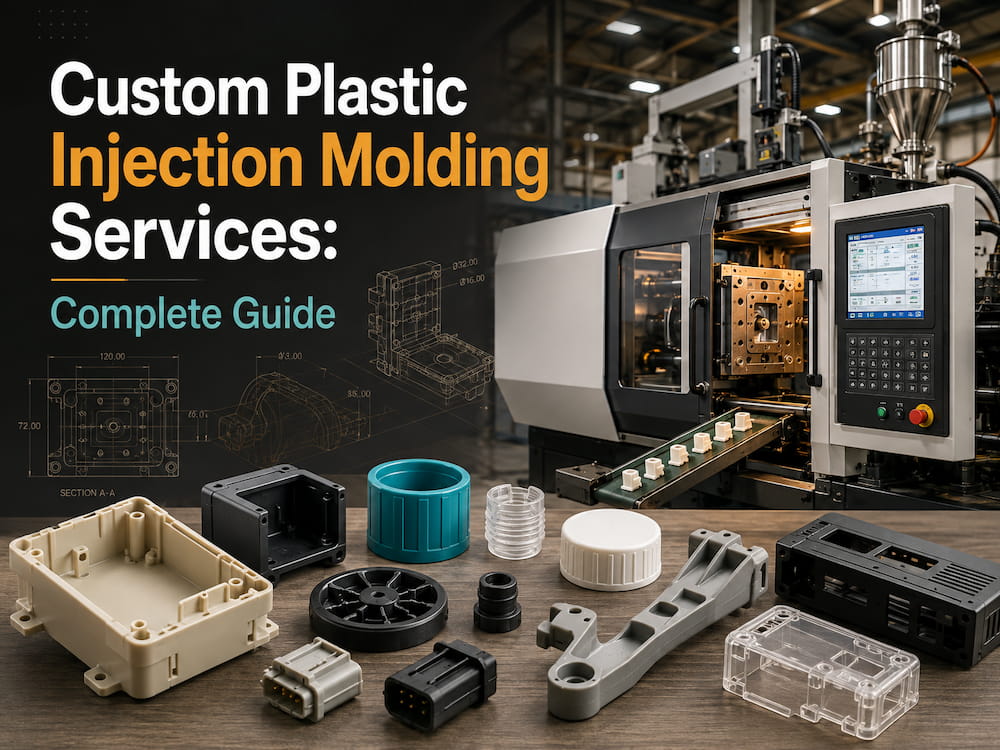
Custom plastic injection molding is rarely just about filling a mold with molten plastic. For manufacturers working in medical technology, aerospace, electronics, and other demanding industries, the real challenge is creating a part that performs exactly as intended thousands—or millions—of times. Plastic Molded Concepts (PMC) is a good example of this engineering-focused approach. The ISO 9001:2015-certified company brings 50 years of experience to high-precision injection molding, overmolding, and insert molding, serving industries including aerospace, medical, electronics, automation, and defense. Its work extends well beyond production: PMC supports mold design, prototype development, material selection—including applications involving eva resin and other engineered polymers—forensic failure analysis, and secondary operations. By combining these services, the company helps manufacturers produce plastic components that are accurate, durable, repeatable, and suited to demanding real-world environments.
That broader approach matters because a molded component can look perfectly acceptable and still fail in service. A housing can warp just enough to interfere with assembly. A connector can crack after repeated temperature changes. An incorrectly chosen resin can become brittle when exposed to chemicals that were never considered during design.
Successful injection molding therefore begins long before the molding machine starts running.
What Are Custom Plastic Injection Molding Services?
Plastic injection molding is a manufacturing process in which thermoplastic resin is heated until it flows, injected into a carefully designed mold, cooled, and then released as a finished component.
The word custom is important.
Instead of manufacturing a standard catalog product, a custom injection molder develops a process around the client’s particular design, material requirements, tolerances, operating conditions, production volume, and quality expectations.
A project might involve a simple enclosure produced in large quantities, but it could just as easily involve a tight-tolerance medical component containing a metal insert or an aerospace part manufactured from a high-temperature engineering polymer.
The fundamental process is the same. The engineering behind it is not.
PMC describes its own approach as scientific injection molding, using process data to control variables such as material temperature, filling behavior, cooling, and other factors that influence the finished component.
Why Precision Starts Before Production
One of the biggest misconceptions about injection molding is that dimensional accuracy depends mainly on the mold.
The mold is certainly critical, but polymers do not behave like machined metal. They expand, contract, flow, cool, and shrink differently depending on the resin and processing conditions.
Consider a plastic electronic housing with several mounting points. If one wall is substantially thicker than another, the thicker area may cool more slowly. That uneven cooling can create internal stress or warpage, leaving screw holes slightly out of position even though the mold itself was manufactured accurately.
This is why experienced molders review the design before tooling is finalized.
Design-for-manufacturability discussions commonly consider wall thickness, ribs, bosses, draft angles, gate locations, parting lines, ejector locations, expected shrinkage, and how the plastic will flow through the cavity.
PMC notes that mold-gate design can contribute to excessive molded-in stress and that identifying these issues early can help prevent durability and quality problems later.
A small design change made before tooling exists may cost very little. The same change after a production mold has been built can become expensive.
Mold Design Is Where Manufacturing Strategy Begins
A good mold does more than reproduce the shape shown in a CAD file.
It must fill consistently, allow gases to escape, cool the component evenly, release the finished part without damage, and continue doing these things through repeated production cycles.
Depending on the component, tooling may include multiple cavities, cooling circuits, slides, lifters, inserts, ejector pins, runners, gates, sensors, and hot-runner components.
The correct tooling strategy also depends on production volume.
A company developing a new product may initially need only hundreds or a few thousand pieces. Building expensive long-life tooling before the design has been validated could tie up unnecessary capital.
For another program expected to produce millions of units, investing in robust multi-cavity tooling and automation may make economic sense from the beginning.
Experienced molding companies help customers make these decisions based on the complete manufacturing program rather than the first purchase order.
Material Selection Can Determine Whether a Part Succeeds or Fails
Choosing a resin because it is strong or inexpensive is not enough.
Plastic components may need to withstand heat, cold, ultraviolet exposure, chemicals, impact, repeated flexing, electrical loads, moisture, sterilization, or mechanical stress.
A designer must also consider how easily the material can be molded.
For example, EVA—ethylene vinyl acetate—is valued for characteristics including flexibility, low-temperature toughness, water resistance, UV resistance, and resistance to stress cracking. Those properties can make certain EVA formulations useful in applications where a softer, more flexible polymer is preferred. PMC also notes that EVA can be processed through injection molding, overmolding, insert molding, welding, and other post-molding operations.
Other projects may require materials such as ABS, polycarbonate, PEEK, PPS, acetal, TPE, or specialized glass-filled formulations.
The important question is not, “Which plastic is best?”
It is, “Which plastic is best for this part, in this environment, using this manufacturing process?”
PMC specializes in engineering-grade resins and works across a broad range of polymer families, including materials designed for demanding mechanical, electrical, chemical, and temperature requirements.
Prototype Development Reduces Expensive Surprises
Going directly from a CAD model to expensive production tooling can be risky.
A prototype gives engineers a chance to discover problems while changes are still relatively inexpensive.
The team may find that a snap-fit feature is too stiff, a grip feels uncomfortable, an assembly cannot be accessed easily, or two components interfere when they are brought together.
Depending on the project, prototypes may be created through 3D printing, CNC machining, low-cost developmental tooling, or prototype injection molds.
Not every prototype serves the same purpose.
A 3D-printed model can be excellent for checking geometry and ergonomics. It may be far less useful for predicting the mechanical performance of the final injection-molded resin.
Prototype injection molding can provide information that is closer to production reality, including how the selected material fills, shrinks, cools, and behaves after molding.
PMC emphasizes prototype development as a way to evaluate fit and function and identify design problems before committing to production tooling.
High-Precision Injection Molding for Critical Industries
Precision takes on a different meaning when a component is used in a medical device, aircraft system, or electronic assembly.
A fraction of a millimeter can influence sealing, alignment, electrical connection, fluid flow, or assembly.
High-precision molding requires control over the entire process—not simply tighter dimensions in the mold.
Material moisture, temperature, injection pressure, fill speed, holding pressure, mold temperature, cooling time, and fiber orientation can all influence the finished dimensions.
Quality systems become particularly important in this environment.
PMC operates an ISO 9001:2015-certified quality management system with traceability capabilities. The International Organization for Standardization explains that ISO 9001 quality management systems establish requirements for organizations to implement, maintain, and continually improve processes that support consistent quality.
Certification alone does not guarantee that every component will be flawless. It does, however, provide a structured framework for managing processes, documentation, corrective actions, customer requirements, and continual improvement.
Medical Injection Molding Requires Additional Considerations
Medical manufacturing illustrates why “plastic is plastic” is a dangerous assumption.
A medical component may have to tolerate disinfectants, sterilization processes, bodily fluids, repeated use, or extremely tight dimensional requirements. Some materials may also need to satisfy biocompatibility requirements depending on their intended use.
PMC provides molding for components incorporated into end-use medical devices and complex assemblies and highlights factors such as chemical resistance, strength, manufacturability, and material suitability during resin selection.
For finished medical-device manufacturers in the United States, quality requirements have also evolved. The FDA’s Quality Management System Regulation became effective February 2, 2026 and incorporates ISO 13485:2016 by reference into 21 CFR Part 820.
A component supplier’s exact regulatory responsibilities depend on its role in the supply chain, so medical-device companies should clearly define specifications, documentation, validation, traceability, and change-control expectations with their molding partners.
Overmolding Combines Materials in One Component
Overmolding allows a second material to be molded over an existing substrate.
A familiar example is a rigid plastic tool or device housing with a softer grip molded directly onto it.
The benefit is not purely cosmetic.
Overmolding may provide improved grip, impact protection, vibration damping, sealing, insulation, or a more comfortable surface for the user.
Medical devices may use soft-touch materials around handles. Electronic equipment may use elastomeric sections for impact protection. Industrial products may incorporate molded seals instead of adding separate gaskets during assembly.
Successful overmolding depends heavily on material compatibility. The second material must bond appropriately to the substrate and tolerate the processing conditions involved.
When designed correctly, the process can also reduce assembly work because two functional materials become one finished component.
Insert Molding Builds Hardware Directly Into Plastic Parts
Insert molding solves a different manufacturing problem.
A metal insert, pin, terminal, threaded component, or other item is positioned inside the mold before plastic is injected around it.
The finished part comes out of the mold with the insert already integrated.
This approach is frequently useful for threaded mounting points, electrical connectors, terminals, bushings, and reinforced components.
Compared with installing hardware afterward, insert molding can reduce assembly operations while creating a strong mechanical connection.
PMC includes both insert molding and overmolding among its pre- and post-molding capabilities, alongside CNC machining, welding, decoration, printing, and other secondary processes.
Secondary Operations Can Simplify the Supply Chain
Injection molding is not always the final manufacturing step.
A component may still require machining, printing, decoration, welding, assembly, testing, or packaging.
Moving parts among several suppliers creates extra transportation, scheduling, inspection, and inventory requirements.
For this reason, some manufacturers prefer molding partners that can perform value-added operations after the part leaves the mold.
PMC’s capabilities include precision CNC machining, plastic and sonic welding, in-mold decoration, hot stamping, pad printing, and related operations.
The advantage is straightforward: fewer handoffs.
When the same supplier molds, modifies, inspects, and completes the component, customers may gain a clearer chain of responsibility while reducing logistical complexity.
Forensic Failure Analysis: When a Plastic Part Keeps Breaking
Sometimes a customer is not developing a new product at all.
They have an existing component that is failing.
Perhaps cracks appear before assembly. Maybe the part leaks under pressure. Dimensions vary unexpectedly. Or components that performed reliably for years suddenly start breaking after a material or process change.
Simply replacing the mold may not solve the problem.
Forensic failure analysis investigates the underlying cause.
PMC’s failure-analysis process can involve material assessment, mold inspection, dimensional review, defect analysis, process investigation, and examination of historical production data.
A failure that appears to be caused by weak plastic might actually stem from molded-in stress produced by an incorrect gate location. Another may involve resin degradation caused by inappropriate processing temperatures.
The objective is not merely to identify what broke. It is to understand why.
That distinction can prevent manufacturers from repeating the same expensive failure.
Safety Still Matters in an Automated Process
Injection molding equipment combines high temperatures, significant pressure, electrical systems, automated machinery, and powerful clamping mechanisms.
Although modern equipment includes extensive safeguards, manufacturing facilities still need appropriate guarding, training, procedures, and maintenance practices.
OSHA’s guidance for horizontal injection molding machine safety identifies hazards involving moving machinery, hot surfaces, molten plastic, electrical equipment, and other aspects of plastics processing.
Workers involved in setup, troubleshooting, maintenance, or mold changes require particular attention because these activities may bring them closer to machinery than normal automated production.
How to Choose a Custom Injection Molding Partner
Price matters, but tooling and production decisions can affect a product for years.
A low quotation provides little value if the finished component requires repeated rework or fails in the field.
Manufacturers should evaluate whether a potential molding partner can answer practical questions about the project.
Can the supplier explain why a specific resin is being recommended? Can its engineers identify manufacturability problems before tooling is built? Does it understand the tolerances that truly matter to the assembly? Can it support prototypes? What happens if a component starts failing six months later?
It is equally important to understand mold ownership, preventive maintenance, inspection capabilities, production capacity, material traceability, engineering-change controls, and secondary operations.
The strongest relationship is usually not one in which the supplier simply accepts a drawing and produces whatever it is given.
A valuable molding partner is willing to point out when something in the drawing, mold, material, or manufacturing plan is likely to cause trouble.
Conclusion
Custom plastic injection molding is most effective when it is treated as an engineering process rather than a purchasing transaction.
The quality of a finished plastic component depends on connected decisions involving part design, mold engineering, resin selection, process control, prototyping, inspection, and post-molding operations.
Techniques such as high-precision injection molding, overmolding, and insert molding make it possible to produce increasingly sophisticated components while reducing separate assembly steps. Prototype development helps identify problems before expensive production tooling is finalized, while forensic failure analysis provides a way to solve problems in parts that are already in service.
For companies operating in demanding markets such as medical devices, aerospace, and electronics, the right manufacturing partner brings more than production capacity. It brings material knowledge, design insight, troubleshooting expertise, quality controls, and the ability to understand how a small molded component affects the performance of a much larger product.
That is where custom injection molding delivers its real value: not simply making plastic parts, but creating components that continue to fit, function, and perform when the finished product reaches the real world.
