A facility can have a choking poster on every wall and still be unprepared. Preparedness shows up when someone can recognize the emergency, call the right response, bring the right people and supplies to the room, and hand over clear information without losing time.
That test belongs in operations as well as clinical education. The five checks below are written for healthcare administrators, practice managers, safety leads, and clinical operations teams. They do not replace clinical training, medical direction, or local law. The facility’s clinical leaders should approve the rescue protocol, and each staff member should stay within their training and assigned scope.
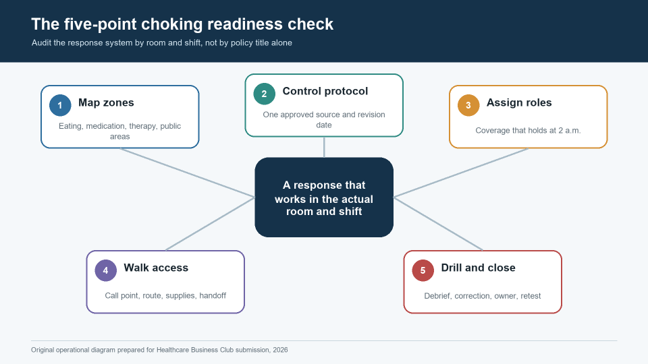
1. Map risk zones by room and shift
A policy can cover the entire building on paper while missing one second-floor waiting room on Saturday afternoon. Start with a location and time map. Mark every place where people eat, drink, receive oral medication, or attend swallowing therapy. Include bedside meal areas, patient dining rooms, rehabilitation spaces, waiting rooms, staff break rooms, and public cafes. Review each location by shift. Daytime coverage says little about nights, weekends, or holidays.
Each zone needs answers to four questions:
- Who is normally present, and who may need help with eating or swallowing?
- Which trained responders can reach the area on each shift?
- How does a staff member summon the internal clinical team or emergency medical services from that room?
- Could a locked door, elevator, long corridor, or weak mobile signal slow the response?
Keep diagnoses and individual swallowing needs in the clinical record and care plan. The operations map has a narrower purpose: show where a response might be needed and whether coverage is dependable. The National Library of Medicine notes that swallowing disorders can make it difficult to swallow food, liquids, or saliva and are more common in older adults. Meal service matters, but so do medication rounds, rehabilitation sessions, and movement between units.
One page per floor or service line is usually enough. Mark the risk zones, nearest call point, expected responder route, and owner of each open gap. Give the page to a newly assigned supervisor. If the coverage problem is still hard to see, the map needs another edit.
2. Keep the clinical protocol and the readiness system distinct
The clinical response should come from a recognized authority and the facility’s medical leadership. The American Red Cross publishes current adult and child choking guidance. The U.S. Food and Drug Administration also tells the public to follow established protocols approved by the Red Cross and American Heart Association. Its safety communication, updated March 4, 2026, places those protocols first. The FDA says an anti-choking device may be considered as a second option if standard protocols are unsuccessful.
The operations team should not rewrite clinical steps to fit a local poster. It should make the approved instructions current, easy to find, and consistent. Check revision dates on wall notices, training handouts, onboarding materials, emergency carts, and the digital policy library. Remove outdated copies. Nobody should have to choose between two versions during an emergency.
Then inspect the support around the protocol:
- Ask a staff member to identify the approved source and revision date.
- Confirm that instructions match the age groups and care settings at the facility.
- Check that the escalation path names the internal response, the emergency number, and the location details a caller must provide.
- If optional equipment is present, confirm that policy, training, inventory, and the manufacturer’s instructions agree on when it can be used.
Procurement and protocol control require different evidence. An equipment receipt tells a manager what arrived, while protocol review establishes how the response is governed. Staff still need a practical test of the system around both. Give each job an owner and a review date.
3. Assign roles that still work at 2 a.m.
“Staff are trained” does not tell a manager who will respond. At 2 p.m., several clinicians may be within sight. At 2 a.m., one clinician may cover several areas. A food-service worker, receptionist, volunteer, or security officer may notice the problem first even when that person is not authorized to provide clinical care.
Build the role plan by zone and shift. Match every assignment to licenses, training, facility policy, and local law. The plan should identify who starts the approved response, who calls the internal emergency team or emergency services, who brings designated supplies, who directs responders to the room, and which supervisor protects privacy and preserves the event record. A small practice may give several jobs to one person. That can work, but it should be an explicit choice rather than an assumption.
The Occupational Safety and Health Administration’s first-aid rule requires ready access to medical advice. When no infirmary, clinic, or hospital is in near proximity, it also requires trained first-aid personnel and readily available supplies. The exact legal application depends on the workplace, and this rule does not answer every staffing question in a healthcare facility. It does prompt two useful checks: who is ready to act, and can that person reach the required supplies promptly?
Test the plan with the ordinary roster. Include meal breaks, shift change, agency staff, temporary room closures, and two calls arriving close together. A plan that depends on one named employee always being present will eventually fail.
4. Walk the whole chain from call point to handoff
An inspection often confirms that an item exists. It may never ask whether anyone can reach it during the first minute of an event. Walk the route instead.
Begin in the risk zone. Find the nearest working call method and use the approved test process. Follow the actual route to designated supplies. Look at doors, signs, lighting, storage height, seals, inspection labels, batteries, expiration dates, and instructions for use. Ask how a caller would describe the room, unit, entrance, or elevator bank to internal responders and emergency services. If optional equipment is stored nearby, check that inventory records, training, and policy give it the same limited role.
The inspection form should be short enough that people finish it properly. A page of “N/A” boxes can hide a dead phone or a locked cabinet. Record evidence that another supervisor can check:
| Check | Evidence to record | Failure example |
| Call route | Test date, device or number, response reached | Dead handset or unclear extension |
| Responder coverage | Role and shift, without unnecessary personnel data | No assigned responder on weekend nights |
| Supply access | Exact location, seal or inventory status | Cabinet locked to most staff |
| Instruction control | Approved source and revision date | Two conflicting posters in one unit |
| Handoff information | Location wording and receiving role | Caller cannot identify the correct entrance |
For hospitals that participate in Medicare or Medicaid, 42 CFR 482.15 requires an all-hazards emergency preparedness program. The rule covers a facility and community risk assessment, policies and procedures, a communication plan, and a training and testing program. Choking readiness is much narrower, and the regulation does not apply to every healthcare organization. Its structure is still useful for an audit: connect risk, policy, communications, training, testing, and documented follow-up.
5. Drill the handoff and close the correction
Tell staff that the exercise is a simulation, then use it to inspect the response system rather than individual performance. Choose a situation that fits the building. For example, a staff member reports that a visitor in a second-floor waiting area appears unable to breathe. The exercise can stop before any physical rescue action. The team can still test recognition, the call route, location wording, responder arrival, supply access, role clarity, crowd management, and transfer of information.
Measure intervals the facility can change, such as time to place the internal call, time to reach the right area, and time to bring designated supplies. Do not turn a simulation time into a promise about patient outcomes. The point is to find local friction.
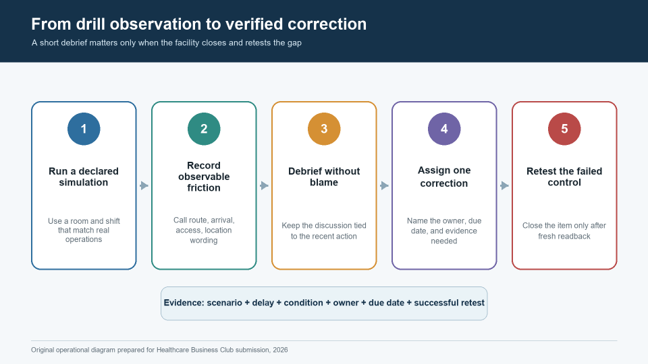
Hold a short debrief as soon as the drill ends. The Agency for Healthcare Research and Quality describes a TeamSTEPPS debrief as a brief team event focused on performance improvement. Its guidance recommends reinforcing what went well, avoiding individual blame, and asking what the team should improve. AHRQ notes that a focused debrief can take about three minutes. Keep the record to facts the facility will use: the scenario, observed delay, contributing condition, correction, owner, and due date. If a sign sends responders to the wrong entrance, replace it and repeat that part of the drill. If night staff cannot find the policy, fix access and test it again. The debrief is finished when the correction has been checked, not when the meeting ends.
A one-page readiness scorecard
Administrators can summarize the five checks by zone and shift:
- Pass: current evidence is available, a recent test succeeded, and no serious gap remains open.
- Conditional: the control works, but a documented limitation needs correction.
- Fail: the team cannot demonstrate the role, call route, supply access, instruction control, or handoff.
Score every serious failure on its own. Four passing dining areas cannot change the fact that one unit has no reachable responder. Record the failed condition, assign an owner, and retest after the correction.
Put the checks into a 30-day cycle
Use the first week to map zones and shifts, identify the approved clinical protocol, and confirm which laws, accreditation standards, and facility policies apply. During week two, assign roles and inspect call methods, routes, supplies, and controlled instructions. Run short simulations on different shifts in week three. Use the last week to close corrections, retest failed controls, and set the next review date.
A binder can document the work. The room-and-shift test shows whether the response system works with the people who are actually there.
Sources
- U.S. Food and Drug Administration, “Update: FDA Encourages the Public to Follow Established Choking Rescue Protocols,” updated March 4, 2026: https://www.fda.gov/medical-devices/safety-communications/update-fda-encourages-public-follow-established-choking-rescue-protocols-fda-safety-communication
- American Red Cross, “Adult & Child Choking: Symptoms and First Aid”: https://www.redcross.org/take-a-class/resources/learn-first-aid/adult-child-choking
- Electronic Code of Federal Regulations, 29 CFR 1910.151, “Medical services and first aid”: https://www.ecfr.gov/current/title-29/subtitle-B/chapter-XVII/part-1910/subpart-K/section-1910.151
- Electronic Code of Federal Regulations, 42 CFR 482.15, “Condition of participation: Emergency preparedness”: https://www.ecfr.gov/current/title-42/chapter-IV/subchapter-G/part-482/subpart-B/section-482.15
- National Library of Medicine, MedlinePlus, “Swallowing Disorders”: https://medlineplus.gov/swallowingdisorders.html
- Agency for Healthcare Research and Quality, TeamSTEPPS, “Reviewing the Team’s Performance: Debrief”: https://www.ahrq.gov/teamstepps-program/curriculum/team/tools/debrief.html
Author
George King is an engineering manager at Fitiger Life LLC. His work focuses on practical emergency-readiness systems for workplaces and care environments. LinkedIn: https://www.linkedin.com/in/georgekingfitiger/
Did you find this helpful? Check out our other helpful articles on our website.
Read Also
- What Today’s Patients Expect From Healthcare Brands
 Healthcare is no longer experienced only through appointments, prescriptions, or hospital visits. Patients now interact with healthcare brands through websites, mobile applications, educational articles, product instructions, customer support teams, social media, and online reviews. Every one of these interactions influences how people judge a company. This shift has raised expectations. Patients want accurate information, convenient… Read more: What Today’s Patients Expect From Healthcare Brands
 - Top Trends Shaping the Future of Mental Health CareMental health care is moving fast to meet daily human needs. People want direct care that fits modern life. Clinics respond by creating flexible options that make healing easier to reach. Providers look past rigid habits to give people solid care. From smart tools to body wellness, these changes help people find relief when life… Read more: Top Trends Shaping the Future of Mental Health Care
- Can Outsourced Telepsychiatry Help Healthcare Organizations Keep Pace With Modern Mental Health Screening?Mental healthcare is changing quickly, but many hospitals, clinics, schools, correctional facilities, and community health organizations do not have enough psychiatric professionals available to turn new screening approaches into timely clinical care. Outsourced telepsychiatry offers one way to close that gap. FasPsych, for example, connects healthcare organizations with psychiatrists, psychiatric nurse practitioners, and other behavioral… Read more: Can Outsourced Telepsychiatry Help Healthcare Organizations Keep Pace With Modern Mental Health Screening?
- Five operational checks for choking readiness in healthcare facilitiesA facility can have a choking poster on every wall and still be unprepared. Preparedness shows up when someone can recognize the emergency, call the right response, bring the right people and supplies to the room, and hand over clear information without losing time. That test belongs in operations as well as clinical education. The… Read more: Five operational checks for choking readiness in healthcare facilities
- Understanding the Demand for Correctional Healthcare ProfessionalsHave you ever wondered who cares for people when they get sick inside a prison? Many people do not realize that jails and prisons need skilled medical teams every single day. By reading this guide, you will learn why these important jobs are growing fast and how you can join this rewarding career field. Caring… Read more: Understanding the Demand for Correctional Healthcare Professionals
- Patient Engagement and Pharmaceutical Support Services: Building a Better Patient JourneyPatients rarely experience healthcare as a simple, linear process. They may need to understand a diagnosis, determine whether they qualify for a clinical trial, gather medical records, navigate insurance requirements, arrange transportation, learn how to use a medication, and stay engaged with treatment for months or years. Serva Health is one example of a specialist… Read more: Patient Engagement and Pharmaceutical Support Services: Building a Better Patient Journey
- Industrial Container Recycling and Waste Management Services: A Practical Guide for BusinessesIndustrial container recycling is an essential part of responsible waste management for manufacturers, warehouses, laboratories, automotive businesses, chemical companies, food processors, and other organizations that regularly handle bulk materials. A strong example is Kelly Drums, a Mid-Atlantic provider of reconditioned drums and comprehensive container management solutions. The company specializes in the pickup, recycling, reconditioning, and… Read more: Industrial Container Recycling and Waste Management Services: A Practical Guide for Businesses
- BCBA & RBT Salary by State 2026 | Behavior Analyst PayPay in applied behavior analysis is harder to pin down than in almost any other healthcare field. Two professionals with the same certification can earn $40,000 apart for no reason other than the state line between them. So before you accept an offer, ask for a raise, or relocate for a bigger paycheck, it helps… Read more: BCBA & RBT Salary by State 2026 | Behavior Analyst Pay