The operational demands placed on modern healthcare administrators have officially outpaced the capabilities of traditional IT infrastructure. While clinical medicine continues to advance at breakneck speed, the back-office systems required to support it often remain painfully stagnant. Today’s insurers, Third-Party Administrators (TPAs), and provider networks are forced to navigate an avalanche of daily claims, aggressive reimbursement timelines, and increasingly intricate benefit plans. Trying to process this modern workload using disconnected legacy servers and fragmented databases is a recipe for high overhead and operational failure. To remain financially viable, organizations must look beyond superficial IT upgrades and make a fundamental structural pivot to the cloud. However, this transition is not merely about moving files to an off-site server; it is about adopting a cohesive, intelligent framework that actively absorbs the administrative burden and streamlines the entire business.
This is exactly where industry innovators like MCSI – Visova are fundamentally changing the game. By offering a true cloud-native, HIPAA-compliant Platform as a Service (vpaas), they allow organizations to seamlessly manage their operations end-to-end. Their comprehensive ecosystem handles everything from highly automated claims processing and complex enrollment to unified member management. Most crucially, the platform expertly navigates the industry’s toughest financial and operational hurdles, including premium billing, intricate provider network management, capitation, and flawless HRA/HSA integration. By leveraging this level of purpose-built technology, MCSI – Visova helps insurers, TPAs, and provider networks streamline their workflows, drastically improve administrative efficiency, and finally get out of the IT management business so they can focus entirely on delivering exceptional care outcomes.
The Legacy Trap: Why On-Premise Systems Are a Liability
For decades, health plans and administrators built their operational infrastructure on massive, physical, on-premise servers. At the time, keeping your data locked in a cold room down the hall felt secure and easily controllable. Today, those legacy systems are essentially anchor weights holding organizations back from innovation.
The biggest fundamental issue with older software architecture is that it was built to execute specific, narrow tasks in total isolation. The enrollment database rarely communicates natively with the premium billing department, and the provider credentialing system is almost always entirely disconnected from the core claims processing engine. This severe lack of interoperability forces human workers to act as the bridges between these digital islands. Staff members end up manually re-entering data, chasing down missing files, and reconciling costly errors across multiple screens.
Moreover, the illusion that on-premise systems are inherently more secure has been completely shattered by modern cybersecurity realities and evolving federal regulations. Regulators are aggressively tightening the screws on healthcare data security. For example, the massive 2026 updates to the HHS HIPAA Security Rule introduce incredibly strict mandates, including universal, mandatory encryption of electronic Protected Health Information (ePHI) both at rest and in transit. These updates remove the old “addressable” flexibilities, meaning that safeguards like multi-factor authentication (MFA) across all remote and onsite systems, annual penetration testing, and 72-hour incident reporting are now hard, unbendable requirements rather than mere recommendations. By removing previous “addressable” flexibilities, these changes shift HIPAA compliance from a simple checklist task to a rigorous, measurable process.
Trying to force a 15-year-old on-premise server to constantly adapt and comply with these rigorous, measurable security controls requires an army of IT professionals and endless capital. Cloud-native platforms, operating in highly fortified, enterprise-grade environments, are inherently designed from the ground up to meet and exceed these rigorous standards, offering automated compliance features that few standalone companies could ever afford to build internally.
Decoding the VPaaS Advantage: Total Workflow Automation
Moving to a cloud-based Platform as a Service is not just a software upgrade; it is a total operational overhaul. When a healthcare organization adopts a unified cloud platform, they acquire a modernized nervous system for their entire business.
Revolutionizing the Claims Lifecycle
The absolute beating heart of healthcare administration is the claims process. In a traditional setup, claims adjudication is notoriously sluggish and staggeringly expensive. Claims arrive with coding errors, missing patient data, or provider contract mismatches, forcing them into a “pending” queue where human examiners have to manually intervene. This drives up administrative costs and deeply frustrates healthcare providers who are left waiting months to be paid for their services.
Advanced cloud solutions utilize complex algorithms and dynamic rules engines to automate this exact process. By cross-referencing incoming claims against specific benefit plans, provider contracts, and clinical edit rules in real-time, the software can automatically approve, deny, or route claims with pinpoint accuracy. This pushes auto-adjudication rates to unprecedented heights, practically eliminating the backlog and allowing highly trained human examiners to focus strictly on complex, high-dollar medical exceptions.
Seamless Member Management and Financials
The modern healthcare consumer expects a frictionless, retail-like experience. They want transparency, instant updates, and zero confusion regarding their coverage and deductibles. Cloud platforms unify the entire member lifecycle into a single, cohesive ecosystem. From the moment an individual or an employer group enrolls, that data flows seamlessly into premium billing, eliminating the data-entry lags that typically cause coverage disputes.
Furthermore, as high-deductible health plans continue to dominate the commercial market, the ability to effortlessly manage complex financial vehicles is critical. True end-to-end platforms offer native integration for Health Reimbursement Arrangements (HRAs) and Health Savings Accounts (HSAs). This ensures that member funds are accurately tracked, automatically applied to out-of-pocket maximums, and reconciled daily without requiring a team of accountants to perform manual data gymnastics.
Empowering Provider Networks in the Era of Value-Based Care
You cannot run a successful health plan without a satisfied, aligned provider network. Unfortunately, provider abrasion—often caused by delayed payments, confusing fee schedules, and credentialing nightmares—remains a massive pain point in the industry. The cloud changes this dynamic by offering secure, self-service web portals directly to providers. By allowing office managers to verify eligibility and track claim statuses in real-time, these portals drastically reduce call center volume and rebuild trust.
More importantly, the financial mechanics of healthcare reimbursement are shifting rapidly away from traditional fee-for-service models and pushing toward complex risk-sharing agreements. Regulators and payers are aggressively tying reimbursement directly to patient outcomes. A perfect example of this shift is the Centers for Medicare & Medicaid Services (CMS) scaling of new mandatory value-based care models in 2026, such as the Transforming Episode Accountability Model (TEAM) and the Ambulatory Specialty Model (ASM), tying reimbursement directly to cost, quality, and care coordination.
TEAM is a mandatory, five-year bundled payment model running through 2030 that requires participating hospitals to be accountable for the cost and quality of specific surgical episodes, like joint replacements and spinal fusions. Under this model, regions have risk-adjusted target prices, and facilities can earn additional payments if they keep actual Medicare billables below the target, or face strict repayment obligations if they exceed it.
Managing these types of high-stakes value-based contracts—alongside traditional capitation (where a primary care group is paid a fixed per-member-per-month rate regardless of utilization)—requires absolute mathematical precision. Cloud platforms give administrators the agility to build, manage, and calculate these dynamic provider networks effortlessly. They track the exact clinical and financial metrics required to ensure that shared savings bonuses are paid accurately and that complex capitation contracts execute flawlessly every single month.
The Tangible ROI of End-to-End Cloud Solutions
So, what is the actual return on investment when a healthcare organization abandons their legacy servers and fully embraces a unified cloud platform? The financial impact is seen across three distinct, measurable metrics:
- Drastic Reduction in Administrative Loss Ratio (ALR): By automating core functions like claims processing, enrollment, and billing, organizations require significantly fewer hands on keyboards. A forward-thinking TPA can process double the volume of claims and take on massive new employer groups without having to proportionally double the size of its administrative staff.
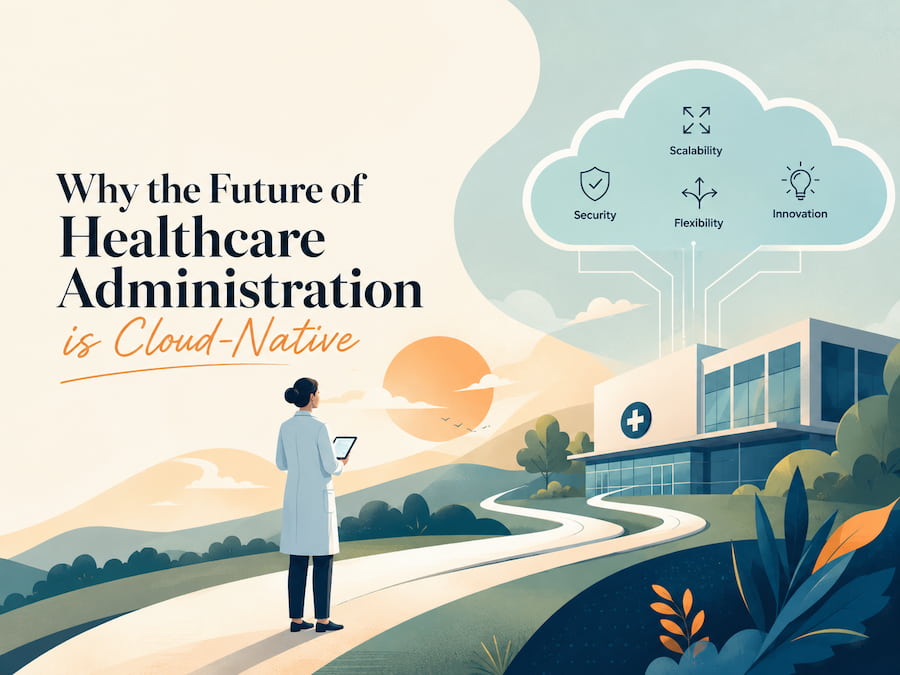
- Unmatched Scalability and Reliability: If a health plan lands a massive new contract during a frantic open enrollment period, a physical server might crash under the weight of the sudden data surge. A cloud-native platform scales instantly, allocating computing resources dynamically to handle the massive web traffic without a single second of downtime.
- Unprecedented Speed to Market: When state regulations change or a company wants to launch a new, highly customized tier of benefit plans, legacy IT systems can take six to eight months to write and test custom code. Modern cloud systems allow business users to adjust rules engines and launch new products in a fraction of the time, capturing critical market share while competitors are still stuck in IT development.
Conclusion
The future of healthcare administration is not going to be won by whoever has the biggest on-premise server room. It is going to be dominated by the organizations that are the most agile, the most secure, and the most fiercely automated. The crippling friction of the past—lost claims, disjointed billing departments, and frustrated provider networks—is entirely preventable today.
By strategically migrating to sophisticated, cloud-native solutions, insurers, TPAs, and provider networks can finally modernize their entire operational footprint. Embracing a comprehensive Platform as a Service strips away the exhaustive busywork, ensures bulletproof regulatory compliance, and restores a company’s ability to focus strictly on what matters most: facilitating exceptional, cost-effective healthcare for the populations they serve.
Did you find this helpful? Check out our other helpful articles on our website.
Read Also
- What Today’s Patients Expect From Healthcare Brands
 Healthcare is no longer experienced only through appointments, prescriptions, or hospital visits. Patients now interact with healthcare brands through websites, mobile applications, educational articles, product instructions, customer support teams, social media, and online reviews. Every one of these interactions influences how people judge a company. This shift has raised expectations. Patients want accurate information, convenient… Read more: What Today’s Patients Expect From Healthcare Brands
 - Top Trends Shaping the Future of Mental Health CareMental health care is moving fast to meet daily human needs. People want direct care that fits modern life. Clinics respond by creating flexible options that make healing easier to reach. Providers look past rigid habits to give people solid care. From smart tools to body wellness, these changes help people find relief when life… Read more: Top Trends Shaping the Future of Mental Health Care
- Can Outsourced Telepsychiatry Help Healthcare Organizations Keep Pace With Modern Mental Health Screening?Mental healthcare is changing quickly, but many hospitals, clinics, schools, correctional facilities, and community health organizations do not have enough psychiatric professionals available to turn new screening approaches into timely clinical care. Outsourced telepsychiatry offers one way to close that gap. FasPsych, for example, connects healthcare organizations with psychiatrists, psychiatric nurse practitioners, and other behavioral… Read more: Can Outsourced Telepsychiatry Help Healthcare Organizations Keep Pace With Modern Mental Health Screening?
- Five operational checks for choking readiness in healthcare facilitiesA facility can have a choking poster on every wall and still be unprepared. Preparedness shows up when someone can recognize the emergency, call the right response, bring the right people and supplies to the room, and hand over clear information without losing time. That test belongs in operations as well as clinical education. The… Read more: Five operational checks for choking readiness in healthcare facilities
- Understanding the Demand for Correctional Healthcare ProfessionalsHave you ever wondered who cares for people when they get sick inside a prison? Many people do not realize that jails and prisons need skilled medical teams every single day. By reading this guide, you will learn why these important jobs are growing fast and how you can join this rewarding career field. Caring… Read more: Understanding the Demand for Correctional Healthcare Professionals
- Innovative Technologies in Oncology: The Future of Cancer TreatmentHave you ever wondered how far cancer treatment has come in recent years? Advances in technology are making a real difference in the fight against cancer. Today, more people are living longer and healthier lives after a cancer diagnosis. This is all thanks to new and groundbreaking medical advancements. The future of cancer care looks… Read more: Innovative Technologies in Oncology: The Future of Cancer Treatment
- Patient Engagement and Pharmaceutical Support Services: Building a Better Patient JourneyPatients rarely experience healthcare as a simple, linear process. They may need to understand a diagnosis, determine whether they qualify for a clinical trial, gather medical records, navigate insurance requirements, arrange transportation, learn how to use a medication, and stay engaged with treatment for months or years. Serva Health is one example of a specialist… Read more: Patient Engagement and Pharmaceutical Support Services: Building a Better Patient Journey
- Cloud-Based Healthcare Administration Solutions: A Guide for Payers, TPAs, and Provider NetworksHealthcare administration has become too complex for disconnected spreadsheets, aging on-premise applications, and manual handoffs between departments. Organizations need technology that can manage claims, enrollment, billing, provider relationships, and member data as connected parts of the same operation. MCSI – Visova is one example, offering a cloud-native vpaas designed to support HIPAA-compliant healthcare administration. Its… Read more: Cloud-Based Healthcare Administration Solutions: A Guide for Payers, TPAs, and Provider Networks