


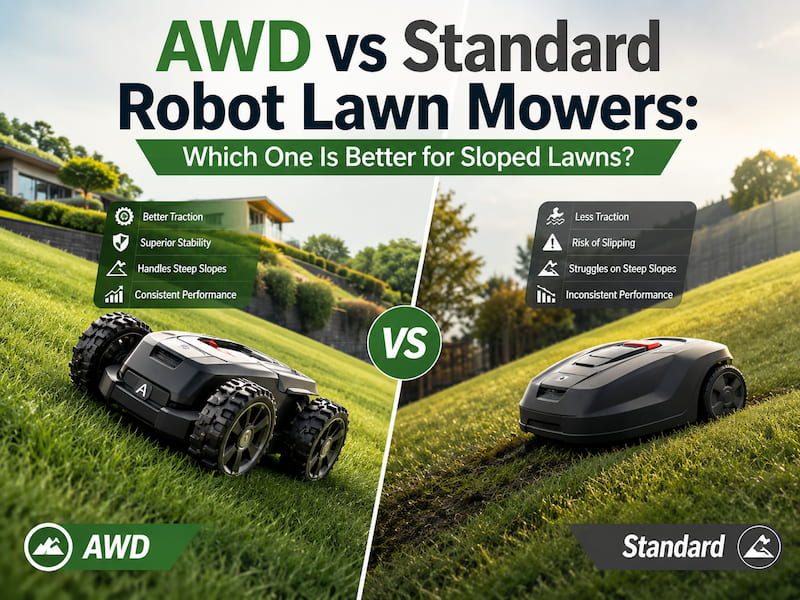
Managing a hillside property comes with distinct aesthetic rewards, but it also presents stubborn maintenance challenges. Traditional walk-behind rotary mowers demand exhausting manual effort on inclines, while standard riding mowers carry dangerous tipping risks on slopes exceeding 15 degrees. Automated turf care has transformed modern yard maintenance, yet homeowners with sloped topography often hit a wall when choosing between standard 2WD models and advanced All-Wheel Drive (AWD) systems.
The core struggle on a slope comes down to basic physics: dynamic weight transfer, loss of traction, and wheel slip. Understanding these mechanics is essential for selecting a machine that maintains traction without destroying delicate turf grass.
Understanding Lawn Incline Metrics: Degrees vs Percentages
Before evaluating drive systems, homeowners must accurately assess their yard’s incline. In lawn care specifications, gradient is measured in two common formats:
- Percentage Gradient (%): The ratio of vertical rise to horizontal run. A 100% slope rises 10 feet vertically over every 10 horizontal feet (a 45-degree angle).
- Angular Degrees (°): The geometric angle measured from the horizontal plane.
Standard rear-wheel-drive automated mowers are engineered to tackle moderate inclines up to 45% (approximately 24°). On flatter lawns or gentle rolling hills, these dual-motor 2WD units deliver crisp, energy-efficient cuts. However, as terrain steepness increases, downhill weight shift strips traction from the drive wheels, causing standard mowers to slide, scuff the soil, or trigger tilt-sensor emergency shutdowns.
The Physics of Hillside Mowing: Standard 2WD vs AWD
When a standard 2WD machine travels uphill, gravity transfers a significant portion of its weight onto the rear axle. While this rearward shift provides downforce, driving over damp grass or uncompacted soil frequently breaks traction. On downhill passes or lateral cross-slope cuts, 2WD models lose steering control because the non-driven front caster wheels lack the directional torque required to keep the machine on course.
In contrast, All-Wheel Drive (AWD) systems deploy independent electric hub motors to every wheel. Torque-vectoring algorithms continuously monitor wheel rotation, automatically diverting power from slipping wheels to those with firm traction. On steep hillsides, AWD offers distinct practical advantages:
- Sustained Slope Traction: High-performance AWD models can ascend inclines up to 80% (approx. 38.6°), maintaining continuous momentum without spinning tires or tearing up turf grass.
- Precise Lateral Stability: Four powered wheels prevent the lower end of the mower from sliding downhill during side-hill traversal, maintaining perfectly straight, uniform cutting paths.
- Enhanced Rough-Terrain Navigation: Heavy ground contours, root swells, and soft depressions require high ground clearance and aggressive tread patterns. Dedicated off-road tread design ensures full contact over uneven terrain.
Feature Comparison for Sloped Properties
| Specification / Feature | Standard Rear-Wheel Drive | Advanced All-Wheel Drive (AWD) |
| Maximum Incline Capability | Up to 45% (approx. 24°) | Up to 80% (approx. 38.6°) |
| Drivetrain Mechanics | Dual rear-wheel motors + front casters | UltraDrive™ four-wheel independent drive |
| Cutting System Efficiency | Standard single-disc system | Dual-disc setup (up to 15.8″ cutting width) |
| Navigation Technology | RTK-Free 3D LiDAR / Boundary Wire | RTK-Free 3D LiDAR + UltraView™ 3.0 AI Vision |
| Ideal Property Size | Up to 0.5 Acre (Medium Yards) | Up to 0.5 Acre+ (Complex & Extreme Terrain) |
Eliminating Signal Dropouts Under Tree Canopies
Sloped landscapes in established neighborhoods often feature heavy tree cover, retaining walls, and multi-level structures. Traditional satellite-guided (RTK-GPS) robotic mowers frequently suffer from signal dropouts under dense foliage, resulting in missed patches or freeze-ups on hill edges.
To overcome these environmental barriers, modern smart mowers utilize onboard RTK-Free 3D LiDAR navigation combined with AI vision systems. By emitting thousands of laser pulses per second, 3D LiDAR constructs a continuous three-dimensional map of the environment. This system functions completely independent of satellite signals or external base stations, delivering steady navigation whether operating under thick pin oaks or alongside steep retaining walls.
Furthermore, AI-powered vision systems—such as UltraView™ 3.0—instantly recognize and navigate around over 300 common yard obstacles including stray garden tools, outdoor furniture, children’s toys, and exposed roots. This hands-free navigation allows homeowners with complex yards to run automated schedules without clearing the lawn beforehand.
Selecting the Ideal Mower for Your Property
Determining whether a standard 2WD or flagship AWD model fits your property depends on gradient severity, terrain complexity, and yard layout:
- For uniform, medium-sized lawns (up to 0.5 acre) with moderate inclines up to 45%, a standard rear-wheel-drive unit such as the MOVA Lidax Ultra 2000 offers an efficient, highly economical solution.
- For properties with steep banks, sudden elevation changes, bumpy terrain, or complex multi-zone layouts, choosing an all-wheel-drive flagship model like the MOVA Lidax Ultra 2000 AWD delivers maximum climbing force, closer edging via UltraTrim™ technology, and twice the cutting speed with dual-disc cutting systems.
Key Takeaways for Hillside Lawn Care
Automated lawn care on slopes is no longer a compromise between convenience and safety. While standard 2WD mowers easily manage moderate hillsides up to 45%, severe inclines and uneven terrain require the superior traction of an AWD system. By selecting a machine equipped with RTK-free 3D LiDAR, multi-map app controls, and intelligent obstacle avoidance, you can maintain pristine, healthy turf year-round without lifting a finger.
