

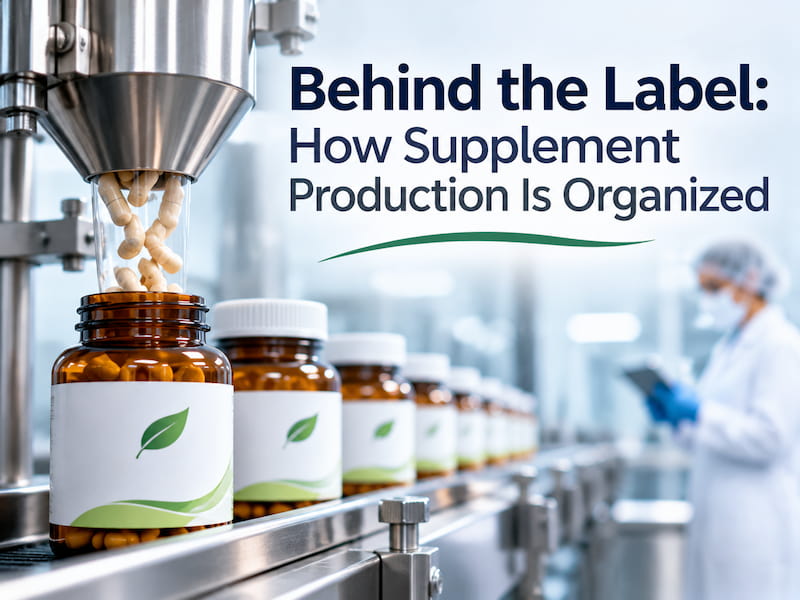
The modern dietary supplement market is vast, dynamic, and consumer-driven. From multivitamins and herbal extracts to specialized sports nutrition powders, consumers encounter thousands of products on store shelves and digital storefronts daily. However, for most consumers, the journey of a supplement—from a conceptual idea in a boardroom to a finished bottle on a shelf—remains entirely opaque.
Behind every commercial supplement label lies a highly structured, collaborative ecosystem. The vast majority of supplement brands do not own or operate massive chemical laboratories or manufacturing plants. Instead, they operate as brand owners, marketers, and distributors, partnering with specialized contract manufacturers to bring their products to life. Understanding how supplement production is organized reveals the intricate balance of science, supply chain logistics, regulatory compliance, and quality assurance required to deliver safe, effective products to the public.
The Core Partnership: Brand Owners and Contract Manufacturers
At the heart of the industry is the contract manufacturing organization (CMO). Brand owners pitch their product concepts, target demographics, and brand visions, while contract manufacturers provide the technical infrastructure, regulatory compliance frameworks, formulation expertise, and production capacity.
This division of labor allows brands to focus on marketing, community building, and sales, while manufacturers focus strictly on scientific formulation, processing mechanics, and quality testing. In regions like Europe and North America, contract manufacturing facilities must operate under stringent regulatory guidelines to ensure consumer safety. For instance, specialized European facilities such as Pharmacom provide comprehensive contract manufacturing services that help brands scale their operations without compromising on technical precision or regulatory standards.
Organizing this production pipeline typically follows five distinct, interconnected stages: formulation, ingredient sourcing, manufacturing, quality control, and packaging.
Phase 1: Product Concept and Formulation
Every supplement begins with a concept. Whether a brand wants to develop a novel nootropic blend, a plant-based protein powder, or a standard vitamin D capsule, the process starts in the formulation laboratory.
Formulation is not merely mixing ingredients together; it is a precise biochemical science. Formulators must evaluate how different compounds interact, their bioavailability, stability, and appropriate dosages. Key considerations during formulation include:
- Synergy and Antagonism: Ensuring that active ingredients enhance one another rather than negate each other’s physiological effects.
- Excipients and Fillers: Selecting safe, inert binding agents, flow agents, or fillers necessary to stabilize the active ingredients during production.
- Delivery Mechanism: Determining whether the product should take the form of a capsule, tablet, softgel, liquid tincture, or powder.
Regulatory frameworks, such as those overseen by agencies like the U.S. Food and Drug Administration (FDA) Dietary Supplements Guidance, dictate that formulations must rely on safe, lawful dietary ingredients. Formulators must verify that every component complies with permitted dosage limits and regulatory classifications.
Phase 2: Ingredient Sourcing and Supply Chain Integrity
Once a formula is locked in, the next major hurdle is sourcing the raw materials. The quality of a finished supplement is fundamentally bound to the quality of its individual components.
Ingredient sourcing is a global operation. Botanicals may come from specific agricultural regions in Asia or South America, synthetic vitamins might be synthesized in European chemical plants, and mineral compounds could be mined or processed domestically. Because raw materials are susceptible to adulteration, contamination, and price volatility, establishing a robust supply chain is critical.
Manufacturers and brand owners vet suppliers through rigorous auditing processes. Sourcing protocols typically involve:
- Certificate of Analysis (CoA): Requiring suppliers to provide detailed technical data verifying identity, purity, and potency for every lot.
- Botanical Authentication: Utilizing advanced techniques like high-performance liquid chromatography (HPLC) or DNA barcoding to verify that herbal ingredients match their exact species taxonomy.
- Traceability: Ensuring full transparency from farm or synthesis lab to the manufacturing facility.
According to research and guidance from institutions like the NIH Office of Dietary Supplements, maintaining ingredient purity and preventing heavy metal or microbial contamination is one of the industry’s most critical operational responsibilities.
Phase 3: The Production Process
With raw materials cleared and verified, production moves to the manufacturing floor. The physical process varies significantly depending on the delivery format.
Blending and Mixing
For powders and capsule fills, raw ingredients are measured with extreme precision and combined in massive industrial blenders. Achieving homogeneity—ensuring that every single scoop or capsule contains the exact ratio of active ingredients—is a technical challenge that requires precise mixing times and particle size management.
Compression and Encapsulation
- Tableting: Powders are blended with excipients and fed into high-speed compression machines that press the mixture into solid tablets under exact pressure thresholds. These tablets are often coated to mask unpleasant tastes or control release rates.
- Encapsulation: Powders or liquids are filled into two-piece gelatin or vegetarian capsules using automated encapsulation machines capable of producing tens of thousands of units per hour.
- Softgels: Liquid or suspension formulations are encapsulated in hermetically sealed soft gelatin shells, commonly used for oils like omega-3 fatty acids.
Throughout these steps, automated equipment monitors weight consistency, hardness, and seal integrity to minimize batch variance.
Phase 4: Rigorous Quality Control and Testing
Quality control (QC) is not a single checkpoint at the end of the line; it is integrated into every phase of supplement production. Under Current Good Manufacturing Practices (cGMPs), facilities must test products at multiple stages:
- In-Process Testing: Technicians pull samples during production runs to verify weight uniformity, disintegration rates, and physical dimensions.
- Finished Product Testing: Once a batch is produced, representative samples undergo final laboratory assays to confirm that the active ingredient levels match the label claims within acceptable statistical tolerances.
- Microbiological Screening: Assays are conducted to ensure the absence of pathogens such as Salmonella, E. coli, and mold.
If a batch fails any of these parameters, it is quarantined and rejected. This systematic oversight ensures that only compliant, safe products advance to the final stages.
Phase 5: Packaging, Labeling, and Compliance
The final operational phase involves packaging the finished supplement into containers that protect it from environmental stressors such as moisture, light, and oxygen, which can degrade sensitive compounds.
- Primary Packaging: HDPE or PET plastic bottles, glass jars, or foil sachets are filled, induction-sealed, and capped with child-resistant closures.
- Secondary Packaging and Labeling: Labels are applied containing mandatory regulatory information, including the Supplement Facts panel, allergen warnings, net weight, expiration dates, and lot numbers.
Lot numbering and expiration dating are critical for post-market surveillance. They allow manufacturers and brands to trace any product back through the exact production run, raw material lot, and supplier if issues ever arise.
Conclusion
The journey behind the supplement label is a testament to modern industrial organization. Far from a simple packaging exercise, successful supplement production requires meticulous coordination across product formulation, global ingredient sourcing, precise mechanical processing, strict analytical testing, and compliant packaging. By partnering with experienced contract manufacturing organizations, supplement brands can navigate these complex operational layers, ensuring that the products reaching consumers are safe, consistent, and scientifically sound.
Check out the rest of our articles!
Read Also
- Behind the Label: How Supplement Production Is Organized
 The modern dietary supplement market is vast, dynamic, and consumer-driven. From multivitamins and herbal extracts to specialized sports nutrition powders, consumers encounter thousands of products on store shelves and digital storefronts daily. However, for most consumers, the journey of a supplement—from a conceptual idea in a boardroom to a finished bottle on a shelf—remains entirely… Read more: Behind the Label: How Supplement Production Is Organized
- 6 Best AI Drug Discovery Platforms for Biotech TeamsKey Takeaways A biotech team shortlisting AI drug discovery platforms is usually comparing products that are not the same kind. One vendor sells access to a model. Another runs a design campaign on your target and returns candidates. A third will only work on a shared-risk basis, taking a position in whatever comes out. All… Read more: 6 Best AI Drug Discovery Platforms for Biotech Teams
- Patient Engagement and Pharmaceutical Support Services: Building a Better Patient JourneyPatients rarely experience healthcare as a simple, linear process. They may need to understand a diagnosis, determine whether they qualify for a clinical trial, gather medical records, navigate insurance requirements, arrange transportation, learn how to use a medication, and stay engaged with treatment for months or years. Serva Health is one example of a specialist… Read more: Patient Engagement and Pharmaceutical Support Services: Building a Better Patient Journey
- Why Biotech Is Entering Its Most Exciting DecadeBiotech has always been an industry built on possibility. Every year brings discoveries, new technologies, and fresh optimism about what medicine might achieve next. What’s different today is that several of those advances are beginning to happen at once. Artificial intelligence is helping researchers analyse enormous amounts of data. Cell therapies are opening new ways… Read more: Why Biotech Is Entering Its Most Exciting Decade
- The Evolution of Patient Engagement: How Pharmaceutical Support Services Are Transforming CareThe journey from receiving a complex diagnosis to successfully managing a chronic condition is rarely a straight line. For many patients, being prescribed a specialty medication or a breakthrough biologic is only the first step in a daunting process filled with administrative hurdles, financial anxiety, and clinical uncertainty. Pharmaceutical companies are increasingly realizing that simply… Read more: The Evolution of Patient Engagement: How Pharmaceutical Support Services Are Transforming Care
- How to Navigate Executive Recruitment in the Pharmaceutical SectorSuccessful leadership hiring in life sciences requires a clear and structured approach. Companies need leaders who can support growth, innovation, and operational strength. Competition for top talent is high and decisions need to be precise. The process also demands a strong understanding of both science and business needs. Many organizations struggle with finding the right… Read more: How to Navigate Executive Recruitment in the Pharmaceutical Sector
- Compounding Pharmacy: Personalized Medication SolutionsA compounding pharmacy plays a vital role in modern healthcare by providing customized medications tailored to the specific needs of individual patients. Unlike mass-produced drugs manufactured by pharmaceutical companies, compounded medications are prepared by licensed pharmacists who carefully combine, adjust, or modify ingredients to create a formulation that best suits a patient’s unique medical requirements.… Read more: Compounding Pharmacy: Personalized Medication Solutions
- The Function of a CRO for Clinical Trials: Structure, Responsibilities, and Operational ImpactClinical trials rely on organized systems that ensure scientific validity, participant protection, and regulatory compliance. As protocols become more intricate and studies expand across multiple regions, many sponsors collaborate with specialized partners to manage key operational and methodological tasks. A CRO for clinical trials provides this structured support, coordinating the activities required to move a study from… Read more: The Function of a CRO for Clinical Trials: Structure, Responsibilities, and Operational Impact