


Egypt’s universal health insurance program is about to get much bigger, and private hospitals, clinics, labs and imaging centers are being invited into it. Phase II of the Universal Health Insurance System is rolling out across six more governorates, a new national compact with the World Bank is funding the expansion, and the health ministry is publicly asking private operators to take over hundreds of primary care units. For facility owners, this is the largest structured demand opportunity the Egyptian market has offered in years, but it rewards preparation, not improvisation.
What Phase II covers
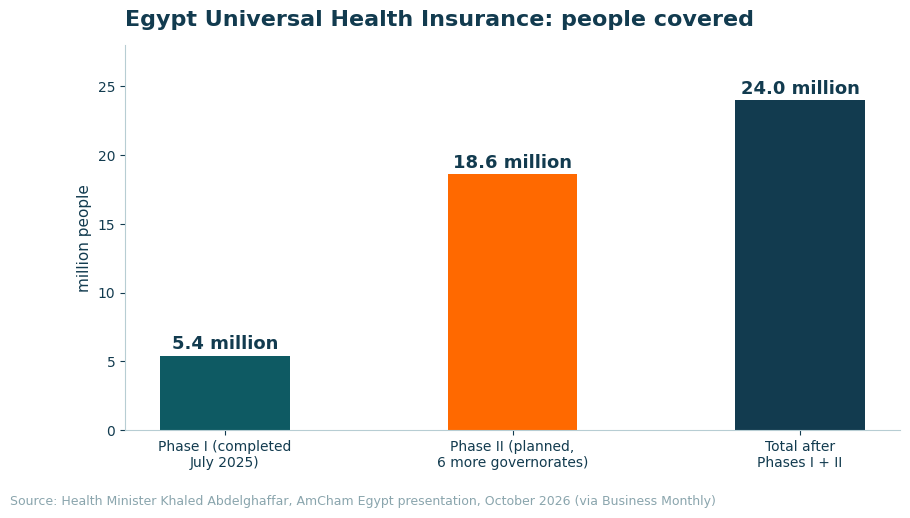
The first phase of Egypt’s universal health insurance, completed in Aswan in July 2025, covered six governorates and more than 5.4 million people, delivering over 116 million medical services through 334 facilities, including private providers. Phase II extends the system to Minya, Kafr El-Sheikh, Damietta, North Sinai, Matrouh and Alexandria, following a pilot that launched in Minya in June 2026. Health and Population Minister Khaled Abdelghaffar, speaking at an AmCham Egypt luncheon in October, put the second phase at 18.6 million people, which would bring coverage across both phases to roughly 24 million.
On November 23, the government signed the Egypt National Health Compact with the World Bank Group, witnessed by Prime Minister Mostafa Madbouly. The compact targets 18.5 million additional beneficiaries by 2030 and finances the upgrade of 935 healthcare facilities in the targeted governorates: 827 primary healthcare facilities and 108 hospitals and critical care units, all brought up to national accreditation standards. The compact also commits the government to raising the share of locally produced essential medicines to more than 75 percent by value and over 90 percent by volume.
The money behind the promise
Egypt allocated EGP 511 billion ($9.5 billion) to healthcare in the FY 2026/27 budget, up from EGP 42.4 billion in FY 2014/15, a more than twelvefold increase. Abdelghaffar told the AmCham audience the budget would need to double, to about EGP 1.02 trillion, to accelerate progress toward universal coverage. The burden the system is designed to lift is visible in one number: out-of-pocket spending fell from 62.6 percent of health expenditure in 2018 to 57.2 percent, still far above the government’s 28 percent target for 2030. The World Bank compact sets the same goal, cutting out-of-pocket spending below 28 percent in the targeted governorates. Every point that figure falls moves spending from cash at the reception desk into insurance-funded, contracted revenue.
The reform sits inside a longer frame. Egypt’s National Health Strategy for 2024 to 2030 sets seven priorities and 44 objectives measured against 692 indicators, developed with input from nearly 50 local and international organizations. The pharmaceutical side of the market is already substantial: roughly EGP 422 billion ($8.5 billion) in 2025, handling more than four billion packs, with value up 37 percent year on year and volume up 9 percent, according to IQVIA figures the minister presented. The compact adds a localization push, targeting more than 75 percent of essential medicines produced locally by value and over 90 percent by volume.
Where private facilities come in
The government’s message to private operators is unusually direct. Around 581 healthcare providers were already contracted into the system in 2026. A concession-based legal framework introduced in 2024 allows private operators to run public facilities, and the ministry is quantifying the surplus: in Minya, roughly 350 primary healthcare units exist against a requirement of about 160, and the minister identified at least 150 units as opportunities for private participation, with another 70 in Alexandria. Licensing is being streamlined and administrative procedures digitized, and the compact itself names greater private-sector participation, investment and innovation as one of its six pillars, alongside workforce development and expanded primary, community and telemedicine services.
For private facilities in the six Phase II governorates, the practical implications are concrete:
- Accreditation is the entry ticket. The 935 facilities in the compact are being prepared to meet national accreditation standards, and contracted providers will be held to the same bar. Start the gap analysis now.
- Primary care is the volume play. The surplus-unit offers in Minya and Alexandria are primary healthcare units, and the system’s design pushes patients through primary gatekeepers first.
- Billing discipline becomes revenue. Insurance-funded care pays through claims, contracts and documented quality, not cash. Facilities that already run tight revenue cycle management processes will adapt fastest to reimbursement-based income.
- Specialty demand follows coverage. Insured patients generate referrals into diagnostics, day surgery and chronic care, the formats where private operators are strongest, as we explored in our analysis of single-specialty hospitals and profits beyond margins.
What Phase I teaches
The minister’s own assessment of Phase I was candid: “We are still learning, we’re still improving, but it is acceptable.” The numbers behind that sentence matter for anyone weighing entry. More than 116 million services have already flowed through the system’s 334 contracted facilities, which means referral pathways, claims processes and pricing schedules are no longer theoretical. Private providers are already inside the tent in the first six governorates, so Phase II is an expansion of a working model, not a leap into the unknown. Facilities joining now are plugging into rails that have already carried real volume.
What to watch
The risks are execution risks. Phase II is scheduled over two to three years, and Egyptian health reforms have historically moved slower than announced. Reimbursement rates and contract terms will decide whether participation is profitable or just busy, and the state remains the anchor payer even as private investment is courted. The compact at least builds in accountability: a joint monitoring, evaluation and accountability framework with the World Bank and development partners will track geographic expansion, facility readiness, beneficiary registration, financing and service quality against specific timelines. For private operators, that framework doubles as a scoreboard worth reading every quarter.
Conclusion
Egypt’s universal health insurance is moving from pilot to national program: roughly 24 million people covered across two phases, a funded plan to upgrade nearly a thousand facilities, and an explicit invitation for private operators to run primary care units and contract into the system. Private hospitals, clinics and labs in the six Phase II governorates should treat the next two years as a preparation window: get accreditation-ready, model the reimbursement economics, and build the claims discipline that insurance-funded revenue demands. The facilities that enter early will set the reference terms for everyone who follows.
Sources
- Business Monthly (AmCham Egypt): Egypt’s $9.5B Healthcare Budget Opens Investment Opportunities (October 2026)
- Daily News Egypt: Egypt, World Bank sign health compact targeting 18.5 million additional beneficiaries by 2030 (November 2026)
Read Also
- Egypt’s Universal Health Insurance Phase II: What Private Facilities Need to Know
 Egypt’s universal health insurance program is about to get much bigger, and private hospitals, clinics, labs and imaging centers are being invited into it. Phase II of the Universal Health Insurance System is rolling out across six more governorates, a new national compact with the World Bank is funding the expansion, and the health ministry… Read more: Egypt’s Universal Health Insurance Phase II: What Private Facilities Need to Know
- Electronic Prior Authorization 2027: How Clinics and Hospitals Can Get ReadyFor most clinics and hospitals, prior authorization is where patient care meets paperwork. Staff spend hours finding out whether an authorization is required, chasing payer-specific documentation rules, uploading records to different portals and tracking requests by phone and fax. In the United States, a federal rule now aims to replace much of that fragmented work… Read more: Electronic Prior Authorization 2027: How Clinics and Hospitals Can Get Ready
- How to Navigate Executive Recruitment in the Pharmaceutical SectorSuccessful leadership hiring in life sciences requires a clear and structured approach. Companies need leaders who can support growth, innovation, and operational strength. Competition for top talent is high and decisions need to be precise. The process also demands a strong understanding of both science and business needs. Many organizations struggle with finding the right… Read more: How to Navigate Executive Recruitment in the Pharmaceutical Sector
- Essential Strategies for Pre-Launch Success in Medical DevicesLaunching a medical device takes more than a good idea. It needs careful planning from the start. Many products fail because teams rush the process. They do not prepare enough before entering the market. A strong pre-launch plan helps reduce risks. It also improves product success. Good planning helps teams stay organized and focused. It… Read more: Essential Strategies for Pre-Launch Success in Medical Devices
- Key Trends in Medical Spa Marketing PerformanceMedical spa marketing is changing quickly. More clinics now compete for the same patients. People want fast results and simple booking options, and this has pushed clinics to improve their marketing strategies. A strong online presence is now very important for growth. Patients also expect clear information before they book. They want to see results,… Read more: Key Trends in Medical Spa Marketing Performance
- Dental Marketing Tactics That Improve Organic Search VisibilityMany people use search engines to find dental services online. They search for terms like “dentist near me” or “best dental clinic in Texas.” If a dental clinic appears at the top of search results, it has a better chance of getting new patients. That is why improving organic search visibility is important for every… Read more: Dental Marketing Tactics That Improve Organic Search Visibility
- Top Business Strategies for Enhancing Senior Well-beingSenior care businesses are growing as more families look for better support for older adults. Many communities now focus on comfort, health, and daily happiness for seniors. Businesses are also improving services to meet changing needs. Good planning and caring support can help seniors enjoy a better quality of life. Many providers use senior living… Read more: Top Business Strategies for Enhancing Senior Well-being
- Effective Dental Marketing Strategies Every Practice NeedsDental practices today face strong competition in both local and online spaces. Patients now search for services in smarter and more selective ways. This makes it important to use clear and practical dental marketing strategies that actually work. A good plan can help attract new patients and keep current ones loyal. It also builds trust… Read more: Effective Dental Marketing Strategies Every Practice Needs