

Healthcare ransomware is no longer a worst-case scenario that happens to someone else. In the third quarter of 2026, healthcare was the most-attacked industry on the planet for disclosed ransomware incidents, and the organizations getting hit are not only big hospital systems. Clinics, imaging centers, labs and the companies that serve them are exactly the mid-market targets ransomware groups prefer. For owners and managers of smaller facilities, the question is not whether the threat is real. It is whether the basics are in place before someone else finds the gap.
Healthcare is now the most-attacked sector
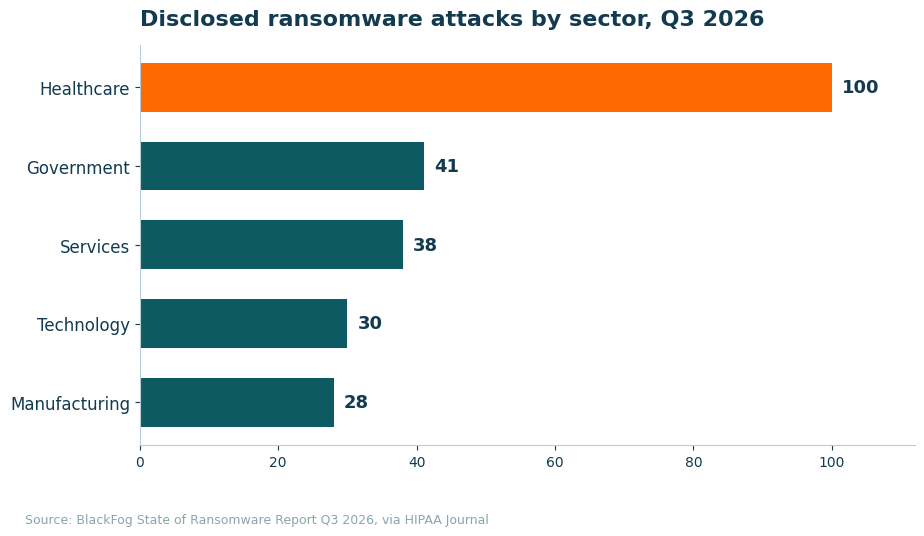
According to the Q3 2026 State of Ransomware Report from BlackFog, there were 353 disclosed ransomware attacks across all industries in the quarter, up 20 percent on the same period last year, plus 2,668 attacks that were claimed on leak sites but never publicly disclosed, up 77 percent. Healthcare topped the list of disclosed attacks with 100 incidents, ahead of government (41), services (38), technology (30) and manufacturing (28). When claimed but undisclosed attacks are counted, healthcare still ranks third overall, with 339 incidents in a single quarter.
Three details from the report matter for healthcare managers. First, 98 percent of disclosed attacks now involve data exfiltration, so encryption is only part of the problem: patient data is stolen, and privacy obligations follow. Second, only about one in nine attacks is ever publicly disclosed, which means the visible numbers understate the real volume. Third, the average ransom demand in the quarter was $763,253, with an average of 697 GB of data stolen per victim and a typical payment deadline of just three days. The largest confirmed healthcare breach of the quarter, at Saber Healthcare Group, exposed the personal and health information of 282,727 people.
The market is consolidating around professional groups
BlackFog counted 116 active ransomware groups in the quarter, including 21 new ones, but two operations dominated: The Gentlemen and Qilin, each with 347 entries on data leak sites, together accounting for 26 percent of all leak-site activity. The Gentlemen in particular has scaled fast by offering affiliates a 90 percent share of ransoms paid, compared with the 70 to 80 percent that is typical, plus a full attack toolkit. Ransomware is now a service industry, and its customers do not need technical skill to hit a clinic. They need a target with weak backups and a legal duty to protect patient data.
Regulators are raising the price of weak security
The financial exposure is not limited to the ransom. In April 2026, the US Department of Health and Human Services settled four separate ransomware investigations for a combined $1,165,000, on top of two years of monitored corrective action plans for each organization. The breaches affected more than 427,000 people in total, and the largest single settlement, $375,000, fell on Assured Imaging, an imaging and screening provider whose breach affected 244,813 patients. The regulator’s finding in case after case is the same: the organization had failed to conduct an accurate and thorough risk analysis, and in some cases had failed to notify patients on time. These were not exotic failures. They were the absence of basic homework.
The Gulf is not watching from a distance
Facilities in our region should read these numbers as local, not foreign. A Gulf-wide review of ransomware and data-theft claims counted 83 observed leak-site claims across Saudi Arabia, the UAE, Qatar, Kuwait, Oman and Bahrain in the first nine months of 2026, made by 28 different groups. The UAE accounted for 45 claims and Saudi Arabia for 17, three quarters of the total, and Saudi claims peaked in the third quarter. Thirteen groups operate across borders and account for 80 percent of claims, and healthcare sits on the target list: hospitals were among the named victims in Kuwait and Bahrain, and the analysis rates financially motivated risk as high and steady in the UAE and Saudi Arabia. A defensive posture built around one country’s headlines, the authors warn, misses most of the field.
This lands at the same moment that regional facilities are digitizing everything from scheduling to billing. The same systems that make operations efficient, from electronic claims to AI-assisted medical billing and coding platforms, concentrate the data attackers want. Digital transformation without security discipline is a larger attack surface, not a smaller one.
What a small clinic or lab actually needs
Regulators and incident data point to the same short list. None of it requires an enterprise budget.
- Do the risk analysis. Know where patient data enters, where it sits, and how it leaves, including billing vendors and cloud systems. This is the specific failure regulators cite most.
- Keep tested, offline backups. A backup that has never been restored is a hope, not a backup. Test restores on a schedule.
- Patch and segment. Most ransomware enters through unpatched systems or phishing, then spreads. Separating clinical systems from office networks limits the blast radius.
- Train staff on phishing. The Consociate breach began with a single successful phishing email.
- Prepare the response before you need it: who decides, who calls the insurer, who notifies patients and regulators, and within what deadline.
- Watch your vendors. Third-party administrators and IT providers are themselves targets, as the settlements show.
Facilities that run disciplined operations already understand the logic: revenue protection and data protection are the same conversation. The same providers who tighten their defenses against insurance claim denials should treat cybersecurity as another front-end control, not an IT luxury.
Conclusion
Ransomware against healthcare is at a record level, the groups behind it are professionalizing, and regulators on both sides of the Atlantic are adding financial penalties to the operational damage. The Gulf’s clinics and hospitals are already on the target lists. The facilities that come through this period intact will not be the ones with the biggest budgets. They will be the ones that did the boring work early: a real risk analysis, tested backups, patched systems, trained staff and a response plan on paper before the three-day deadline arrives.
Sources
- HIPAA Journal: Healthcare Sector Disclosed 100 Ransomware Attacks in Q3 (BlackFog Q3 2026 report)
- US HHS Office for Civil Rights: Settlements in four HIPAA Security Rule ransomware investigations (April 2026)
- ClairSec: Ransomware and Data-Theft Claims in the Gulf, Q1-Q3 2026
Read Also
- Healthcare Ransomware in 2026: What Small Clinics and Labs Actually Need
 Healthcare ransomware is no longer a worst-case scenario that happens to someone else. In the third quarter of 2026, healthcare was the most-attacked industry on the planet for disclosed ransomware incidents, and the organizations getting hit are not only big hospital systems. Clinics, imaging centers, labs and the companies that serve them are exactly the… Read more: Healthcare Ransomware in 2026: What Small Clinics and Labs Actually Need
- AI Scribes in Clinics: What Happens After the Pilot and How to Choose a VendorAn AI scribe listens to a consultation, with the patient’s consent, and writes a draft note for the doctor to review and sign. The pitch for AI scribes is simple: less typing, more eye contact, and notes finished before the end of the day. For a clinic owner, the harder questions come after the demo.… Read more: AI Scribes in Clinics: What Happens After the Pilot and How to Choose a Vendor
- Innovative Technologies in Oncology: The Future of Cancer TreatmentHave you ever wondered how far cancer treatment has come in recent years? Advances in technology are making a real difference in the fight against cancer. Today, more people are living longer and healthier lives after a cancer diagnosis. This is all thanks to new and groundbreaking medical advancements. The future of cancer care looks… Read more: Innovative Technologies in Oncology: The Future of Cancer Treatment
- Cloud-Based Healthcare Administration Solutions: A Guide for Payers, TPAs, and Provider NetworksHealthcare administration has become too complex for disconnected spreadsheets, aging on-premise applications, and manual handoffs between departments. Organizations need technology that can manage claims, enrollment, billing, provider relationships, and member data as connected parts of the same operation. MCSI – Visova is one example, offering a cloud-native vpaas designed to support HIPAA-compliant healthcare administration. Its… Read more: Cloud-Based Healthcare Administration Solutions: A Guide for Payers, TPAs, and Provider Networks
- How Intelligent Invoice Processing Is Reshaping Healthcare AP WorkflowsWhat happens when healthcare invoice volumes outpace the AP team’s ability to review, validate, and route them, while cost per invoice keeps rising? That gap is pushing finance leaders past basic digitization. Supplier invoices across formats, systems, departments, and approval paths, and holding speed, accuracy, compliance, and visibility together gets harder at scale. Intelligent invoice… Read more: How Intelligent Invoice Processing Is Reshaping Healthcare AP Workflows
- From 1905 to 2026: How German Legacy Manufacturers Power Deutsche Dental Technologien’s SuccessFrom 1905 to 2026: How Busch & Co.’s Legacy Powers Deutsche Dental Technologien’s Success In an era where dental technology advances at breakneck speed, few companies embody the perfect blend of historic craftsmanship and modern business agility quite like Busch & Co. and its strategic partner Deutsche Dental Technologien. What began as a small dental bur factory in… Read more: From 1905 to 2026: How German Legacy Manufacturers Power Deutsche Dental Technologien’s Success
- Why the Future of Healthcare Administration is Cloud-NativeThe operational demands placed on modern healthcare administrators have officially outpaced the capabilities of traditional IT infrastructure. While clinical medicine continues to advance at breakneck speed, the back-office systems required to support it often remain painfully stagnant. Today’s insurers, Third-Party Administrators (TPAs), and provider networks are forced to navigate an avalanche of daily claims, aggressive… Read more: Why the Future of Healthcare Administration is Cloud-Native
- The Digital Overhaul: Why Modern Healthcare Administration Demands Advanced Technology SolutionsLet’s be honest about the current state of healthcare administration: it is staggering under its own complexity. The days of managing patient populations, claims, and provider networks with spreadsheets and disjointed legacy systems are long gone. Today, the sheer volume of data processing required just to keep a healthcare organization afloat is enough to paralyze… Read more: The Digital Overhaul: Why Modern Healthcare Administration Demands Advanced Technology Solutions