


Key Takeaways
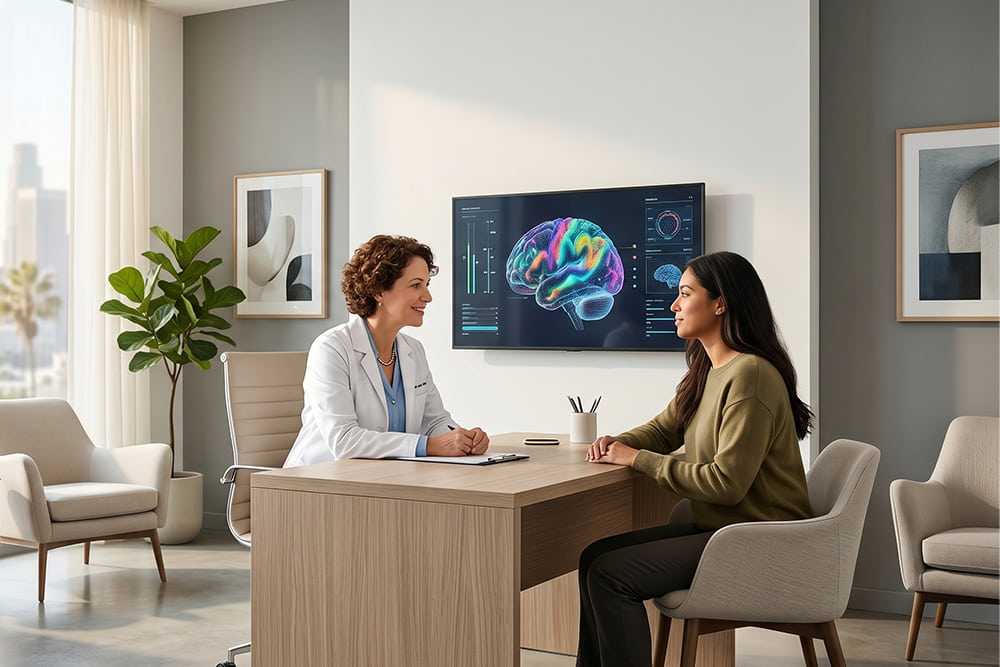
At Amen Clinics Los Angeles, they leverage cutting-edge SPECT imaging to map out brain activity, which in turn shapes personalized mental health treatment plans. This method leads to a sharper focus on the root causes of issues like anxiety and depression.
The treatment plans at Amen Clinics are designed to meet individual needs, steering clear of one-size-fits-all prescriptions. Instead, they conduct comprehensive assessments that delve into psychological evaluations and brain function, crafting distinct strategies for each patient.
Real patient experiences from Amen Clinics showcase the power of personalized care, with many reporting notable improvements in mood disorders thanks to individualized treatment options, including neurofeedback and therapy.
Neurofeedback offered at Amen Clinics serves as a real-time brain training technique that enhances mental clarity. It tackles a range of challenges, including ADHD and anxiety, providing a non-invasive, engaging alternative for patients.
Incorporating nutritional psychiatry into their model, Amen Clinics illustrates how dietary adjustments—like boosting omega-3 fatty acids while steering clear of processed sugars—can have a significant positive effect on mental health and emotional wellbeing.
Amen Clinics also stands out by debunking common myths related to medication. They promote a balanced strategy where medications are paired with personalized therapies, while also ensuring that effectiveness is regularly monitored.
When it comes to therapy, Amen Clinics focuses on evidence-based methodologies such as Cognitive Behavioral Therapy (CBT), which emphasizes structured, goal-oriented outcomes over traditional talk therapy. This approach fosters active involvement and practical steps on the path to recovery.
What Sets Amen Clinics Apart in Mental Health Care?
Innovative Brain Imaging Techniques You Should Know About
Let me take you back to when I first heard about brain imaging in mental health treatment. I felt skeptical, to say the least. The idea of using brain visuals to guide therapy seemed so futuristic. But here’s the reality: at Amen Clinics Los Angeles, this isn’t just a fantasy. It’s actively revolutionizing mental health care.
They employ advanced technologies like SPECT imaging. Now, this isn’t your typical MRI; it’s a deep exploration of blood flow and activity in the brain. Why’s that important? The insight into which brain areas are active (or not) contributes substantially to treatment decisions. It’s akin to tuning a musical instrument; you can’t mend what you can’t see.
- Identify underlying issues: SPECT can reveal areas related to anxiety, depression, and attention issues.
- Tailor interventions: Rather than a one-size-fits-all approach, treatment plans are crafted around actual brain functioning.
- Follow-up assessments: Imaging tracks progress over time, enabling ongoing improvements.
Let’s be honest—this opens up new avenues for understanding mental health challenges that traditional methods often overlook. Imaging serves as a bridge to personalized care.
Personalized Treatment Plans: Why One Size Doesn’t Fit All
Think about traditional mental health treatment for a moment. Usually, you’re handed a diagnosis and a prescription, as if deciphering complex human emotions is as simple as finding a lost sock. But I’ve witnessed how Amen Clinics completely redefines this approach. They recognize that mental health is as unique as fingerprints.
They’re not just tossing one method your way. Instead, it’s about respecting each individual’s nuances. After all, why should someone with a traumatic background follow the same plan as someone whose chronic anxiety stems purely from biological factors?
- Thorough initial assessments: They really dig deep, utilizing brain imaging, psychological evaluations, and family history to inform treatment decisions.
- Flexible therapies: Medications might come into play, but they’re often complemented by therapies like CBT or mindfulness practices.
- Continual adjustments: Regular evaluations adapt the plan based on how you respond to the treatment.
Creating a treatment strategy that feels custom-made for you can completely shift the experience. And doesn’t that feel freeing?
Real Patient Stories: Powerful Journeys at Amen Clinics
Success Stories That Challenge Traditional Approaches
Let’s be real: stories are powerful, especially in mental health. When I delved into patient experiences at Amen Clinics, I encountered hopeful narratives that contradict skepticism. Take Sarah, for example; she faced severe mood swings that had her stuck in a cycle of despair.
After visiting Amen Clinics, brain imaging revealed physiological patterns that clarified her situation. This led to a comprehensive treatment plan that combined medications with neurofeedback—a technique she’d never explored before. Fast forward a few months, and Sarah finally found stability after years of turmoil. It’s not magic; it’s science. But it sure feels like magic, doesn’t it?
“When you see your brain in action, everything changes.”
Countless stories echo this idea. They emphasize the value of personalized care, showing that success in mental health often isn’t a straight line. It can twist and turn based on how well we grasp the underlying factors that contribute to personal challenges.
Before and After: The Impact on Daily Life
Imagine waking up one day after years of feeling like you’re trudging through molasses—slow and heavy. That was exactly David’s situation before he sought help at Amen Clinics. The transformation was almost cinematic! Initially, he struggled with anxiety, focus, and insomnia. But after just a few sessions, a tailored plan addressing his unique brain patterns ignited some significant changes.
What’s the baseline here? Each day used to be a monumental effort to regain control. But after his treatment? David found clarity and purpose in life. Here are just a few of the positive changes he experienced:
- Improved relationships: Strained ties with friends and family started to heal.
- Enhanced work performance: He approached responsibilities with a renewed sense of vigor.
- Better emotional regulation: Mood swings no longer ruled his life.
These aren’t just stories; they’re powerful testaments to the effectiveness of tailored mental health care.
Exploring the Types of Treatments Offered at Amen Clinics
Neurofeedback: A High-Octane Option for Mental Clarity
Neurofeedback; if you haven’t come across it yet, it sounds like something plucked from a sci-fi movie. But trust me, it’s very real and incredibly powerful. Think of neurofeedback like a workout for your brain. I remember observing a session where patients played a video game merely through focused thought. Wild, right?
The premise is straightforward: you monitor brain waves in real-time, helping train your brain to operate more effectively. This is cutting-edge stuff. Traditional methods frequently leave immense potential untapped, concentrating on the “what” without investigating the “how.” Neurofeedback turns that narrative around by focusing on both dimensions.
- Real-time brain training: Instant feedback amplifies motivation and commitment.
- Supports multiple issues: From ADHD to anxiety, applications are vast.
- Non-invasive approach: For many, this feels less intrusive than taking medication—a huge win.
And here’s the best part? These sessions don’t require anyone to sit quietly with a pen and paper. They engage people, leaving them with a sense of accomplishment.
Nutritional Psychiatry: Using Food to Fuel Your Mental Health
If somebody mentioned that your diet could influence your mood, you might roll your eyes. But at Amen Clinics, they pull aside the curtain, revealing the genuine role nutrition plays in mental health. We’re not just regurgitating “you are what you eat” as a quaint saying; we’re talking real, tangible connections.
Consider this: even small dietary tweaks can lead to significant enhancements in mental clarity and emotional stability. What fuels our brains? Here’s a peek into dietary shifts recommended at Amen Clinics:
- Increased omega-3 fatty acids: Found in fish, they’re essential for brain function.
- Antioxidant-rich foods: Berries and leafy greens combat oxidative stress.
- Avoiding processed sugars: These often lead to mood swings and crashes.
Eating isn’t merely about fueling the body; it’s a key part of a holistic strategy for mental well-being. And don’t just take my word for it—patients often report enhanced feelings of stability and clarity after revamping their diets.
Common Myths About Mental Health Treatment Debunked
The Truth About Medication: What You Really Need to Know
Ah, medication—the often-feared aspect of mental health. Everywhere, you’ll find stories about drugs, side effects, and dependency. Many people have negative perceptions, but it’s crucial to disentangle facts from myths. At Amen Clinics, I found a nuanced approach regarding medication. It’s not about blanket prescriptions or one-size-fits-all solutions.
Many patients harbor reservations about depression medications. Can you blame them? But here’s what I discovered: when medication is paired with tailored therapy, it can be incredibly effective. The stigma surrounding this aspect often stems from a lack of understanding. It’s not about whether medications are good or bad; it’s determining their role in a broader context.
- Not every case requires medication: Sometimes therapy and lifestyle adjustments are all that’s needed.
- Compatible with full-picture approaches: Plans often weave together various forms of care.
- Monitoring is essential: Regular check-ins assess effectiveness and refine prescriptions when necessary.
It continues to surprise me. How can we overlook this? The key lies in engaging and collaborating with professionals who genuinely understand you.
Therapy Isn’t Just Talk: Understanding Evidence-Based Practices
When most people envision therapy, they picture reclining on a couch, discussing their woes. Classic, right? But this stereotype misses the mark. That’s where traditional narratives about mental health can let us down. Here, activities can involve much more than idle chatter.
At Amen Clinics, therapy dives into evidence-based practices that are scientifically supported to deliver results. Cognitive Behavioral Therapy, or CBT, is one example. It’s structured and active, driving change rather than just mulling over feelings. The best part? It challenges the thought patterns and behaviors that elevate mental health struggles.
- Goal-oriented approach: You’ll work towards specific outcomes, rather than drifting in existential chatter.
- Empirical evidence: Data backs the effectiveness of many therapies available.
- Diverse therapy options: From CBT to DBT and mindfulness, there’s a spectrum to suit different preferences.
Therapy isn’t just conversation; it’s about engagement. It’s taking tangible steps toward a more fulfilling life.
FAQ
What kind of patients benefit the most from Amen Clinics?
A diverse range of patients—those grappling with anxiety, depression, and ADHD—find valuable support here. Anyone seeking personalized care that extends beyond just medications will flourish in this environment.
How does SPECT imaging differ from other imaging methods?
SPECT offers real-time insights into blood flow and brain activity, contrasting with MRIs or CT scans that focus mainly on structural aspects. This capability allows clinicians to zero in on functional issues, crucial for effective treatment planning.
Do treatment plans evolve over time at Amen Clinics?
Absolutely! One of their standout features is the commitment to continual evaluation and adaptation. Routine check-ins ensure treatment aligns with how the patient is responding, leading to optimal outcomes.
Can dietary changes alone improve mental health?
While dietary adjustments can greatly impact mood and cognitive function, they usually form a part of a more comprehensive strategy. Alone, they may not suffice for serious conditions, but they can complement therapy and medication quite effectively.
What role does therapy play at Amen Clinics?
Therapy isn’t just idle chit-chat here. The focus is on evidence-based practices that bring about genuine change. Expect structured sessions that are oriented towards practical steps rather than merely discussing feelings.
Are there any risks associated with neurofeedback?
Neurofeedback is generally safe, though some patients might initially find the process a bit frustrating or challenging. Real-time feedback can feel overwhelming, especially if you’re not used to harnessing your thoughts in that manner. It’s vital to have a skilled professional guiding the process.
What’s the feedback from patients who have undergone treatment?
Patients often express life-changing improvements in emotional regulation and mental clarity. Many feel grateful for a personalized approach that made them feel genuinely understood and cared for.
How does Amen Clinics address stigma around mental health treatment?
They confront stigma directly by promoting education. The clinics emphasize tailored care instead of one-size-fits-all solutions, which shifts how people view mental health treatment. A commitment to scientifically supported methods reduces misconceptions and encourages more open patient engagement.
Useful Resources
- Amen Clinics
- American Psychological Association
- National Alliance on Mental Illness
- Mayo Clinic
- National Center for Biotechnology Information
- Psychology Today
- National Institute of Mental Health
- Centers for Disease Control and Prevention – Mental Health
- Harvard Health
