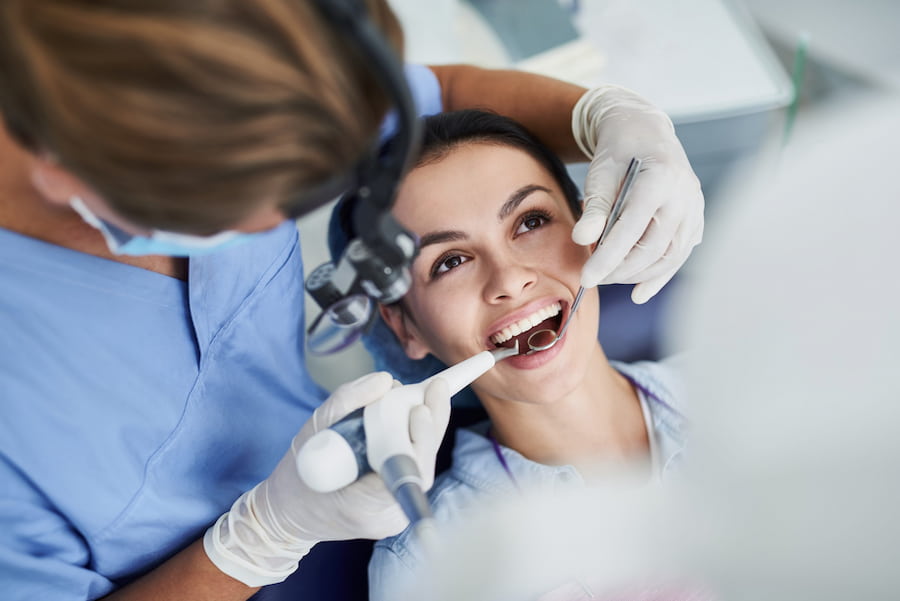
Professional prevention management is the go-to for today’s well-informed patients. With the growing importance of staying fit and healthy, there is a strong desire for patients to interrelate it with their oral health. As per a survey, more than 90% of 2,70,000 patients suggested GBT to others in comparison to the conventional methods. GBT is a culmination of an efficient, modern technological boom that collaborates with dentists to deliver excellent dental cleaning and preventive care at a personal level. A Guided Biofilm Therapy Provider showcases a positive encounter with a patient who lacks discomfort and fosters patient loyalty with gentle and accurate dental care. Consequently, it contributes to the success of the dental care provider and patients’ happiness.
GBT is a novel approach with immense advantages to treat plaque and tartar whether it has just developed or a matured biofilm. Firstly, let us have a quick understanding of what a dental biofilm is. Well, it is a polymicrobial entity that begins its development on biotic and abiotic surfaces which can be either hard or soft tissues of the oral cavity or inanimate surfaces that could range from orthodontic bands to invisible aligners, or prostheses. It starts by deteriorating the periodontal and peri-implant health. It begins its growth on the tooth or implant surface. The supra and subgingival dental plaque biofilm forms on areas that are hard to reach which mostly compromises routine oral care.
How does Guided Biofilm Therapy work?
The disclosing agent: The plaque and tartar buildup on the tooth surface is made visible to the patient and the dentist by using a nontoxic substance known as the disclosing agent which is a binding agent that colours the bacterial deposit on the tooth. The process known to be a plaque detector helps the patient and the dentist to see the state of dental hygiene. It enables the dentist to ensure that the plaque deposits are completely removed. It improves clinical results and motivates patients to have dental cleanups on a regular basis to prevent periodontal disease. With the latest technologies like Fluorescence Technology, the dentist can easily visualize the biofilm and perform targeted cleaning.
The air polishing devices: With principles like the “venturi” powder chamber principle, the mixture of air and powder is created by combining the carburetor technique and swirling. The second principle is the pressurization of air into the powder chamber that reaches the outlet by swirling action and the air-powder slurry is formed. Some of the air polishing devices that offer accurate plaque removal are :
– Sodium Bicarbonate Powder Air Polishers: a mixture of air, water, and sodium bicarbonate powder effectively removes plaque and is best suitable for sensitive gums and oral tissues.
– Glycine powder air polishers are less abrasive compared to Sodium Bicarbonate. It is helpful to treat patients with exposed dentin or fragile restorations.
– Ultrasonic Air Polishers work with a combination of ultrasonic vibrations with air polishing technology. It is suitable for mature and stubborn calculus deposits.
Every air-polishing device has its own merits. It allows the dentist to perform the cleaning process in a customized way. The dentist chooses the polishing device that suits the patient’s oral health. Therefore the dentist achieves optimal results in plaque removal.
Other latest technologies include Intraoral cameras which make the therapy futuristic with high-definition images of the mouth, ensuring accuracy and precise assessment of oral health. Digital imaging technology is another aid that personalizes the treatment with detailed digital scans of the teeth and gums.
In comparison with the traditional scaling and root planning (SRP) treatment which gained popularity for its plaque debridement mechanism, the new age GBT is a precision-based method. It conceptualizes special oral care and treatment of plaque removal with the best devices and pain management techniques. Its differentiation is undoubtedly the protocol.
Did you find this helpful? Check out our other helpful articles on our website.
Read Also
- IVF in Later Life: Opportunities, Risks, and Modern Strategies for Success
 Is it worth considering IVF after age 40? In today’s world, the boundaries of reproductive age are gradually shifting, adapting to social changes. More and more women aged 40 and older are making a conscious decision to become mothers once they have achieved career stability, established a solid financial foundation, and attained deep psychological maturity.… Read more: IVF in Later Life: Opportunities, Risks, and Modern Strategies for Success
 - How to Choose a Pediatrician: What Parents Should Look For Before the First VisitChoosing a pediatrician is one of the first major healthcare decisions parents make — and one of the most important. Your child’s doctor will be a consistent presence through well-child visits, illnesses, developmental milestones, and sometimes difficult conversations. Getting this choice right from the start sets the foundation for your child’s long-term health. Start Looking… Read more: How to Choose a Pediatrician: What Parents Should Look For Before the First Visit
- Ankle Injuries in Athletes: When to Push Through and When to See a SpecialistAnkle injuries are among the most common in sports, from weekend warriors to competitive athletes. The challenge is that the ankle’s complexity means what feels like a simple sprain might actually involve a fracture, torn ligament, or cartilage damage beneath the joint. Knowing when to rest at home versus when to seek professional evaluation can… Read more: Ankle Injuries in Athletes: When to Push Through and When to See a Specialist
- What to Expect When Seeing an Orthopedic Surgeon for Knee or Joint PainKnee and joint pain affects millions of Americans each year, ranging from minor discomfort after exercise to debilitating conditions that limit daily movement. Knowing when to see a specialist — and what to expect when you do — can make the entire experience less intimidating and more productive. When Should You See an Orthopedic Surgeon?… Read more: What to Expect When Seeing an Orthopedic Surgeon for Knee or Joint Pain
- Real Health Risks of Mold Exposure in South Florida HomesAlthough I’m not a doctor, having lived through enough post-hurricane mold outbreaks to know which symptoms send people to the ER in Miami, Fort Lauderdale, and West Palm Beach—and which ones linger for years. Immediate Reactions (hours to days) Allergic-type response (most common): Runny nose, red itchy eyes, sneezing, sinus pressure that feels like a… Read more: Real Health Risks of Mold Exposure in South Florida Homes
- Discover the Benefits of Secure Dental for Your Oral HealthThe Undeniable Link Between Oral Health and Overall Well-Being Oral health is much more than just a hygiene issue; it plays a crucial role in your overall health. Research has repeatedly shown that what happens in your mouth can significantly influence your body as a whole. The mouth is the gateway to the rest of… Read more: Discover the Benefits of Secure Dental for Your Oral Health
- The Role of Ingredients in Your Skincare: What to Look ForSkincare works best when you understand what goes into the products you use daily. Ingredients form the foundation of every formula and determine how the skin reacts over time. Each cream, cleanser, or serum has its own role, determined by its ingredients. Learning what to look for helps you pick products that help skin and… Read more: The Role of Ingredients in Your Skincare: What to Look For
- Your Guide to Finding a Trusted DentistChoosing the right dentist in Sandgate or your area is crucial for maintaining good oral health and achieving a confident smile. With countless dental practices to choose from, patients may find the task daunting. Data from the American Dental Association indicates that there are over 200,000 practicing dentists in the United States, highlighting the importance… Read more: Your Guide to Finding a Trusted Dentist