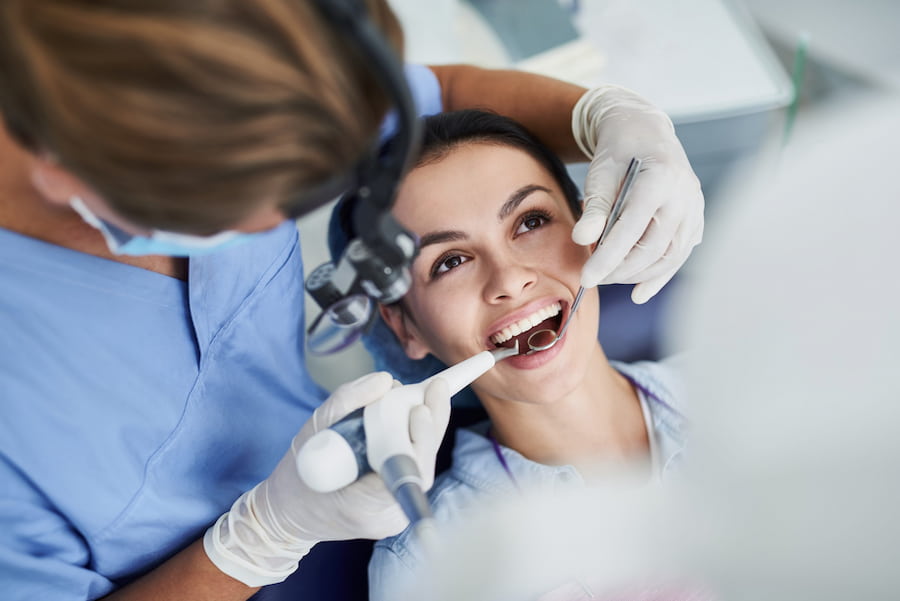
Professional prevention management is the go-to for today’s well-informed patients. With the growing importance of staying fit and healthy, there is a strong desire for patients to interrelate it with their oral health. As per a survey, more than 90% of 2,70,000 patients suggested GBT to others in comparison to the conventional methods. GBT is a culmination of an efficient, modern technological boom that collaborates with dentists to deliver excellent dental cleaning and preventive care at a personal level. A Guided Biofilm Therapy Provider showcases a positive encounter with a patient who lacks discomfort and fosters patient loyalty with gentle and accurate dental care. Consequently, it contributes to the success of the dental care provider and patients’ happiness.
GBT is a novel approach with immense advantages to treat plaque and tartar whether it has just developed or a matured biofilm. Firstly, let us have a quick understanding of what a dental biofilm is. Well, it is a polymicrobial entity that begins its development on biotic and abiotic surfaces which can be either hard or soft tissues of the oral cavity or inanimate surfaces that could range from orthodontic bands to invisible aligners, or prostheses. It starts by deteriorating the periodontal and peri-implant health. It begins its growth on the tooth or implant surface. The supra and subgingival dental plaque biofilm forms on areas that are hard to reach which mostly compromises routine oral care.
How does Guided Biofilm Therapy work?
The disclosing agent: The plaque and tartar buildup on the tooth surface is made visible to the patient and the dentist by using a nontoxic substance known as the disclosing agent which is a binding agent that colours the bacterial deposit on the tooth. The process known to be a plaque detector helps the patient and the dentist to see the state of dental hygiene. It enables the dentist to ensure that the plaque deposits are completely removed. It improves clinical results and motivates patients to have dental cleanups on a regular basis to prevent periodontal disease. With the latest technologies like Fluorescence Technology, the dentist can easily visualize the biofilm and perform targeted cleaning.
The air polishing devices: With principles like the “venturi” powder chamber principle, the mixture of air and powder is created by combining the carburetor technique and swirling. The second principle is the pressurization of air into the powder chamber that reaches the outlet by swirling action and the air-powder slurry is formed. Some of the air polishing devices that offer accurate plaque removal are :
– Sodium Bicarbonate Powder Air Polishers: a mixture of air, water, and sodium bicarbonate powder effectively removes plaque and is best suitable for sensitive gums and oral tissues.
– Glycine powder air polishers are less abrasive compared to Sodium Bicarbonate. It is helpful to treat patients with exposed dentin or fragile restorations.
– Ultrasonic Air Polishers work with a combination of ultrasonic vibrations with air polishing technology. It is suitable for mature and stubborn calculus deposits.
Every air-polishing device has its own merits. It allows the dentist to perform the cleaning process in a customized way. The dentist chooses the polishing device that suits the patient’s oral health. Therefore the dentist achieves optimal results in plaque removal.
Other latest technologies include Intraoral cameras which make the therapy futuristic with high-definition images of the mouth, ensuring accuracy and precise assessment of oral health. Digital imaging technology is another aid that personalizes the treatment with detailed digital scans of the teeth and gums.
In comparison with the traditional scaling and root planning (SRP) treatment which gained popularity for its plaque debridement mechanism, the new age GBT is a precision-based method. It conceptualizes special oral care and treatment of plaque removal with the best devices and pain management techniques. Its differentiation is undoubtedly the protocol.
Did you find this helpful? Check out our other helpful articles on our website.
Read Also
- Top Trends Shaping the Future of Mental Health Care
 Mental health care is moving fast to meet daily human needs. People want direct care that fits modern life. Clinics respond by creating flexible options that make healing easier to reach. Providers look past rigid habits to give people solid care. From smart tools to body wellness, these changes help people find relief when life… Read more: Top Trends Shaping the Future of Mental Health Care
 - Full-Arch Dental Tourism: Why UK Patients With Severe Bone Loss Are Looking AbroadDental implants have become one of the fastest-growing segments of private dentistry. Within that market, one patient group behaves very differently from the rest: people who have been told they do not have enough upper jawbone for conventional implants. For these patients, the choice is rarely between one clinic and another. It is between a… Read more: Full-Arch Dental Tourism: Why UK Patients With Severe Bone Loss Are Looking Abroad
- Levels of Mental Health Care and When to Seek SupportMental health care can range from occasional outpatient appointments to 24-hour hospital treatment. The appropriate level depends on safety, symptom severity, daily functioning, medical needs, available support, treatment history and personal preferences. A licensed clinician should assess these factors rather than relying on a symptom list alone. Need help now? In the United States, call… Read more: Levels of Mental Health Care and When to Seek Support
- How to Choose a Shilajit Brand Based on the ResearchIn a randomized trial published in the Journal of the International Society of Sports Nutrition in 2019, 63 active men took 250 mg of standardized shilajit, 500 mg, or a placebo every day for eight weeks, and the benefit for strength retention after a fatiguing workout appeared only at 500 mg. For anyone choosing a… Read more: How to Choose a Shilajit Brand Based on the Research
- How to Incorporate Relaxation into Your Busy ScheduleFinding balance when you have a packed daily agenda often feels out of reach. Between work duties, family obligations, and personal projects, personal rest usually gets pushed to the bottom of the list. Small, intentional shifts in daily habits can help restore calm without requiring hours of extra free time. Continue reading to discover everything… Read more: How to Incorporate Relaxation into Your Busy Schedule
- Red Light Therapy for Skin and Wellness: Meet Vital Red Light TherapyModern wellness is not always about complicated treatments or long routines. Many people are now looking for simple, convenient ways to support their skin, recovery, and overall wellness at home. One technology getting more attention is red light therapy. Red light therapy uses specific wavelengths of red and near-infrared light to support the body’s natural… Read more: Red Light Therapy for Skin and Wellness: Meet Vital Red Light Therapy
- Managing Shock Loss After a Hair Transplant: The Financial and Clinical Imperative of Post-Op CareIn the rapidly evolving landscape of private healthcare, executive leadership within cosmetic and restorative surgery clinics faces a dual challenge: maintaining strict clinical standards while maximizing patient lifetime value (LTV) and brand advocacy. As the global medical tourism and elective procedure markets expand, clinical outcome quality alone is no longer the sole differentiator for premium… Read more: Managing Shock Loss After a Hair Transplant: The Financial and Clinical Imperative of Post-Op Care
- Transform Your Skin Health: Premier Gluta IV Therapy in DubaiThis comprehensive guide explores how modern intravenous wellness treatments can help revitalize your complexion, boost immune function, and support overall cellular health. By incorporating modern IV therapy Dubai services into a routine health regimen, individuals can achieve direct nutrient absorption for optimal results. Selecting a customized gluta IV drip Dubai treatment provides targeted antioxidant defense,… Read more: Transform Your Skin Health: Premier Gluta IV Therapy in Dubai