

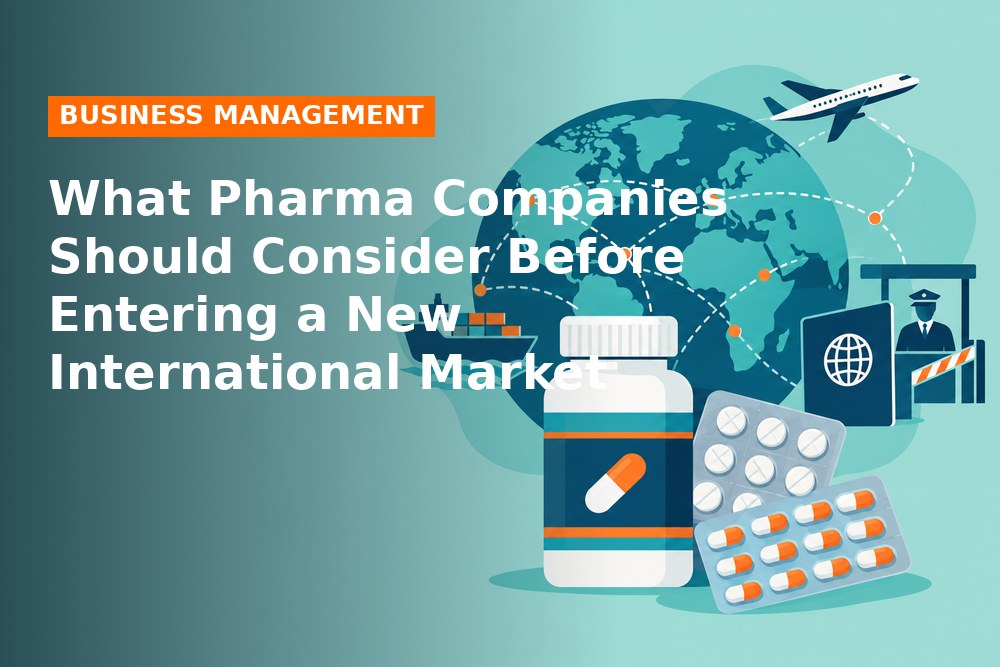
A pharmaceutical product can be successful in one country. It may struggle to even set foot in another. The reason is simple. Global market entry is not merely a regulatory activity. A company’s product may be approved with strong clinical data backing it. The manufacturing network may be vast. However, the unexpected barriers around local regulations, pricing, reimbursement, distribution, intellectual property, labeling, or post-market obligations may just make market entry challenging.
Pharma companies planning international expansion need to build a sustainable path from regulatory approval to patient access. Let’s look into ways such companies can strengthen their international hold from the beginning.
Ways to Open Global Markets for Pharma Companies
Here’s how pharmaceutical firms can clear their road to international markets for sale:
International Market Assessment
Regulatory submission will come later. First, companies should consider the commercialization and strategic appeal of the target market. This means looking beyond population size. A useful market assessment should consider a few points. These include prevalence of diseases, treatment patterns, medical needs that haven’t been considered, competing products, prescribing practices, healthcare infrastructure, and the potential patient population for the specific product.
For example, a market may have a large population but limited access to a particular therapy. That is because of reimbursement restrictions or high out-of-pocket costs. Conversely, there may be an appealing opportunity in a smaller market. A huge need that hasn’t been met or a supportive reimbursement environment may be available.
Companies also need to assess if the product’s intended indication matches local clinical practice. This commercial analysis should happen before significant regulatory resources are committed.
Understand the Local Regulatory Pathway
Regulatory requirements cannot simply be copied from the company’s home market. The World Health Organization’s marketing authorization definition covers quality, safety, and efficacy assessment of medical products before their introduction to the market. Regulatory oversight can also extend across the product lifecycle. It includes post-approval changes.
Therefore, the first regulatory question should be, “How will the target authority classify the product?” Several factors are affected by this answer. It covers the needed evidence, application route, clinical data expectations, manufacturing requirements, and approval timeline.
Companies should identify the following:
- The national or regional regulatory authority
- Product classification
- Applicable marketing authorization pathway
- Local applicant or Marketing Authorization Holder requirements
- Manufacturing and GMP expectations
- Clinical or bridging-study requirements
- Labeling and packaging rules
- Pharmacovigilance obligations
- Post-approval variation requirements
- Import and distribution requirements
The regulatory strategy should then be built around the target country.
See How You Can Reuse Existing Dossier
International expansion does not always mean starting from zero. The ICH Common Technical Document (CTD) was developed to provide a common structure for pharmaceutical registration information. It has a five-module format. There’s a region-specific Module 1, while modules 2-5 are common across regions.
That’s how an existing dossier becomes a valuable foundation for expansion. However, companies should not assume that a CTD prepared for one regulator will be accepted without modification by another. A country-specific gap assessment can identify differences in the following:
- Administrative documentation
- Product information
- Labeling
- Stability data
- Local clinical requirements
- Manufacturing-site information
- Quality documentation
- Safety information
- Pharmacovigilance documents
Companies need to decide what they can reuse, adapt to, and generate locally.
Determine the Requirement of Local Clinical Evidence
A product may already have extensive clinical evidence. However, the target authority may have specific expectations. It may concern the population studied, ethnic factors, local clinical practice, or additional proof. Thus, companies should decide early whether existing clinical data are sufficient. Or, there are requirements for additional local studies, bridging data, or other evidence.
This should also be considered from a commercial perspective. Clinical proof may become relevant. Regulatory approval, health technology assessment, reimbursement, and payer discussions–all of it may be covered here. Therefore, regulatory and market-access teams should work together.
Look to Pricing and Reimbursement
A medicine can receive marketing authorization. However, it may still face a lot of commercial barriers. There may be no or unfavorable reimbursement/category, or it may be priced beyond what healthcare systems or patients can support.
This is why pricing and reimbursement strategy should start before launch. Companies should have answers to the below-mentioned queries:
- Whether the product is reimbursed publicly or privately
- How pricing is determined
- Whether health technology assessment is required
- What evidence payers expect
- Whether reference pricing is used
- What patient affordability looks like
- Whether tendering or negotiated procurement is important
Economic and clinical evidence may also be commercially important for some products. The European Union is a useful example of this. EMA explains that marketing authorization and access are related, but they are distinct processes. Centrally authorized medicines may still require access consideration and repayment at the single country level.
Look for the Right Local Operating Model
The country and regulatory pathway may decide whether a company needs a local entity, authorized representative, importer, distributor, or Marketing Authorization Holder. This decision should not be based alone on the easiest company structure to set up. The local partner may have the duties mentioned below:
- Regulatory submissions
- Importation
- Warehousing
- Distribution
- Pharmacovigilance
- Regulatory communications
- Product recalls
- Commercial activities
Therefore, clearly define the responsibilities in agreements before commercialization begins. Companies shouldn’t choose a distributor purely because it has an established sales network. Lack of regulatory or pharmacovigilance skills can be problematic.
Check Intellectual Property and Competitive Position
Companies should consider:
- The status of the patent
- Supplementary protection or exclusivity provision
- Data exclusivity
- Trademarks
- The competitive scenario of the market they want to enter
Market entry timing for innovative products can rely on intellectual property protection.
Generic or biosimilar products? They are a different situation. That’s because these companies may need to understand reference-product exclusivity, patent barriers, and local requirements. These govern the abbreviated or comparable development routes.
Early Planning of Supply Chain, Manufacturing, and Distribution
Regulatory approval may come. But their commercial value may decline if the supply is not credible. So, companies should evaluate some factors before launching. These include manufacturing capacity, the sites approved for manufacturing, batch-release requirements, import controls, cold-chain requirements, warehousing, and distribution capabilities.
The importance of regulated distribution and good storage and distribution practices for medical products after manufacturing has also been emphasized by the WHO. That’s why supply chain planning should start with regulatory planning.
Companies should also consider changes that the target authority may require. These cover manufacturing sites, packaging configuration, serialization, language, or product presentation.
Ensure Post-Market Compliance Within Market-Entry
Medicine reaches patients. Pharmacovigilance, i.e., detecting, assessing, understanding, and preventing adverse effects and other drug-related issues, and post-market surveillance continue (per WHO). So, companies may need systems for the following:
- Adverse-event reporting
- Safety signal detection
- Risk-management activities
- Periodic safety reporting
- Regulatory safety communications
- Product complaints
- Recalls and withdrawals
- Post-approval studies
- Regulatory variations
These responsibilities can also affect other regulatory authorities’ decisions.
Create a Country-Specific Market-Entry Roadmap
After considering all factors, the following roadmap may become useful:
- Phase 1 – Market Assessment: Check demand, competition, unmet need, pricing, reimbursement
- Phase 2 – Regulatory Review: Confirm classification, pathway, and dossier requirements. Consider local representation and timelines
- Phase 3 – Gap Analysis: Compare the existing dossier and operating model with country-specific requirements
- Phase 4 – Submission & Market Access: Prepare the regulatory submission. Develop pricing, reimbursement, and commercial strategies
- Phase 5 – Launch Readiness: Finalize supply chain, distribution, and labeling. Consider pharmacovigilance and local operational responsibilities
- Phase 6 – Lifecycle Management: Observe safety and regulatory changes. Consider market performance and post-approval needs
Final Words
Pharma firms can’t enter a new pharmaceutical market with a single registration project. It is a combination of everything mentioned here. Success only reaches those companies that evaluate these elements before committing to a launch. Also, they must have built a country-specific strategy around them.
The regulatory dossier may open the door. But it is just part of a wider strategy to enter the market. Regulatory intelligence can help here. Companies can identify country-specific requirements, observe the changes, and reduce gaps that are avoidable before they submit anything. It’s quite helpful for an existing product dossier that needs to be adapted across several areas.
Author’s Bio
I’m Sakshi Gautam, a regulatory affairs professional working with Artixio. With over 7 years of experience across cosmetics, healthcare, nutrition, and health supplements, I focus on simplifying complex regulatory requirements, including product registration, labeling, compliance, and international market entry, into clear and practical insights that help businesses navigate global markets with greater confidence.
Sources
- ICH: The Common Technical Document (CTD)
- WHO: Registration and Marketing Authorization of Medical Products
Read Also
- What Pharma Companies Should Consider Before Entering a New International Market
 A pharmaceutical product can be successful in one country. It may struggle to even set foot in another. The reason is simple. Global market entry is not merely a regulatory activity. A company’s product may be approved with strong clinical data backing it. The manufacturing network may be vast. However, the unexpected barriers around local… Read more: What Pharma Companies Should Consider Before Entering a New International Market
- Egypt’s Universal Health Insurance Phase II: What Private Facilities Need to KnowEgypt’s universal health insurance program is about to get much bigger, and private hospitals, clinics, labs and imaging centers are being invited into it. Phase II of the Universal Health Insurance System is rolling out across six more governorates, a new national compact with the World Bank is funding the expansion, and the health ministry… Read more: Egypt’s Universal Health Insurance Phase II: What Private Facilities Need to Know
- Electronic Prior Authorization 2027: How Clinics and Hospitals Can Get ReadyFor most clinics and hospitals, prior authorization is where patient care meets paperwork. Staff spend hours finding out whether an authorization is required, chasing payer-specific documentation rules, uploading records to different portals and tracking requests by phone and fax. In the United States, a federal rule now aims to replace much of that fragmented work… Read more: Electronic Prior Authorization 2027: How Clinics and Hospitals Can Get Ready
- How to Navigate Executive Recruitment in the Pharmaceutical SectorSuccessful leadership hiring in life sciences requires a clear and structured approach. Companies need leaders who can support growth, innovation, and operational strength. Competition for top talent is high and decisions need to be precise. The process also demands a strong understanding of both science and business needs. Many organizations struggle with finding the right… Read more: How to Navigate Executive Recruitment in the Pharmaceutical Sector
- Essential Strategies for Pre-Launch Success in Medical DevicesLaunching a medical device takes more than a good idea. It needs careful planning from the start. Many products fail because teams rush the process. They do not prepare enough before entering the market. A strong pre-launch plan helps reduce risks. It also improves product success. Good planning helps teams stay organized and focused. It… Read more: Essential Strategies for Pre-Launch Success in Medical Devices
- Key Trends in Medical Spa Marketing PerformanceMedical spa marketing is changing quickly. More clinics now compete for the same patients. People want fast results and simple booking options, and this has pushed clinics to improve their marketing strategies. A strong online presence is now very important for growth. Patients also expect clear information before they book. They want to see results,… Read more: Key Trends in Medical Spa Marketing Performance
- Dental Marketing Tactics That Improve Organic Search VisibilityMany people use search engines to find dental services online. They search for terms like “dentist near me” or “best dental clinic in Texas.” If a dental clinic appears at the top of search results, it has a better chance of getting new patients. That is why improving organic search visibility is important for every… Read more: Dental Marketing Tactics That Improve Organic Search Visibility
- Top Business Strategies for Enhancing Senior Well-beingSenior care businesses are growing as more families look for better support for older adults. Many communities now focus on comfort, health, and daily happiness for seniors. Businesses are also improving services to meet changing needs. Good planning and caring support can help seniors enjoy a better quality of life. Many providers use senior living… Read more: Top Business Strategies for Enhancing Senior Well-being