


A healthcare claim can pass an automated check and still return unpaid. The electronic record may contain the correct diagnosis, the billing platform may confirm that required fields are populated, and the clearinghouse may accept the transaction. Days later, however, the payer denies the claim because the patient’s coverage changed, an authorization does not apply to that service, or the submitted information does not support a plan-specific rule. Nothing necessarily failed at the point of transmission. The failure may have occurred earlier, as information moved between people and systems.
This distinction matters to hospital IT managers, practice administrators, and revenue cycle teams. Adding more claim edits may improve technical validation, but it will not fix missing data ownership, outdated eligibility results, or disconnected authorization records. To reduce avoidable rework, organizations must examine the handoffs that surround the claim, not just the claim file itself.
Why a clean transmission is not a payable claim
A clearinghouse acceptance confirms that a transaction met certain processing requirements. It is not a promise that the insurer will pay. The payer can still assess enrollment, benefits, medical necessity, authorization status, coding relationships, and contract rules during adjudication.
Consider an outpatient procedure scheduled two weeks in advance. Registration staff verified active coverage on the booking date. A clinician documented the procedure, and the billing team sent a properly formatted claim. But the patient’s plan changed before the date of service. If the eligibility result was never refreshed, the claim may be routed to the wrong payer even though every field in the outgoing transaction is syntactically valid. Such situations highlight why accurate eligibility verification is an important part of medical billing services.
The handoffs where information gets lost
The first vulnerable handoff is registration to billing. Names, identification numbers, coordination-of-benefits details, and plan information may be entered during a telephone call, imported from a portal, or copied from a prior visit. If staff update one screen but not the source record, different applications can carry different versions of the same information.
The second is clinical documentation to charge capture. A clinician may document a service accurately while the billing workflow lacks a structured diagnosis association, rendering-provider detail, or required order reference. Staff should not infer clinical facts to fill gaps; the record needs an appropriate clarification workflow.
The third is authorization to claim creation. Approval numbers are often tracked in a separate portal or spreadsheet. A valid authorization may apply only to specified dates, units, facilities, or services. Merely finding an approval number in the chart does not establish that it matches the claim.
The fourth is remittance to follow-up. When denial codes and payer messages enter the billing system without standardized categorization, staff may repeatedly correct individual claims without recognizing that one upstream error is affecting hundreds of encounters. Each interface can function correctly on its own while the overall process remains unreliable.
What transaction standards solve—and what they do not
Standardized electronic transactions give organizations a shared structure for exchanging administrative information. Under the US HIPAA administrative simplification framework, eligibility inquiry and response commonly use X12 270/271 transactions; claims use X12 837; and electronic remittance advice uses X12 835. These standards support healthcare administrative simplification.
Yet a standard describes how information travels; it does not guarantee that the data represents the latest clinical or coverage circumstances. A 271 response is only as useful as its timing and the details it returns. Similarly, the ability to produce an 837 transaction does not establish that the documentation supports every claim line.
Systems architects should therefore test not only whether an interface transfers data, but whether it preserves meaning, timestamps, source information, and exception states. For critical fields, teams should be able to answer who entered the data, when it was verified, which system is authoritative, and what happens if another system disagrees.
Prior authorization requires a connected workflow
Prior authorization illustrates the difference between exchanging a message and managing a process. Staff may need to determine whether approval is required, assemble clinical documentation, submit a request, respond to an information request, record the decision, and check the approved scope before treatment.
The CMS Interoperability and Prior Authorization Final Rule requires certain impacted payers to implement standards-based APIs beginning in 2027, with compliance dates depending on payer type. The rule addresses electronic access to authorization requirements and decisions for applicable non-drug items and services; it does not make every health plan or service subject to identical rules.
Organizations preparing for these changes should map how authorization data reaches scheduling, the EHR, and billing. A usable system needs more than an approval flag. It should preserve the request identifier, service details, effective dates, conditions, decision status, and subsequent updates where available. Exceptions also need owners: who follows up when information is missing, and who checks whether the authorization still applies on the date of service?
Build exception queues around causes, not inboxes
A common response to an integration problem is to create another work queue. Unfortunately, the queue can become a holding area for unresolved claims if it does not distinguish one cause from another.
A better design separates front-end coverage problems, incomplete clinical documentation, authorization mismatches, coding questions, transaction rejections, and post-adjudication denials. Each category should have a defined owner and a documented next action. A registration error belongs with the team that can correct the patient record; a clinical documentation issue belongs in an appropriate provider clarification process; a payer adjudication dispute may require contract review or an appeal.
Queue rules should also account for deadlines. A claim approaching a timely-filing limit deserves different priority from a recently submitted claim awaiting an ordinary payer response. Worklists become more useful when they show age, dollar exposure, assigned owner, last action, and the next required step.
Automation can route exceptions, but it should not silently edit clinical facts or submit unsupported appeals. Staff must be able to inspect why a rule fired and override an incorrect recommendation through an auditable process.
Measure repeat work, not just denial percentages
A single denial-rate metric can hide substantial operational waste. Suppose a practice reduces denials through aggressive write-offs: its reported denial backlog may shrink even though revenue recovery has not improved. Or suppose a large volume of claims is repeatedly corrected before submission: downstream denials may look acceptable while employees spend hours on avoidable rework.
More informative measures include the share of encounters requiring demographic correction, the percentage of eligibility checks refreshed near the date of service, authorization-related holds, claims returned for documentation clarification, repeated rejection reasons, and time from a denial to its first meaningful action.
Measure outcomes by cause and by stage. For example, track the number of authorization mismatches caught before service, then the number that still appears in payer denials. That comparison shows whether the intervention is actually closing the gap.
The 2024 CAQH Index Report documents the scale of electronic administrative transactions and remaining automation opportunities across the healthcare industry. Its findings provide useful context for leaders assessing workflow investments, although national estimates cannot replace measurements of their own processes.
Treat interoperability as a data-governance problem
Interoperability efforts often focus on selecting an interface or application programming interface. But connected software is only the beginning. An organization also needs agreement about the definitions and ownership of information.
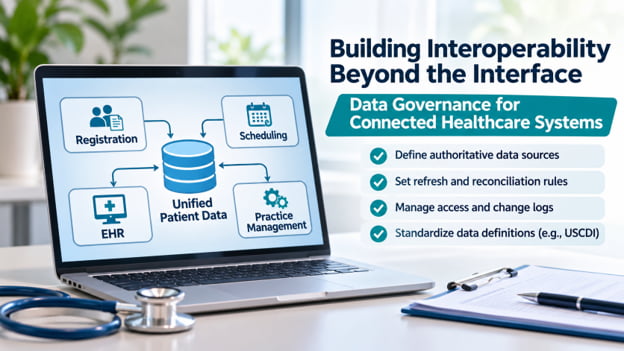
Take a simple field such as primary payer. Registration, the scheduling platform, the EHR, and the practice management system may each store a payer value. If two records disagree, an integration engine must not quietly select the most recent update without considering whether it was verified and whether the information applies to the service date.
Data governance should identify authoritative sources, refresh rules, reconciliation steps, access permissions, and change logs. Teams should decide how missing values are represented and how corrections propagate to connected systems. A blank field, an unverified field, and a confirmed negative finding are not interchangeable.
For system testing, use realistic scenarios rather than only ideal records: two active insurance policies, a plan switch between booking and treatment, authorization approved for fewer units than billed, or a correction entered after the initial claim has left the organization.
A practical ninety-day improvement plan
In the first thirty days, select two or three high-volume denial categories and trace representative cases from scheduling to final payer response. Record each application touched, every manual re-entry, and the point where the first unreliable value entered the workflow. Focus on a limited number of root causes rather than attempting to redesign the entire revenue cycle.
During the next thirty days, clarify field ownership and implement targeted controls. These might include eligibility rechecks closer to the service date, required authorization-to-service matching, structured documentation clarification, or automated exception routing with an assigned owner. Test the changes against both ordinary and unusual cases.In the final thirty days, compare the same measures used at baseline. Did preventable correction volume fall? Are staff spending less time searching multiple systems? Are authorization-related denials declining, or merely shifting into a different queue? Review the findings with registration, clinical, coding, billing, and IT representatives together.A small, verified improvement is more valuable than a sweeping automation project whose success is judged only by the number of transactions processed.
Conclusion: Fix the information journey
Healthcare claim denials will not disappear simply because organizations automate claim edits. Automation can detect missing fields and accelerate transmission, but it cannot by itself repair outdated coverage information, disconnected authorization decisions, or uncertainty about who owns an exception.
The more durable approach is to treat the revenue cycle as a connected information process. Accurate data must be collected at the right time, carried consistently between systems, checked against the relevant payer requirements, and reviewed whenever an exception occurs. When IT and revenue cycle teams examine the entire journey, they can reduce repeat work without treating every denied claim as an isolated billing mistake.
Did you find this helpful? Check out our other helpful articles on our website.
Read Also
- Why Healthcare Claim Denials Persist Despite Automated Billing Systems
 A healthcare claim can pass an automated check and still return unpaid. The electronic record may contain the correct diagnosis, the billing platform may confirm that required fields are populated, and the clearinghouse may accept the transaction. Days later, however, the payer denies the claim because the patient’s coverage changed, an authorization does not apply… Read more: Why Healthcare Claim Denials Persist Despite Automated Billing Systems
- Managing Physician Practice Finances When Billing Demands Keep GrowingPhysician practices rarely struggle because they lack patients. More often, financial pressure builds as appointment volume increases, staffing costs rise, payer rules become harder to follow, and unpaid claims take longer to resolve. A practice can appear busy while still experiencing inconsistent cash flow. The challenge is especially visible during seasonal surges, such as flu… Read more: Managing Physician Practice Finances When Billing Demands Keep Growing
- How Continuing Medical Education Advances Your CareerMedicine moves fast, and new clinical tools appear every month. Patient care rules change fast too. Doctors need fresh knowledge to give their patients the best care. Continuing medical education gives doctors a clear path to sharpen their skills. It helps them build confidence, fix gaps in their knowledge, and guide their careers. Steady learning… Read more: How Continuing Medical Education Advances Your Career
- 6 Best AI Drug Discovery Platforms for Biotech TeamsKey Takeaways A biotech team shortlisting AI drug discovery platforms is usually comparing products that are not the same kind. One vendor sells access to a model. Another runs a design campaign on your target and returns candidates. A third will only work on a shared-risk basis, taking a position in whatever comes out. All… Read more: 6 Best AI Drug Discovery Platforms for Biotech Teams
- What Today’s Patients Expect From Healthcare BrandsHealthcare is no longer experienced only through appointments, prescriptions, or hospital visits. Patients now interact with healthcare brands through websites, mobile applications, educational articles, product instructions, customer support teams, social media, and online reviews. Every one of these interactions influences how people judge a company. This shift has raised expectations. Patients want accurate information, convenient… Read more: What Today’s Patients Expect From Healthcare Brands
- Top Trends Shaping the Future of Mental Health CareMental health care is moving fast to meet daily human needs. People want direct care that fits modern life. Clinics respond by creating flexible options that make healing easier to reach. Providers look past rigid habits to give people solid care. From smart tools to body wellness, these changes help people find relief when life… Read more: Top Trends Shaping the Future of Mental Health Care
- Can Outsourced Telepsychiatry Help Healthcare Organizations Keep Pace With Modern Mental Health Screening?Mental healthcare is changing quickly, but many hospitals, clinics, schools, correctional facilities, and community health organizations do not have enough psychiatric professionals available to turn new screening approaches into timely clinical care. Outsourced telepsychiatry offers one way to close that gap. FasPsych, for example, connects healthcare organizations with psychiatrists, psychiatric nurse practitioners, and other behavioral… Read more: Can Outsourced Telepsychiatry Help Healthcare Organizations Keep Pace With Modern Mental Health Screening?
- Five operational checks for choking readiness in healthcare facilitiesA facility can have a choking poster on every wall and still be unprepared. Preparedness shows up when someone can recognize the emergency, call the right response, bring the right people and supplies to the room, and hand over clear information without losing time. That test belongs in operations as well as clinical education. The… Read more: Five operational checks for choking readiness in healthcare facilities