


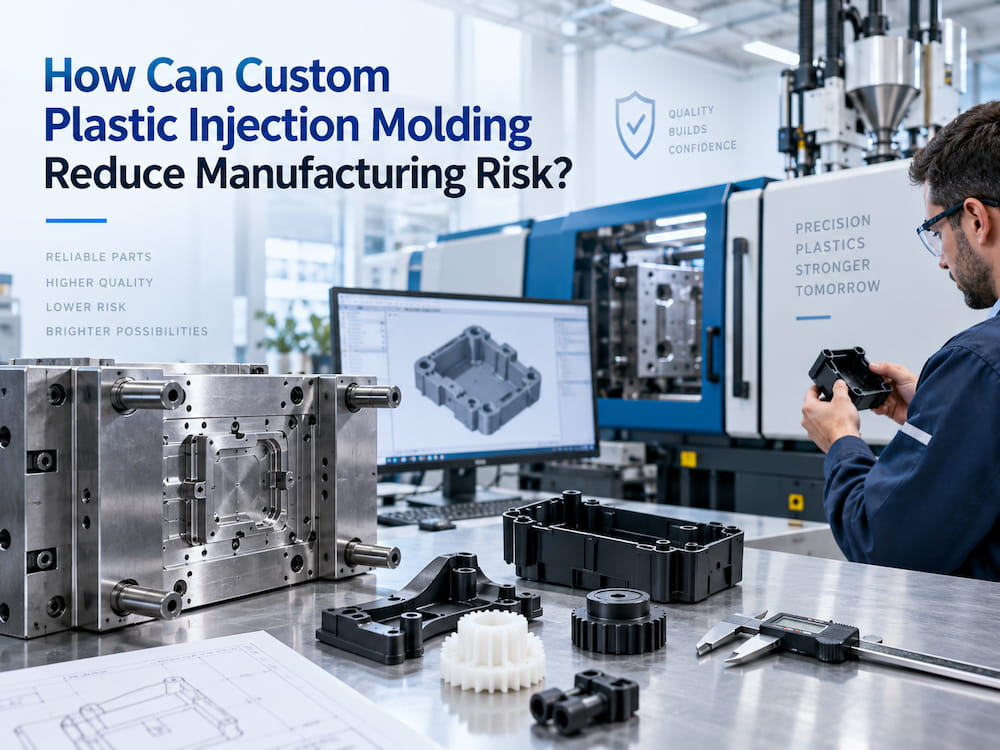
A plastic component may cost only a few dollars to manufacture, yet its failure can compromise a product worth thousands. That is why custom plastic injection molding services should be viewed as more than a production method—they are part of a broader strategy for controlling design, material, quality, and manufacturing risk. Plastic Molded Concepts (PMC) is a useful example of this approach. The company has 50 years of injection molding experience and maintains an ISO 9001:2015-certified quality management system, while providing high-precision injection molding, overmolding, and insert molding for demanding industries including aerospace, medical, and electronics. PMC also supports customers with mold design, prototype development, forensic failure analysis, secondary operations, and engineered-material selection, including applications involving eva resin.
These capabilities allow manufacturers to address potential problems before they become expensive production failures and help deliver durable, accurate, and consistent plastic components.
The distinction matters. Manufacturers rarely struggle because they simply cannot find a company capable of melting plastic and injecting it into a mold. Problems usually appear when an apparently minor decision made early in development creates consequences months later.
A wall is slightly too thick and begins to sink. A resin performs well during initial testing but becomes brittle after chemical exposure. A metal insert moves under injection pressure. A molded housing looks correct but warps enough during cooling to interfere with final assembly.
Custom injection molding works best when these risks are considered together rather than handled one at a time.
Injection Molding Is Really a Chain of Decisions
A finished molded component is the outcome of dozens of connected decisions.
The product designer determines geometry. Engineers establish performance requirements. Material specialists select a polymer. Toolmakers determine how the mold will fill and cool. Process technicians control temperature, pressure, speed, and cycle time. Quality teams decide how parts will be measured. Secondary operations may then machine, weld, decorate, or assemble the component.
A mistake at the beginning can travel through every stage that follows.
Imagine an electronic enclosure designed with several thick mounting bosses. The CAD model looks fine, but during molding those areas cool more slowly than the surrounding walls. The difference causes shrinkage and distortion. Engineers can compensate later with processing adjustments, but there may be limits to what the molding machine can correct.
Changing the design before the mold is built would usually be easier.
That is why experienced custom injection molding companies become involved before production rather than simply receiving finished tooling and a purchase order.
Mold Design Can Prevent Problems Before They Exist
Tooling is one of the largest investments in an injection molding program, so errors discovered after mold construction can be costly.
Mold design affects far more than the external shape of the component. Engineers need to consider how molten plastic enters the cavity, where air escapes, how heat is removed, how the component shrinks, and how the finished part leaves the tool.
Gate location is a good example.
Placing a gate in an inconvenient position may create a visible mark, but appearance is only one concern. Material flowing from different directions can meet and form weld lines. Flow orientation may influence strength. Poor gate placement may also contribute to internal stress.
PMC specifically highlights mold design assistance as a way to improve manufacturability and identify potential problems before they reach production. The company notes that early collaboration can prevent costly redirection once tooling is already underway.
For buyers, this changes an important question. Instead of asking only, “How much will the mold cost?” it is worth asking, “How much risk has been engineered out of the mold?”
Material Selection Is About the Operating Environment
Many plastic products fail because material selection focuses too heavily on one property.
A designer may choose a resin for strength while overlooking chemical resistance. Another may prioritize heat resistance without adequately considering impact performance. In electronics, dimensional stability and electrical characteristics may be just as important as mechanical strength.
The real environment of use should drive the decision.
Will the component encounter disinfectants? Oil? Steam? Sunlight? Repeated flexing? Freezing temperatures? Electrical current? Vibration? Long-term mechanical load?
Those questions become especially important when working with engineering-grade polymers.
EVA, for example, offers a different performance profile from rigid engineering plastics. Depending on formulation, ethylene-vinyl acetate can provide flexibility, low-temperature toughness, water resistance, and stress-crack resistance. Other applications may instead require materials such as polycarbonate, acetal, nylon, PEEK, PPS, or reinforced polymer formulations.
PMC specializes in engineered resins and works with customers to match material characteristics to the conditions the finished component will encounter.
Choosing the right resin is therefore less about finding the “best plastic” and more about finding the material whose strengths and limitations match the application.
Prototyping Is Cheap Compared With Discovering a Problem in Production
One of the most useful ways to reduce risk is to create and test something before committing to full production tooling.
A prototype can reveal problems that are difficult to recognize on a computer screen.
A handle may be uncomfortable. A clip may require too much force. An enclosure may interfere with another component. A medical device housing may have a feature that is difficult to clean. Two parts that appear compatible in CAD may become difficult to assemble once manufacturing tolerances are introduced.
Different prototype methods answer different questions.
A 3D-printed model may help evaluate shape, fit, and ergonomics. CNC machining can produce more accurate functional samples from certain materials. Developmental or prototype injection tooling can provide information closer to the eventual molding process.
The point is not to make a prototype simply because the development checklist says one is required. The prototype should answer specific questions before more money is committed.
For complex or mission-critical products, an additional development cycle is often much less expensive than revising hardened production tooling.
High-Precision Molding Depends on Process Stability
There is a tendency to associate high-precision injection molding with sophisticated machinery alone.
The equipment matters, but consistency matters more.
Plastic dimensions can be affected by melt temperature, mold temperature, material moisture, injection speed, packing pressure, cooling time, and even how reinforcing fibers become oriented as material flows into the mold.
A process that produces one perfect component is not necessarily a good process.
A good process produces acceptable components repeatedly even when normal manufacturing variation occurs.
That is where formal quality systems become relevant. PMC’s current certificate confirms that its quality management system is certified to ISO 9001:2015 and covers injection molding plus value-added activities including overmolding, insert molding, CNC machining, in-mold decoration, packaging, and plastic welding.
ISO itself describes ISO 9001 quality management systems as a framework for establishing, controlling, evaluating, and continually improving the processes an organization uses to meet requirements. ISO published a new 2026 edition in September 2026; manufacturers should therefore confirm which edition appears on a supplier’s current certification and understand any applicable transition arrangements.
For customers, the practical issue is traceability and control: Can the manufacturer determine which material lot was used? Are process changes documented? What happens when a measurement falls outside specification? Can the cause be investigated?
Those questions matter more than simply seeing a quality logo on a website.
Overmolding Can Eliminate Entire Assembly Steps
Sometimes the most effective way to reduce manufacturing risk is to eliminate operations.
Overmolding allows one material to be molded over another substrate or molded component. A rigid plastic body, for example, may receive a softer thermoplastic elastomer layer to create a grip, seal, cushion, or protective surface.
Without overmolding, the manufacturer might have to produce the two pieces separately and connect them using adhesive, fasteners, or manual assembly.
Every additional assembly operation introduces another opportunity for variation.
Overmolding can therefore provide both functional and manufacturing advantages. The challenge is ensuring that the materials are compatible, that bonding is sufficient, and that the first component can tolerate the processing conditions required for the second.
PMC’s overmolding work includes medical, aerospace, electronics, defense, PCB, RFID, and other applications involving combinations of polymers and inserted substrates.
Insert Molding Turns Separate Components Into One Part
Insert molding approaches the same problem from another direction.
Instead of assembling a threaded bushing, terminal, bearing, or metal contact after molding, the insert is positioned inside the tool and plastic is molded around it.
The finished component leaves the mold with the hardware already integrated.
This is especially useful in electrical and electronic products, medical equipment, aerospace assemblies, and industrial components where metal features need to be held securely within a plastic structure.
PMC describes insert molding as a way to reduce assembly steps while improving mechanical strength, with applications including bushings, terminals, and threaded inserts.
As with overmolding, however, integration must be engineered carefully. The insert must remain in position while molten plastic flows around it, and differences in thermal expansion or mechanical loading need to be considered.
Medical Components Raise the Stakes
The risks associated with injection molding become particularly visible in healthcare manufacturing.
A molded medical component may need to satisfy dimensional requirements while also tolerating cleaning chemicals, sterilization, repeated handling, or other application-specific conditions.
The manufacturer of the finished medical device also operates within a regulated quality environment. The FDA’s Quality Management System Regulation became effective on February 2, 2026 and incorporates ISO 13485:2016 by reference into the device current good manufacturing practice framework. The regulation applies to finished device manufacturers, so the exact obligations of an injection molding supplier depend on its role in the supply chain.
This makes communication between the device company and its molding partner especially important.
Material specifications, traceability requirements, validation expectations, drawings, approved changes, inspection methods, and documentation responsibilities should be clear before production begins.
Secondary Operations Are Part of the Quality Equation
A molded component may leave the press in perfect condition and still become defective during the next operation.
Drilling can crack a poorly supported feature. Welding can distort thin walls. Printing can fail to adhere properly. An incorrectly installed insert can damage an otherwise acceptable component.
For this reason, secondary operations should not be treated as an afterthought.
PMC’s current capabilities include CNC machining, plastic welding, in-mold decorating, hot stamping, packaging, and other value-added processes in addition to injection molding.
Keeping more operations under one manufacturing system can simplify communication and reduce the number of times a part changes hands.
There is also a traceability advantage. When molding and secondary processing are connected, investigating a defect can be easier than when several unrelated suppliers are involved.
Forensic Failure Analysis Is Valuable When the Problem Is Already Here
Not every customer approaches an injection molding company with a new design.
Sometimes the conversation begins with a box of cracked parts.
The component may have performed successfully for years before failures appeared. Perhaps the resin changed. Maybe a mold repair altered flow behavior. A new processing window may have introduced excess stress. The product might now be exposed to a chemical that was not considered during original development.
Guessing at the solution can become expensive.
Forensic failure analysis attempts to reconstruct what happened by studying the component, resin, tooling, process history, dimensions, and operating environment.
PMC positions troubleshooting and failure analysis as a significant part of its work, including projects involving molding problems that other suppliers have been unable to resolve.
The important lesson is that a cracked part is evidence, not necessarily the root cause.
Changing the material may hide a processing problem. Changing processing conditions may temporarily compensate for poor mold design. Effective troubleshooting separates the symptom from the source.
Manufacturing Safety Should Be Part of Supplier Evaluation
Precision and quality are not the only factors that matter in an injection molding facility.
Injection molding machinery combines high clamp forces, hot polymers, moving mechanical systems, electrical equipment, and automated components.
The Occupational Safety and Health Administration’s injection molding machine safety guidance addresses safeguards such as machine guarding, interlocks, employee training, and lockout/tagout during servicing.
Customers evaluating a manufacturing partner may therefore want to consider plant organization, maintenance practices, employee training, guarding, automation controls, and general manufacturing discipline alongside price and technical capability.
A well-controlled production environment tends to support both people and processes.
The Cheapest Molded Part Can Become the Most Expensive
Unit price is easy to compare because it appears clearly on a quotation.
The cost of poor manufacturing decisions is harder to see.
Suppose Supplier A quotes a component at $1.12 while Supplier B quotes $1.19. The seven-cent difference seems significant across hundreds of thousands of parts.
But what happens if the cheaper component creates more assembly rejects? What if dimensional drift causes intermittent field failures? What if tooling requires frequent repairs or the supplier cannot troubleshoot problems quickly?
Total cost includes far more than resin and machine time.
Tool modifications, scrap, inspection, sorting, assembly delays, line downtime, freight, product returns, engineering time, warranty claims, and reputation can dwarf the original piece-price difference.
A better sourcing decision asks which molding partner provides the most reliable path from design to repeatable production.
Choosing a Custom Injection Molding Partner From a Risk Perspective
Manufacturers can learn a great deal by changing the questions they ask prospective suppliers.
Rather than beginning with “How low can you quote this part?” begin with the design itself.
Ask what the supplier would change before building the mold. Ask which tolerance is most difficult to maintain. Ask what could go wrong with the selected resin. Ask how the design will behave after cooling. Ask how the company will determine why a part failed if a problem appears after launch.
A technically strong supplier should be able to discuss potential problems without pretending that manufacturing carries no risk.
It should also be comfortable saying when a design needs improvement.
That kind of conversation may be less reassuring than a simple promise that everything is easy, but it is usually much more useful.
Conclusion
Custom plastic injection molding services deliver the greatest value when they reduce uncertainty before large-scale production begins.
Mold design prevents manufacturability problems. Careful resin selection helps the component survive its intended environment. Prototypes expose weaknesses while changes remain affordable. High-precision process control makes repeatable production possible. Overmolding and insert molding can eliminate separate assembly operations, while secondary manufacturing capabilities reduce handoffs.
And when something does go wrong, forensic failure analysis provides a structured way to determine why.
For industries such as aerospace, electronics, and medical technology, these capabilities are particularly important because a small molded component may influence the reliability of a much larger and more valuable system.
The best custom injection molding relationship therefore is not simply between a buyer and a parts supplier. It is a collaboration between product designers, materials specialists, mold engineers, process technicians, and quality professionals working toward the same outcome: a plastic component that continues to perform long after it leaves the molding machine.
