

The radiologist shortage has stopped being a forecast and become an operating condition. Imaging volumes keep rising while the supply of radiologists and technologists does not, and in 2026 the gap is being managed, not solved. The two tools doing the managing are remote reading and artificial intelligence, and new workforce data shows how far both have moved from experiment to standard practice. For imaging center owners and hospital managers, the question is no longer whether to use them. It is whether their staffing and workflow model is built for the market as it now is.
Remote reading is now the norm, not the exception
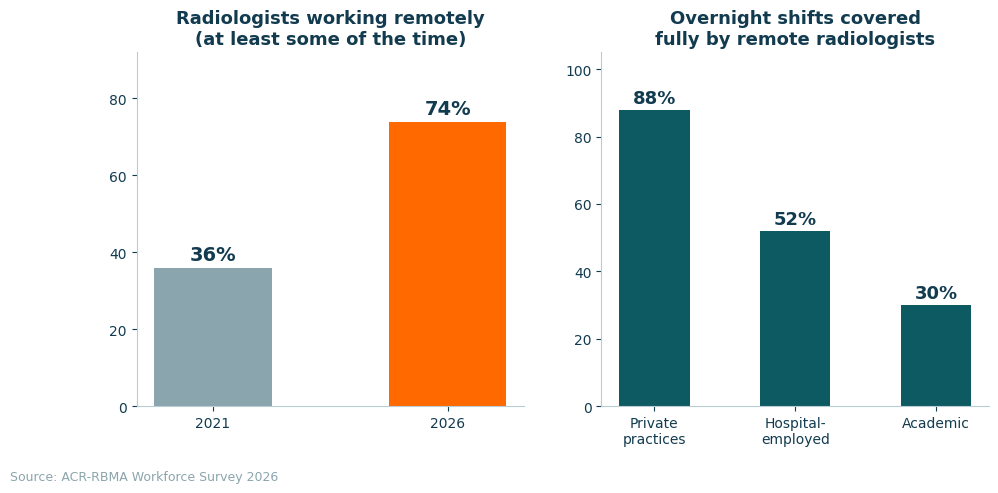
The clearest picture of the shift comes from the 2026 ACR-RBMA Workforce Survey. In 2021, 36 percent of radiologists worked remotely at least some of the time. By 2026, that share had more than doubled to 74 percent. Overnight coverage shows the sharpest change: 88 percent of private practices and 52 percent of hospital-employed groups now cover overnight shifts entirely with offsite radiologists. Academic practices, at 30 percent, are the holdouts.
The survey carries a second message for recruiters. Hospital-employed radiologists now outnumber independent private-practice radiologists, academic radiologists are the most likely to be looking for a new job within a year, and early-career radiologists are significantly less interested in ownership tracks than their mid- and late-career colleagues. Recruitment pitches built on partnership alone are aimed at a shrinking audience.
AI adoption is broad, but narrower than the headlines
The same survey reports that 89 percent of radiology practices now use AI in some form. The detail matters: most of that is non-interpretive AI, and the single most common use is auto-impression software that drafts the conclusion of the report, now used by roughly half of radiologists. AI that reads images and replaces judgment remains the exception. The technology is absorbing administrative work first, which is precisely where a short-staffed practice feels the most relief.
The Becker’s analysis adds a caution that operators recognize once the sales pitch ends: implementing AI is not a software purchase. It requires workflow redesign, governance structures, interoperability planning, physician adoption strategies and ongoing performance monitoring, and many organizations still cannot point to measurable returns. For a small imaging center, the practical reading is to buy AI where the payback is mechanical, in report turnaround and worklist triage, and to be skeptical of anything whose value depends on replacing a radiologist the market does not have anyway.
Why the pressure keeps building
As Becker’s analysis of radiology in 2026 frames it, the specialty faces a double squeeze. Demand keeps growing, driven by aging populations, wider screening programs and heavier use of advanced imaging, while Medicare payment reductions and commercial negotiations compress reimbursement, and labor, equipment, cybersecurity and IT costs rise faster than inflation. Smaller independent practices are the most exposed: recruitment is hardest for them, premium teleradiology coverage eats margin, and the AI investment case is hardest to prove at small scale. Many health systems now depend on teleradiology partnerships and premium labor rates simply to maintain coverage, which turns a staffing problem into a permanent cost line. The predictable result is consolidation, with health systems centralizing imaging operations and independent groups exploring mergers, partnerships and enterprise-scale operating models to stay competitive. The organizations most likely to succeed, the analysis concludes, will not be those that adopt the most technology, but those that align operations, staffing, workflow and financial management around the same plan.
What this means for imaging centers in our region
The Gulf’s version of this story is being written now. Saudi Arabia’s privatization program explicitly includes diagnostics among its nine priority service areas, and analysis of the Kingdom’s healthcare opening notes that standardized single-specialty formats, imaging included, are the models that travel best across borders. Regional centers face the same physics as US ones: scanner demand grows faster than radiologist supply, and remote reading plus AI workflow tools are how the gap gets bridged. Centers that build teleradiology relationships and reporting efficiency into their model early will carry a structural advantage, a theme we also covered in our look at single-specialty hospitals and profits beyond margins. And because faster reading only pays when billing keeps up, the operational discipline described in our guide to revenue cycle management for hospitals applies to imaging throughput just as directly.
The recruitment market has flipped
The survey also documents a quiet reversal in who holds leverage. Hospital-employed radiologists now outnumber independent private-practice owners, and academic radiologists report being far more likely to seek a new job in the next year than their peers in other settings, a warning for teaching hospitals that assumed prestige was retention enough. Meanwhile, radiologists in the first third of their careers are significantly less interested in practice ownership than mid- and late-career doctors, so the classic partnership-track pitch reaches a shrinking audience. Employers still leading with ownership offers are recruiting for a market that existed ten years ago; flexibility, remote-friendly rotations and sustainable workloads are what the 2026 candidate actually prices.
What operators should do with this data
- Treat remote coverage as a design choice, not an emergency fix. Contract overnight and subspecialty coverage before the vacancy, not after it.
- Recruit to the new reality: flexibility and sustainable workloads now outrank ownership tracks for many candidates.
- Start AI where ROI is provable, in reporting workflow and triage, and measure turnaround time before and after.
- Watch retention in academic and employed segments; that is where movement is most likely, and where experienced hires will come from.
Conclusion
The radiologist shortage is a structural condition, and the market has already chosen its coping mechanisms: three quarters of radiologists now work remotely at least part of the time, overnight remote coverage is standard in private practice, and AI is handling a growing share of reporting work. Imaging centers and hospitals that plan staffing, technology and reimbursement around those facts will protect both access and margin. Those waiting for the workforce to grow back to 2019 levels are planning around a market that no longer exists.
Sources
- American College of Radiology: Workforce Watch, ACR-RBMA Workforce Survey 2026
- Becker’s Hospital Review: Radiology in 2026, the workforce crisis meets the AI revolution
- Middle East Health (L.E.K. Consulting): Why international specialist providers are entering Saudi Arabia
Read Also
- Radiologist Shortage in 2026: How Imaging Centers Are Coping with Remote Reading and AI
 The radiologist shortage has stopped being a forecast and become an operating condition. Imaging volumes keep rising while the supply of radiologists and technologists does not, and in 2026 the gap is being managed, not solved. The two tools doing the managing are remote reading and artificial intelligence, and new workforce data shows how far… Read more: Radiologist Shortage in 2026: How Imaging Centers Are Coping with Remote Reading and AI
- How Hospitals and Clinics Are Using AI to Fight Insurance Claim DenialsInsurance claim denials used to be a problem for the billing office. It is now a contest between two sets of software. Insurers use automated tools to check, downcode, audit and deny claims at scale, and hospitals and clinics are answering with tools of their own. A November 2026 roundtable published by HFMA, the US… Read more: How Hospitals and Clinics Are Using AI to Fight Insurance Claim Denials
- Why Patients Miss Appointments and What Clinics Can Do About ItAn empty appointment slot looks small on a schedule. Over a year, it adds up. The staff are paid, the room is ready and the equipment is switched on, but the patient never arrives. Another patient who needed that time may have waited weeks for it. Missed appointments, usually called no-shows, are one of the… Read more: Why Patients Miss Appointments and What Clinics Can Do About It
- Why Healthcare Claim Denials Persist Despite Automated Billing SystemsA healthcare claim can pass an automated check and still return unpaid. The electronic record may contain the correct diagnosis, the billing platform may confirm that required fields are populated, and the clearinghouse may accept the transaction. Days later, however, the payer denies the claim because the patient’s coverage changed, an authorization does not apply… Read more: Why Healthcare Claim Denials Persist Despite Automated Billing Systems
- Managing Physician Practice Finances When Billing Demands Keep GrowingPhysician practices rarely struggle because they lack patients. More often, financial pressure builds as appointment volume increases, staffing costs rise, payer rules become harder to follow, and unpaid claims take longer to resolve. A practice can appear busy while still experiencing inconsistent cash flow. The challenge is especially visible during seasonal surges, such as flu… Read more: Managing Physician Practice Finances When Billing Demands Keep Growing
- How Continuing Medical Education Advances Your CareerMedicine moves fast, and new clinical tools appear every month. Patient care rules change fast too. Doctors need fresh knowledge to give their patients the best care. Continuing medical education gives doctors a clear path to sharpen their skills. It helps them build confidence, fix gaps in their knowledge, and guide their careers. Steady learning… Read more: How Continuing Medical Education Advances Your Career
- 6 Best AI Drug Discovery Platforms for Biotech TeamsKey Takeaways A biotech team shortlisting AI drug discovery platforms is usually comparing products that are not the same kind. One vendor sells access to a model. Another runs a design campaign on your target and returns candidates. A third will only work on a shared-risk basis, taking a position in whatever comes out. All… Read more: 6 Best AI Drug Discovery Platforms for Biotech Teams
- What Today’s Patients Expect From Healthcare BrandsHealthcare is no longer experienced only through appointments, prescriptions, or hospital visits. Patients now interact with healthcare brands through websites, mobile applications, educational articles, product instructions, customer support teams, social media, and online reviews. Every one of these interactions influences how people judge a company. This shift has raised expectations. Patients want accurate information, convenient… Read more: What Today’s Patients Expect From Healthcare Brands