


Clinic staffing has stopped getting worse, and that is exactly why 2027 is dangerous. Turnover has plateaued at levels that still bleed money, administrative vacancies sit open for months, and the relative calm gives practice owners a window to fix retention before the labor market tightens again. The data through 2026 tells one consistent story: the problem is no longer the quit rate alone. It is the cost of every replacement, the vacancies nobody can fill, and the workload that quietly lands on the people who stay.
Turnover has stabilized, at a high level
The clearest read comes from the Medical Group Management Association. MGMA’s May 2026 Stat poll of 303 practice leaders found 69 percent reporting turnover about the same as last year or lower, 39 percent the same and 30 percent lower, against 29 percent reporting higher turnover. That is nearly identical to the May 2025 result, which is the point: the post-pandemic labor shock has cooled, but nothing has been solved. Churn remains concentrated in the roles that keep clinic flow, access and cash moving: medical assistants, front-desk and patient-access staff, nursing and clinical support, and revenue cycle.
MGMA’s follow-up responses spell out what breaks when each role turns over. Medical assistant turnover shows up in rooming time and visit capacity. Front-desk churn drives call abandonment, scheduling errors and referral delays. Revenue cycle departures age claims, denial follow-up and patient balance work. Losing a specialty technologist, a mammography tech or a cardiac sonographer, can cap appointment availability outright until coverage returns. This is the operational reality behind the administrative burden we covered in our guide to electronic prior authorization readiness: the work lands on exactly these roles.
The real number: what a departure costs
Most practices cannot say what a resignation costs them, which is how retention loses budget fights it should win. Rachel Brace, co-founder of BackPocket Talent and a former practice administrator, puts a figure on it in an interview with Medical Economics: replacing a medical-industry employee earning under $75,000 costs 16 to 20 percent of salary, counting recruiting fees, job ads and covering the open shifts. Her arithmetic is blunt. When turnover costs 18 percent and a retention bonus paid at six and twelve months costs $2,000, the bonus is the better use of the money. “We never really looked at how much it costs when somebody walks out the door,” she said of her own practice, “because you’re usually scrambling and you’re not thinking straight.”
Turnover is also the wrong lone metric. A practice can report lower turnover while running frozen positions, reduced hours and a burned-out remnant. MGMA advises watching three measures together: turnover rate, vacancy rate, and workload pressure, the last tracked through overtime, callouts, third-next-available appointment, call abandonment, message queue age, denial follow-up age and days in accounts receivable. If turnover improves but those numbers do not, the workforce is not stable. It is just quieter.
Vacancies are the stuck part
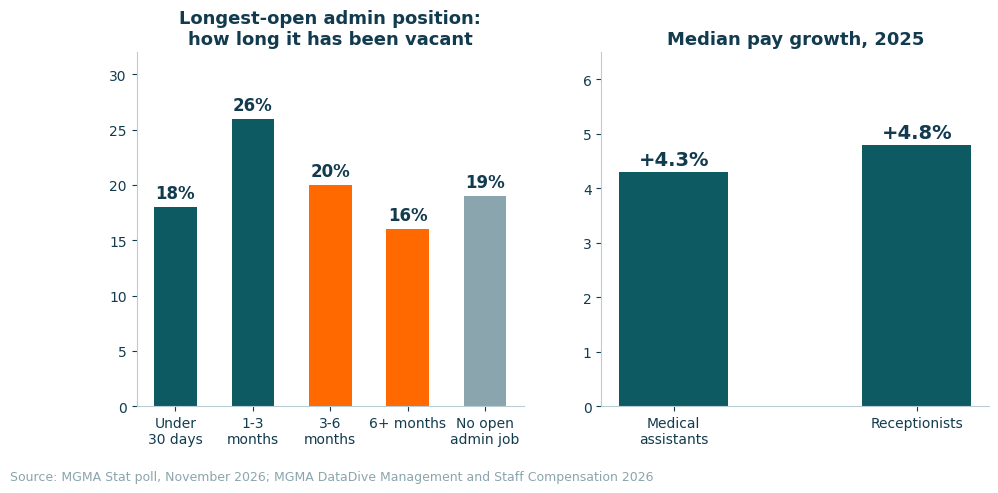
The second half of the problem is hiring. MGMA’s November 2026 Stat poll found about four in five medical groups carrying an open administrative position, and 16 percent said their longest-open role had been vacant six months or longer. Front-office jobs, receptionists, patient access and schedulers, and leadership positions each made up about two in five roles named, with leadership vacancies dominating the six-month-plus group. More than half of the comments blamed the applicant pool, too few candidates or missing qualifications, while about one in four cited pay and one in seven location. In May, 56 percent of leaders said medical assistant hiring had gotten harder. Median medical assistant pay rose 4.3 percent in 2025 and receptionist pay 4.8 percent, yet 64 percent of practices budgeted only a 1 to 3 percent base increase for 2026, which MGMA’s own leadership warns may not retain top performers. The macro backdrop offers no rescue: the Bureau of Labor Statistics reported healthcare added about 17,000 jobs in September 2026, half the 33,000 monthly average of the preceding year, with ambulatory services adding about 13,000.
What the practices that improved did differently
The practices reporting lower turnover in MGMA’s polling describe the same playbook, and it is managerial, not magical:
- Structured onboarding with 30-, 60- and 90-day milestones, so new hires know what competency looks like at each stage instead of learning it by failing.
- Stay interviews and early-tenure check-ins, short structured conversations that surface fixable friction before it becomes a resignation.
- Manager development with protected calendar time, because the manager relationship is consistently among the strongest drivers of whether healthcare staff stay.
- Peer mentoring and visible internal mobility, a path from front desk to scheduling, referrals or revenue cycle, so advancement does not require leaving.
- Scheduling predictability for on-site roles and targeted remote or hybrid flexibility for revenue cycle staff, where work-from-home has become an expectation.
- Skills-based pay used surgically: a differential paid only for the hours a skill is actually deployed, and career ladders with overlapping pay ranges so the best medical assistant is not stuck at the same title and pay for years.
What this means for clinics in our region
Gulf operators compete for the same internationally mobile workforce while regional capacity expands. As international specialist providers enter Saudi Arabia and groups across the GCC add facilities, staffing becomes the binding constraint on growth, not capital. The replacement-cost math travels: whether the salary is denominated in dollars or riyals, losing a trained nurse coordinator or billing lead costs a fifth of a year’s pay and months of slowed operations. The retention playbook travels too, and so does the diagnostic discipline. Owners who track vacancy and workload next to turnover, as imaging centers have been forced to do with remote reading, will see the cracks before they show up in the resignation letters.
Conclusion
Clinic staffing in 2027 is a retention economics problem wearing an HR costume. Turnover has plateaued but not healed, four in five groups carry an open administrative seat, and every departure of a mid-salary employee costs roughly a fifth of that salary to replace. The practices that use this calmer market to build retention infrastructure, structured onboarding, stay interviews, manager development, internal ladders and surgical pay differentials, will keep their teams when hiring tightens again. Those that mistake a stable quit rate for a solved problem will fund their competitors’ growth instead.
Sources
- MGMA Stat: Stabilized but not solved, staff turnover in medical practices in 2026
- MGMA Stat: 4 in 5 medical groups report open admin jobs
- Medical Economics: How private practice owners can weigh staff raises against the cost of turnover
Read Also
- Clinic Staffing in 2027: What Retention Actually Costs Now
 Clinic staffing has stopped getting worse, and that is exactly why 2027 is dangerous. Turnover has plateaued at levels that still bleed money, administrative vacancies sit open for months, and the relative calm gives practice owners a window to fix retention before the labor market tightens again. The data through 2026 tells one consistent story:… Read more: Clinic Staffing in 2027: What Retention Actually Costs Now
- Radiologist Shortage in 2026: How Imaging Centers Are Coping with Remote Reading and AIThe radiologist shortage has stopped being a forecast and become an operating condition. Imaging volumes keep rising while the supply of radiologists and technologists does not, and in 2026 the gap is being managed, not solved. The two tools doing the managing are remote reading and artificial intelligence, and new workforce data shows how far… Read more: Radiologist Shortage in 2026: How Imaging Centers Are Coping with Remote Reading and AI
- How Hospitals and Clinics Are Using AI to Fight Insurance Claim DenialsInsurance claim denials used to be a problem for the billing office. It is now a contest between two sets of software. Insurers use automated tools to check, downcode, audit and deny claims at scale, and hospitals and clinics are answering with tools of their own. A November 2026 roundtable published by HFMA, the US… Read more: How Hospitals and Clinics Are Using AI to Fight Insurance Claim Denials
- Why Patients Miss Appointments and What Clinics Can Do About ItAn empty appointment slot looks small on a schedule. Over a year, it adds up. The staff are paid, the room is ready and the equipment is switched on, but the patient never arrives. Another patient who needed that time may have waited weeks for it. Missed appointments, usually called no-shows, are one of the… Read more: Why Patients Miss Appointments and What Clinics Can Do About It
- Why Healthcare Claim Denials Persist Despite Automated Billing SystemsA healthcare claim can pass an automated check and still return unpaid. The electronic record may contain the correct diagnosis, the billing platform may confirm that required fields are populated, and the clearinghouse may accept the transaction. Days later, however, the payer denies the claim because the patient’s coverage changed, an authorization does not apply… Read more: Why Healthcare Claim Denials Persist Despite Automated Billing Systems
- Managing Physician Practice Finances When Billing Demands Keep GrowingPhysician practices rarely struggle because they lack patients. More often, financial pressure builds as appointment volume increases, staffing costs rise, payer rules become harder to follow, and unpaid claims take longer to resolve. A practice can appear busy while still experiencing inconsistent cash flow. The challenge is especially visible during seasonal surges, such as flu… Read more: Managing Physician Practice Finances When Billing Demands Keep Growing
- How Continuing Medical Education Advances Your CareerMedicine moves fast, and new clinical tools appear every month. Patient care rules change fast too. Doctors need fresh knowledge to give their patients the best care. Continuing medical education gives doctors a clear path to sharpen their skills. It helps them build confidence, fix gaps in their knowledge, and guide their careers. Steady learning… Read more: How Continuing Medical Education Advances Your Career
- 6 Best AI Drug Discovery Platforms for Biotech TeamsKey Takeaways A biotech team shortlisting AI drug discovery platforms is usually comparing products that are not the same kind. One vendor sells access to a model. Another runs a design campaign on your target and returns candidates. A third will only work on a shared-risk basis, taking a position in whatever comes out. All… Read more: 6 Best AI Drug Discovery Platforms for Biotech Teams