

Hospital-at-home is no longer a pilot waiting for permission. On February 3, 2026, the Consolidated Appropriations Act, 2026 extended Medicare’s Acute Hospital Care at Home waiver through September 30, 2030, the longest run of certainty the program has ever had. The clinical evidence is now strong, and the technology stack is mature. What is not settled is the math, and 2026 has made that clearer than ever: the same year the waiver won five more years, the largest program in the country cut itself in half. For hospital owners and clinic operators, the question has shifted from “is this real?” to “does it pay in my building?”
The waiver is now law through 2030
Section 6210 of the Consolidated Appropriations Act, 2026 (H.R. 7148, Public Law 119-75) extends the Acute Hospital Care at Home waiver through September 30, 2030, replacing a January 30, 2026 expiry that had briefly lapsed during the autumn 2025 government shutdown, when Mayo Clinic moved about 30 home patients back into hospital beds before the deadline. The House passed the package 217 to 214, and it also preserves Medicare’s expanded telehealth reimbursement through 2027. According to Healthcare Dive’s report on the funding bill, Moving Health Home executive director Krista Drobac called the five-year extension “a critical step toward making hospital-at-home a durable part of our health care system,” arguing that long-term certainty is what allows providers to plan, invest and scale.
Participation on paper is broad. CMS program updates tracked by Hospital-at-Home Watch show the agency’s list of approved hospitals was last refreshed on October 19, 2026, and an April 2026 CMS notice counted 433 hospitals that had requested the waiver and 396 approved, 65 of them through an expedited route for experienced operators. CMS is also tightening the data it collects: in August it proposed a yearly Acute Hospital Care at Home Quantity, Intensity, and Mix of Services tool, required by the same law so the agency can report to Congress. Approval is not activity, though. One analysis of 2021 and 2022 data found that only 68 of 313 waivered hospitals had at least 12 admissions, and just 11 of those accounted for about half of all home admissions in the study.
The clinical case is settled; the cost split is not
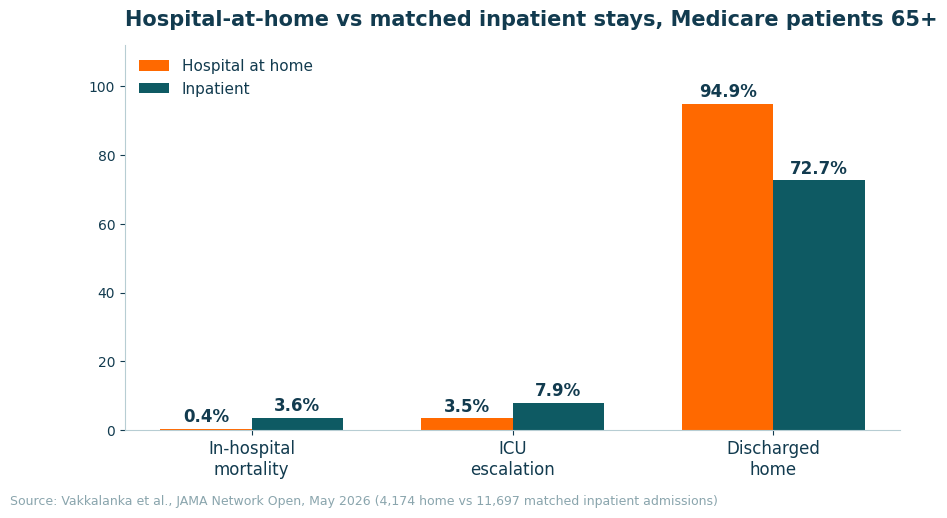
The strongest evidence yet arrived in May 2026, when University of Iowa researchers published a propensity-matched study in JAMA Network Open comparing 4,174 hospital-at-home admissions with 11,697 matched inpatient stays among Medicare patients aged 65 and over. As the Strategic Revenue Insights analysis of the study details, in-hospital mortality was 0.4 percent at home against 3.6 percent in hospital, and ICU escalation ran 3.5 percent against 7.9 percent. Thirty-day readmission was statistically indistinguishable, 11.7 percent versus 11.0 percent, and 94.9 percent of home patients were discharged back to their own homes, against 72.7 percent of inpatients. Length of stay was longer at home, 7.36 days versus 6.24.
The cost numbers explain the tension. The index admission at home cost 10 percent more than the matched inpatient stay, while the 30 days after discharge cost 35 percent less, leaving the total episode at 0.96 against an inpatient baseline of 1.00. The saving shows up downstream: only 2.1 percent of home patients went on to rehabilitation facilities, against 20.2 percent of inpatients. A hospital paid a fixed inpatient rate does not collect that saving. A payer, or a provider carrying post-discharge risk, does. CMS’s own congressionally required study reached a similar position: lower 30-day mortality and positive patient and clinician experience, but not enough evidence that the program lowered Medicare spending overall, and a significant gap in data on what a home day actually costs the hospital.
The rules of the payment
CMS’s April 2026 Federal Register notice restates the deal plainly: there is no payment change under the program, and hospitals may not bill Medicare or beneficiaries for anything beyond a typical inpatient admission. In return, the hospital must deliver real acute care in the home: patients must genuinely need inpatient-level treatment, receive at least daily physician rounding and at least two in-person visits a day from nurses or mobile integrated health paramedics, and can only be admitted from the emergency department or by transfer from an inpatient bed. The hospital collects its normal inpatient payment while covering the cost of daily rounding and twice-daily home visits, which is where small programs start to bleed.
2026’s verdict: scale or exit
The week of October 22 delivered the year’s clearest signal. An internal Mass General Brigham memo, reported by the Boston Globe, confirmed the system is halving what was the country’s largest Home Hospital program, from about 70 patients at a time to no more than 30, after average losses of roughly $30 million a year over three years. Clinical operations paused indefinitely at Salem Hospital, Newton-Wellesley Hospital and Brigham and Women’s Faulkner Hospital, with the remainder focused on Mass General and Brigham, where bed capacity is the real pressure. Cone Health in North Carolina is winding its program down in the fourth quarter, despite reporting no deaths or hospital-acquired infections in its first year, citing reimbursement models, operational complexity and long-term sustainability; it had capped the program at six patients. Health First in Florida ended its program in September as part of 214 job cuts, and Covenant Health in Tennessee discontinued its program in April.
It is not one-way traffic. Saint Francis in Tulsa launched in January alongside its jointly owned health plan and says it will continue even if Medicare reimbursement stops. Baptist Health in Jacksonville launched in February and plans to expand. Cleveland Clinic opened sites in west Cleveland in March and has admitted about 3,000 patients since 2023. The census math explains the split. Mass General Brigham reported more than 4,000 admissions since January 2022 at about five days each, roughly 20,000 patient days over 964 days, or about 21 patients a day against 70 listed beds. A team that must provide daily physician rounding and two in-person visits per patient per day is a fixed cost that does not shrink with census, which is why the survivors tend to be full hospitals, systems with their own health plans, or both.
The technology stack that makes it work
The regulatory floor defines the stack. Daily physician rounding can be virtual: CMS reminded clinicians in October that telehealth for Acute Hospital Care at Home patients uses place of service 21 with modifier 95, because Medicare treats those patients as inpatients. On top of that sit remote patient monitoring devices streaming vitals, a clinical command center, an EHR-integrated dispatch for labs, medications and equipment, and disciplined documentation. The documentation burden is the same one driving clinics toward AI scribes after the pilot phase, and the security burden is heavier than in a ward: a home program multiplies connected endpoints in a sector that is already the most-attacked industry for ransomware.
What the Gulf should take from this
The region’s home care market is growing fast on the non-acute side. IMARC Group projects the GCC home healthcare market to grow from $8.8 billion in 2025 to $19.0 billion by 2034, driven by chronic disease, an aging population, AI-enabled remote monitoring and medical tourism. Acute hospital substitution barely exists here yet, which is an advantage: operators can skip the American pilot phase and build only where the two conditions the US data keeps repeating are met, a genuinely full parent hospital and a payer relationship that shares the downstream saving. As coverage expands under programs like Egypt’s universal health insurance phase II, that payer question will arrive in this market too, and it will reward whoever answered it first.
Conclusion
Hospital-at-home now has something it never had before: legal certainty to 2030, matched-cohort evidence of better outcomes, and a mature technology stack. What it still lacks, in most buildings, is a business case. The 2026 exits share one profile, small census and no payer alignment, and the survivors share the opposite. The facilities that will make this model durable, in the US and in the Gulf, are the ones that treat home beds as a capacity strategy with a contract attached, not as a technology purchase.
Sources
- Hospital-at-Home Watch: Program news, CMS hospital-at-home updates
- Healthcare Dive: Trump signs funding bill with PBM reforms, hospital-at-home and telehealth extensions
- Strategic Revenue Insights: Why are health systems ending hospital-at-home programs
- IMARC Group: GCC Home Healthcare Market Size, Growth and Forecast 2034
Read Also
- Hospital-at-Home in 2027: The Tech Stack and the Reimbursement Math
 Hospital-at-home is no longer a pilot waiting for permission. On February 3, 2026, the Consolidated Appropriations Act, 2026 extended Medicare’s Acute Hospital Care at Home waiver through September 30, 2030, the longest run of certainty the program has ever had. The clinical evidence is now strong, and the technology stack is mature. What is not… Read more: Hospital-at-Home in 2027: The Tech Stack and the Reimbursement Math
- Healthcare Ransomware in 2026: What Small Clinics and Labs Actually NeedHealthcare ransomware is no longer a worst-case scenario that happens to someone else. In the third quarter of 2026, healthcare was the most-attacked industry on the planet for disclosed ransomware incidents, and the organizations getting hit are not only big hospital systems. Clinics, imaging centers, labs and the companies that serve them are exactly the… Read more: Healthcare Ransomware in 2026: What Small Clinics and Labs Actually Need
- AI Scribes in Clinics: What Happens After the Pilot and How to Choose a VendorAn AI scribe listens to a consultation, with the patient’s consent, and writes a draft note for the doctor to review and sign. The pitch for AI scribes is simple: less typing, more eye contact, and notes finished before the end of the day. For a clinic owner, the harder questions come after the demo.… Read more: AI Scribes in Clinics: What Happens After the Pilot and How to Choose a Vendor
- Innovative Technologies in Oncology: The Future of Cancer TreatmentHave you ever wondered how far cancer treatment has come in recent years? Advances in technology are making a real difference in the fight against cancer. Today, more people are living longer and healthier lives after a cancer diagnosis. This is all thanks to new and groundbreaking medical advancements. The future of cancer care looks… Read more: Innovative Technologies in Oncology: The Future of Cancer Treatment
- Cloud-Based Healthcare Administration Solutions: A Guide for Payers, TPAs, and Provider NetworksHealthcare administration has become too complex for disconnected spreadsheets, aging on-premise applications, and manual handoffs between departments. Organizations need technology that can manage claims, enrollment, billing, provider relationships, and member data as connected parts of the same operation. MCSI – Visova is one example, offering a cloud-native vpaas designed to support HIPAA-compliant healthcare administration. Its… Read more: Cloud-Based Healthcare Administration Solutions: A Guide for Payers, TPAs, and Provider Networks
- How Intelligent Invoice Processing Is Reshaping Healthcare AP WorkflowsWhat happens when healthcare invoice volumes outpace the AP team’s ability to review, validate, and route them, while cost per invoice keeps rising? That gap is pushing finance leaders past basic digitization. Supplier invoices across formats, systems, departments, and approval paths, and holding speed, accuracy, compliance, and visibility together gets harder at scale. Intelligent invoice… Read more: How Intelligent Invoice Processing Is Reshaping Healthcare AP Workflows
- From 1905 to 2026: How German Legacy Manufacturers Power Deutsche Dental Technologien’s SuccessFrom 1905 to 2026: How Busch & Co.’s Legacy Powers Deutsche Dental Technologien’s Success In an era where dental technology advances at breakneck speed, few companies embody the perfect blend of historic craftsmanship and modern business agility quite like Busch & Co. and its strategic partner Deutsche Dental Technologien. What began as a small dental bur factory in… Read more: From 1905 to 2026: How German Legacy Manufacturers Power Deutsche Dental Technologien’s Success
- Why the Future of Healthcare Administration is Cloud-NativeThe operational demands placed on modern healthcare administrators have officially outpaced the capabilities of traditional IT infrastructure. While clinical medicine continues to advance at breakneck speed, the back-office systems required to support it often remain painfully stagnant. Today’s insurers, Third-Party Administrators (TPAs), and provider networks are forced to navigate an avalanche of daily claims, aggressive… Read more: Why the Future of Healthcare Administration is Cloud-Native