



Saudi healthcare privatization is no longer a policy direction to watch. It is a pipeline with numbers attached: 290 hospitals and 2,300 primary health centers earmarked for private hands by 2030, a national insurance buyer that pays for quality instead of volume, and 424 expressions of interest from companies in 21 countries. For hospital operators, clinic groups and investors in the region, the question has shifted from whether the Kingdom is serious to where the workable entry points actually are.
The scale of the shift
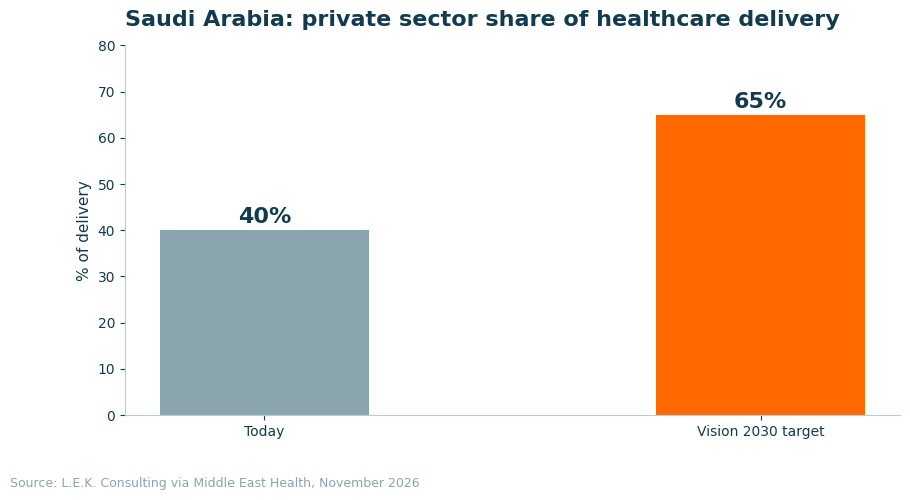
Vision 2030 targets a rise in private-sector participation in healthcare delivery from roughly 40 percent today to 65 percent by the end of the decade, according to an L.E.K. Consulting analysis for Middle East Health. The Ministry of Health is converting from provider to regulator: public facilities have been consolidated into about 20 regional clusters under the Health Holding Company, created when the Cabinet transferred all ministry assets to it in August 2022, and a privatization pipeline spans nine priority service areas, from primary care and diagnostics to long-term care, rehabilitation and home care.
The man running that transformation is Nasser Al Huqbani, who spent 26 years building Dr. Sulaiman Al Habib Medical Group into the Kingdom’s largest private operator and took it public in 2020, an IPO oversubscribed 83 times with nearly $57.9 billion in orders. Forbes Middle East’s profile of Al Huqbani notes that HMG’s market capitalization reached $21.9 billion by September 2026, and that the Health Holding Company he now leads serves more than 20 million registered beneficiaries, with national coverage reaching 97.4 percent of a 33 million population and health-service satisfaction above 85 percent. Average life expectancy hit 80 years in 2025, ahead of the Vision 2030 target, and the Kingdom ranked sixth among 193 countries in the UN E-Government Development Index, powered in part by platforms like Sehhaty and the Seha Virtual Hospital. The system he is converting toward corporate-style, financially autonomous clusters is the largest restructuring of its kind in the Middle East.
The new buyer: insurance, not ministries
The deepest structural change is financial. The Centre for National Health Insurance, operational with 471 staff as of March 2026 and financed by the Ministry of Finance, separates purchasing from provision for the first time: it buys services from public clusters and private providers alike, linking payment to quality and efficiency rather than volume. Mandatory insurance for expatriates and much of the privately employed Saudi workforce has already created a funded private demand pool. For operators, this means the customer is increasingly an insurer with contracts, accreditation requirements and utilization review, not a ministry with a budget line. Facilities that understand payer behavior, including the claims discipline we covered in our article on how providers fight insurance claim denials, will negotiate from strength.
Where the real openings are
The L.E.K. analysis is blunt about what works. The fastest-moving segment is not tertiary hospitals but single-specialty and ambulatory formats: day surgery, dialysis, ophthalmology, outpatient oncology, diagnostics, rehabilitation and home care. These carry lower fixed costs, ramp faster, match payer preferences, and, critically, their standardized models can be replicated across cities. Modern private capacity remains concentrated in Riyadh, Jeddah and the Eastern Province; Tier 2 and Tier 3 cities are the largest unserved catchment, but economics there favor hub-and-spoke networks over standalone full-service sites. It is the same logic we examined in our analysis of single-specialty hospital profitability: focused formats with disciplined unit economics outperform.
Entry route matters just as much. Partnership is the dominant and usually correct path, pairing a local partner’s land, regulatory navigation and payer relationships with the international operator’s clinical model and brand. Acquisition supply is thin and priced accordingly. Building alone is defensible only for asset-light, repeatable formats with enough density to carry a management platform. Two warnings recur: pricing is set by bilateral negotiation with insurers with no minimum floor, so revenue forecasts carry wide error bars, and provider setup plus insurer empanelment commonly consumes well over a year before meaningful revenue begins. Entrants that treat Saudisation and clinical training obligations as part of their offer, rather than a compliance cost, move through approvals materially faster.
What operators should take from this
- Model the downside at entry-tier reimbursement rates, not market averages, and give insurer empanelment a named owner and a funded timeline.
- Decide before committing capital whether the model requires public patient flow. If it does, secure the outsourcing or concession contract first; if it merely benefits, build to private demand and treat public volume as upside.
- Match the format to the catchment: single-specialty and ambulatory for replication, hub-and-spoke for Tier 2 and Tier 3 expansion.
- Plan for a quality-linked payer. The Centre for National Health Insurance is designed to pay for outcomes and efficiency, so clinical governance and data reporting are commercial assets, not overhead.
Who actually pays
The L.E.K. analysis separates three funding pools that behave very differently: government budgets, private insurance and out-of-pocket payment. Most clinical volume still sits in the public system, so for many specialties the growth question is really an outsourcing question. Routes exist, from bilateral hospital-level outsourcing and cluster-led agreements to centralized procurement tenders and concession structures for new capacity, but timelines are hard to predict and there is no published model-contract library. The discipline this demands, the authors argue, is to know before committing capital which pool the revenue actually comes from, because a patient ramp built on the wrong payer mix can be exactly right while the yield is not.
Conclusion
Saudi Arabia is moving clinical activity into private hands as a matter of policy, with the insurance architecture, the holding structure and the privatization pipeline already in place. The opportunity is real and unusually well signposted, but the operators who scale will be the ones who prove the unit economics of a single site against a specific catchment and payer mix before signing the second lease. In the Kingdom’s healthcare market, disciplined formats and payer fluency will beat ambition alone.
Sources
- Middle East Health (L.E.K. Consulting): Why international specialist providers are entering Saudi Arabia, and what will decide who succeeds (November 2026)
- Forbes Middle East: Nasser Al Huqbani took HMG public, now he’s running Saudi Arabia’s entire healthcare system (September 2026)
Read Also
- Saudi Healthcare Privatization: What Vision 2030 Means for Hospital Operators
 Saudi healthcare privatization is no longer a policy direction to watch. It is a pipeline with numbers attached: 290 hospitals and 2,300 primary health centers earmarked for private hands by 2030, a national insurance buyer that pays for quality instead of volume, and 424 expressions of interest from companies in 21 countries. For hospital operators,… Read more: Saudi Healthcare Privatization: What Vision 2030 Means for Hospital Operators
- Hospital Margins Hit New Lows: Where Systems Are Cutting and What Smaller Facilities Can LearnUS hospital margins have slipped to a new low. The median adjusted year-to-date operating margin across more than 1,300 hospitals fell to just 1.1 percent in September 2026, according to Kaufman Hall’s latest National Hospital Flash Report, after holding above 3 percent for much of the summer. A historically large share of hospitals now operate… Read more: Hospital Margins Hit New Lows: Where Systems Are Cutting and What Smaller Facilities Can Learn
- The Growing Patient Demand for Dental Implants: A Market OverviewWalk into a dental practice today and ask the front desk what patients are calling about, and implants will come up fast. A treatment that was once niche, expensive, and a little intimidating has moved firmly into the mainstream of patient requests. The shift didn’t happen by accident, and for practice owners and healthcare investors… Read more: The Growing Patient Demand for Dental Implants: A Market Overview
- The Growing Need to Introduce Yoga Therapy in HospitalsDid you know that yoga means a union between the mind, body, and soul? It is an ancient form of physical healing tracing back 3000 years ago. Yoga improves or balances mental focus and eases body pain. Since the 18th century, its popularity has risen; now, over 36 million Americans perform yoga daily. Today, yogic… Read more: The Growing Need to Introduce Yoga Therapy in Hospitals
- How to Identify the Right Healthcare Franchise for Your Investment StrategyAre you an investor looking to capitalize on the ever-growing healthcare industry? Investing in a medical franchise can be a great way to diversify your portfolio and take advantage of ever-changing trends in the sector. To help you make the right choice, we’ve compiled this guide outlining all the key factors that will inform your… Read more: How to Identify the Right Healthcare Franchise for Your Investment Strategy
- Global Diagnostic Imaging Services Market to Grow by CAGR of ~6% During 2023 – 2033Research Nester published a report titled “Diagnostic Imaging Services Market: Global Demand Analysis & Opportunity Outlook 2033” which delivers a detailed overview of the global diagnostic imaging services marketin terms of market segmentation by product, application, end-user, and by region. Further, for the in-depth analysis, the report encompasses the industry growth indicators, restraints, and supply… Read more: <strong>Global Diagnostic Imaging Services Market to Grow by CAGR of ~6% During 2023 – 2033</strong>
- What You Need to Know About Big PharmaWhen you trip and hurt your knee in real life, you take some pain medication and it starts to feel alright again. The same goes for the bruises you got when you were little – a trip to the pharmacist and you’ve got a nice soothing cream. Sounds lovely, doesn’t it? There’s a darker side… Read more: <strong>What You Need to Know About Big Pharma</strong>
- Best Healthcare Businesses That Don’t Require a DegreeStarting a business in the healthcare industry can be a rewarding and profitable venture,but it’s not always necessary to have a degree to be successful. Here are a fewexamples of healthcare businesses that can be started without a degree: 1- Medical Billing and Coding Medical billing and coding is a necessary aspect of running a… Read more: Best Healthcare Businesses That Don’t Require a Degree