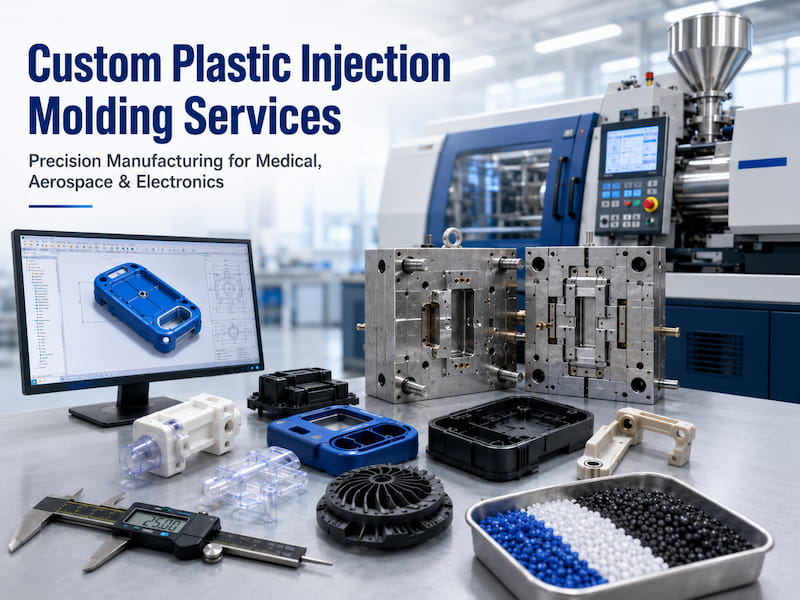
Custom plastic injection molding services give manufacturers a reliable way to transform complex product designs into accurate, durable, and repeatable components. Plastic Molded Concepts (PMC), whose engineered-material resources include detailed information about EVA resin, is one example of an experienced custom molding partner. The ISO 9001:2015-certified company has 50 years of experience providing high-precision injection molding, overmolding, and insert molding for demanding industries such as aerospace, medical, electronics, automation, and defense. PMC also helps clients with mold design, material selection, prototype development, forensic failure analysis, and secondary operations, creating an end-to-end process for producing accurate, durable, and high-quality plastic components.
Plastic injection molding is sometimes viewed as a straightforward production method: melt a plastic material, inject it into a tool, cool it, and remove the finished part. In practice, producing a component that performs reliably is considerably more complicated.
Part geometry, resin properties, wall thickness, gate placement, mold temperature, injection speed, cooling conditions, dimensional tolerances, and the intended operating environment all influence the finished product. A mistake in any of these areas can result in warpage, cracking, weak weld lines, sink marks, incomplete filling, dimensional instability, or premature product failure.
For this reason, the best injection molding companies do much more than operate molding machines. They work as engineering and manufacturing partners from the earliest design stage through production, assembly, testing, and delivery.
What Are Custom Plastic Injection Molding Services?
Custom plastic injection molding is a manufacturing process in which a mold and production method are developed around the specifications of a particular component.
Unlike manufacturers producing generic plastic products, custom injection molders create parts according to a client’s:
- Product design
- Performance requirements
- Dimensional tolerances
- Material specifications
- Surface and appearance standards
- Regulatory obligations
- Production volumes
- Assembly requirements
- Operating environment
- Budget and delivery schedule
The process typically begins with a digital part design or product concept. Engineers evaluate whether the design can be manufactured consistently using injection molding and identify changes that could improve strength, appearance, moldability, cycle time, or cost.
Once the design and material have been approved, a production mold is created. Plastic resin is heated until it can flow, injected under pressure into the mold cavity, cooled until it becomes dimensionally stable, and then ejected.
Although the basic production cycle may take only seconds or minutes, developing a reliable molding process can require extensive engineering, testing, and validation.
Why Manufacturers Choose Injection Molding
Injection molding is especially valuable when an organization needs to manufacture the same component repeatedly while maintaining consistent dimensions and performance.
The process can support small precision components, large structural parts, complex geometries, integrated fastening features, textured surfaces, transparent components, and products made from advanced engineering-grade resins.
Its main advantages include:
High Production Repeatability
Once the mold and process settings have been validated, large quantities of parts can be produced with consistent dimensions and characteristics.
Repeatability is particularly important when components must fit into a larger assembly or meet strict functional requirements.
Complex Part Geometry
Injection molding can produce shapes that would be difficult, slow, or expensive to manufacture using machining or other processes.
Features such as ribs, bosses, channels, clips, threads, hinges, and mounting points may be incorporated directly into the molded component.
Efficient High-Volume Production
The initial tooling investment can be substantial, but the per-part cost generally becomes more attractive as production volume increases.
Automation can further reduce handling time, labor requirements, and variability.
Broad Material Selection
Manufacturers can choose from commodity plastics, elastomers, reinforced polymers, high-temperature materials, medical-grade resins, electrically insulating materials, and other engineered formulations.
Reduced Assembly Requirements
Multiple features can sometimes be combined into a single molded component. Overmolding and insert molding can also integrate different materials or embedded hardware during production.
Low Material Waste
A well-designed molding process uses a controlled amount of material for each cycle. Regrinding or recycling runners and other production scrap may also be possible for suitable materials and applications.
The Custom Injection Molding Process
A successful project generally progresses through several connected stages.
1. Product and Application Review
Before choosing a resin or creating a mold, the injection molding company must understand what the component is expected to do.
Important questions include:
- What loads will the part experience?
- Will it be exposed to heat, cold, moisture, chemicals, or ultraviolet light?
- Does it need to be rigid, flexible, transparent, or electrically insulating?
- Will it contact food, pharmaceuticals, or the human body?
- Is the component intended for indoor or outdoor use?
- What is its expected service life?
- Which dimensions are critical?
- Will it be assembled with other parts?
- How many units will be required each year?
- Which regulatory or industry standards apply?
This information influences nearly every later decision. A resin that works well in a consumer housing may be unsuitable for an aircraft component, electrical connector, diagnostic device, or chemical-processing system.
2. Design for Manufacturability
Design for manufacturability, commonly called DFM, evaluates whether a proposed component can be molded reliably and economically.
A DFM review may address wall thickness, draft angles, undercuts, ribs, bosses, radii, parting lines, ejector placement, gate locations, and expected shrinkage.
Uniform wall thickness is usually preferable because large variations can lead to uneven cooling. Areas that cool at different rates may shrink differently, increasing the risk of warpage, sink marks, internal stress, or dimensional problems.
Draft angles help the cooled component release from the mold without scratching, dragging, or becoming damaged. Rounded transitions can reduce stress concentration, while properly designed ribs can add stiffness without requiring excessively thick walls.
An experienced molding partner may recommend small design changes that have a significant effect on production reliability. Addressing these issues before tooling is built is generally less expensive than modifying a completed mold.
3. Mold Design and Tooling
The mold is the foundation of the injection molding process. Its quality affects part dimensions, surface appearance, cycle time, cooling consistency, maintenance requirements, and production life.
A production mold may include:
- One or more cavities
- Cores
- Slides
- Lifters
- Cooling channels
- Ejector systems
- Gates
- Runners
- Vents
- Inserts
- Sensors
- Hot-runner components
Mold designers must anticipate how molten material will enter and fill each cavity. They must also consider how air will escape, how the part will cool, where the mold will separate, and how the finished component will be ejected.
PMC notes that early involvement in mold design can help identify gate or tooling issues that might otherwise create excessive molded-in stress or compromise the component’s durability.
Tooling material is another important decision. Aluminum molds may be suitable for prototypes or selected lower-volume programs, while hardened steel tooling is commonly used for demanding, long-running production.
The best choice depends on expected volume, resin abrasiveness, part complexity, tolerance requirements, budget, and the anticipated life of the program.
4. Plastic Material Selection
Choosing a plastic resin is not simply a matter of selecting the strongest or least expensive material.
Every polymer has a different combination of properties. Material selection may need to account for:
- Tensile strength
- Impact resistance
- Stiffness
- Flexibility
- Creep resistance
- Chemical resistance
- Moisture absorption
- Operating temperature
- Flammability
- Electrical properties
- Ultraviolet stability
- Transparency
- Biocompatibility
- Sterilization compatibility
- Colorability
- Surface finish
- Regulatory requirements
- Processing characteristics
- Cost and availability
Engineered resins can be modified with glass fibers, minerals, impact modifiers, lubricants, flame retardants, colorants, or other additives. These formulations can improve selected characteristics, but they may also influence shrinkage, wear, appearance, and processing behavior.
EVA, or ethylene-vinyl acetate, illustrates why material selection must be connected to the application. EVA is a flexible, lightweight thermoplastic copolymer known for impact resistance, low-temperature toughness, water resistance, stress-crack resistance, and electrical insulation. It can be used in applications ranging from electrical components and medical supplies to seals, packaging, orthotics, and sporting goods.
A knowledgeable molder evaluates both the resin’s published properties and how those properties may change during processing. Excessive heat, moisture, residence time, or shear can degrade certain polymers and prevent the finished component from performing as expected.
5. Prototype Development
A prototype allows the product team to evaluate form, fit, function, ergonomics, and assembly before investing in full production.
Prototype methods may include:
- 3D printing
- CNC machining
- Cast urethane
- Soft tooling
- Bridge tooling
- Prototype injection molds
Each method has advantages and limitations.
A 3D-printed prototype may be useful for checking shape and assembly, but it may not accurately represent the strength, surface finish, dimensional behavior, or material properties of an injection-molded production component.
Prototype tooling produces parts using a process closer to final production. This can provide more meaningful information about filling, shrinkage, cooling, warpage, gate appearance, and resin performance.
PMC describes prototypes as a way to identify design and functional concerns before committing to a production mold.
Prototype development is particularly valuable when the component will be used in a safety-critical, highly regulated, or expensive assembly.
6. Process Development and Validation
After the mold is installed in the injection molding machine, technicians establish the processing conditions needed to produce acceptable parts consistently.
Variables may include:
- Melt temperature
- Mold temperature
- Injection speed
- Injection pressure
- Fill time
- Holding pressure
- Cooling time
- Screw speed
- Back pressure
- Cushion
- Clamp force
These settings must work together. Increasing pressure may help fill a thin section, for example, but could also increase flash, internal stress, or wear on the tool.
Scientific molding methods use data and controlled experimentation to establish a stable processing window. Instead of relying only on an operator’s experience or visual inspection, technicians document how the material and mold respond to changes in process conditions.
This approach makes it easier to distinguish between a random adjustment and a repeatable manufacturing process.
High-Precision Injection Molding
High-precision injection molding is used when small dimensional changes could affect product assembly, performance, safety, or reliability.
Applications may include:
- Medical device components
- Aerospace connectors
- Electronic housings
- Sensor components
- Gears
- Fluid-management parts
- Sealing components
- Laboratory equipment
- Optical parts
- Electrical insulators
Producing tight-tolerance plastic parts requires control over more than the physical mold dimensions. Polymer shrinkage, fiber orientation, temperature, pressure, moisture, cooling rate, and post-molding conditioning can all affect the final measurements.
A component may measure correctly immediately after molding but change slightly as it cools, absorbs moisture, or experiences temperature variation.
For this reason, dimensional requirements should be discussed with the molding partner early. Not every feature needs the tightest possible tolerance. Applying unnecessarily restrictive tolerances can increase tooling complexity, inspection requirements, scrap, and cost without improving the product.
Overmolding Services
Overmolding is a process in which one material is molded over another substrate or previously molded component.
Common applications include:
- Soft-touch grips
- Protective seals
- Vibration-damping surfaces
- Insulated handles
- Medical device grips
- Electronic enclosures
- Impact-resistant edges
- Integrated gaskets
The substrate may be rigid plastic, while the overmolded material is a flexible thermoplastic elastomer. Other projects use two rigid materials to achieve different functional or visual characteristics.
Material compatibility is essential. The materials must bond adequately and tolerate each other’s processing temperatures. Poor compatibility can lead to peeling, separation, deformation, or weak interfaces.
PMC emphasizes that overmolding material selection should consider chemical and mechanical bonding, regulatory requirements, appearance, cost, and the intended service environment.
Overmolding can improve ergonomics and performance while eliminating separate assembly operations, adhesives, or mechanical fasteners.
Insert Molding Services
Insert molding places a separate component inside the mold before plastic is injected around it.
Common inserts include:
- Threaded metal inserts
- Bushings
- Electrical terminals
- Magnets
- Pins
- Contacts
- Mesh
- Reinforcement elements
The process can create a strong connection between the insert and the molded plastic while reducing later assembly steps.
Insert molding is widely used for electrical, medical, automotive, aerospace, and industrial components. It can produce parts with durable threads, embedded conductive elements, reinforced mounting points, or integrated mechanical features.
Successful insert molding requires accurate insert placement and control over temperature, pressure, and material flow. The mold must hold the insert securely without allowing it to shift during injection.
PMC’s insert molding capabilities include molding plastic around terminals, bushings, threaded inserts, and other components, with secondary operations available when the final assembly requires additional work.
Forensic Failure Analysis
Not every injection molding project begins with a new product. Sometimes a manufacturer seeks help because an existing plastic component is cracking, deforming, leaking, discoloring, or failing prematurely.
Replacing the mold or changing the resin without identifying the root cause can waste time and money. A successful correction begins with systematic failure analysis.
Forensic analysis may include:
- Reviewing the failed component
- Inspecting fracture surfaces
- Comparing good and defective parts
- Measuring critical dimensions
- Evaluating resin condition
- Reviewing material certifications
- Examining the mold
- Studying gate and flow patterns
- Reviewing process data
- Checking for contamination
- Investigating environmental exposure
- Examining historical production records
Failures may result from an unsuitable resin, material degradation, poor gate design, internal stress, incorrect processing conditions, dimensional inaccuracies, chemical exposure, or a combination of issues.
PMC’s failure-analysis services use material assessment, mold inspection, defect analysis, dimensional review, and historical information to investigate root causes and prevent repeated failures.
This capability can be especially valuable for mission-critical components because a small molded-part defect may compromise a much larger and more expensive system.
Secondary and Post-Molding Operations
A molded part is not always a finished product. Many components require secondary operations before they are ready for assembly or shipment.
Services may include:
- CNC machining
- Drilling
- Tapping
- Trimming
- Plastic welding
- Ultrasonic welding
- Heat staking
- Hot stamping
- In-mold decoration
- Pad printing
- Laser marking
- Painting or coating
- Adhesive bonding
- Assembly
- Packaging
- Inspection and testing
Using one supplier for molding and secondary operations can simplify logistics and accountability.
Instead of shipping components among several vendors, the client can receive a completed part or assembly from a single source. This may shorten lead times, reduce handling damage, and make quality issues easier to trace.
PMC’s current ISO certificate covers injection molding and value-added operations that include insert molding, overmolding, CNC machining, in-mold decorating, hot stamping, packaging, and plastic welding.
Quality Management and ISO 9001:2015
Quality management is especially important when molded components are used in regulated or mission-critical products.
The International Organization for Standardization describes ISO 9001 quality management systems as a framework for establishing, maintaining, evaluating, and continually improving processes used to meet customer and applicable requirements.
Certification does not mean that every manufactured component will automatically be perfect. It indicates that the company’s quality management system has been assessed against defined requirements.
A strong molding quality system may include:
- Incoming material verification
- Lot traceability
- Document control
- Approved process instructions
- First-article inspection
- In-process measurement
- Final inspection
- Calibrated equipment
- Nonconformance management
- Corrective and preventive action
- Employee training
- Supplier controls
- Internal audits
- Management review
- Continuous improvement
Buyers should still discuss the specific inspection and validation requirements for their project. A simple consumer component and a medical or aerospace component may need very different levels of documentation.
Injection Molding for Medical Applications
Plastic injection molding is widely used to manufacture medical device housings, diagnostic components, fluid-handling parts, laboratory products, surgical accessories, and other healthcare-related components.
Material selection may need to consider:
- Biocompatibility
- Chemical resistance
- Sterilization exposure
- Lot traceability
- Cleanliness
- Dimensional stability
- Color and additives
- Shelf life
- Risk of extractables or leachables
- Regulatory documentation
As of February 2, 2026, the FDA’s Quality Management System Regulation incorporates ISO 13485:2016 by reference for applicable finished medical device manufacturers. The FDA explains that manufacturers must establish and follow quality-management requirements to help ensure that finished devices consistently meet applicable specifications. Organizations developing medical products can review the agency’s Quality Management System Regulation guidance.
A component supplier’s exact regulatory responsibilities depend on its role and the product involved. Medical device companies should clearly communicate required materials, documentation, validation, change-control procedures, and traceability expectations to their molding partners.
Injection Molding for Aerospace and Electronics
Aerospace and electronic components may be exposed to heat, vibration, chemicals, electrical current, moisture, or strict weight limitations.
Common requirements include:
- Low weight
- High strength-to-weight ratio
- Dimensional stability
- Flame resistance
- Electrical insulation
- Electromagnetic performance
- Chemical resistance
- Low moisture absorption
- Temperature resistance
- Accurate fit within assemblies
Engineering-grade thermoplastics can sometimes replace metal in selected applications, reducing weight while incorporating several features into a single molded part.
However, changing from metal to plastic requires careful engineering. The materials behave differently under load, temperature changes, and long-term stress. The product team must consider creep, thermal expansion, wall thickness, fastening methods, and environmental exposure.
Electronics applications may also require specialized materials with flame-retardant, static-dissipative, electrically conductive, or insulating properties.
Manufacturing Safety
Injection molding machines combine high temperatures, pressure, electrical systems, moving platens, hydraulic equipment, and molten plastic.
The Occupational Safety and Health Administration warns that plastics-processing equipment can expose workers to moving parts, high voltage, high temperatures, burns, and crushing or amputation hazards when guards or safety procedures are inadequate. OSHA’s injection molding machine safety guidance discusses machine guarding, personal protective equipment, ventilation, thermal hazards, and safe operating practices.
When evaluating a supplier, manufacturers may want to ask about employee training, machine guarding, preventive maintenance, housekeeping, material-handling procedures, and workplace safety programs.
A well-managed facility protects employees while also supporting process stability and dependable production.
What Determines the Cost of Custom Injection Molding?
The total project cost depends on several variables.
Part Complexity
Components with slides, lifters, undercuts, internal threads, thin walls, or complex geometry usually require more sophisticated tooling.
Mold Material
Hardened steel molds typically cost more than aluminum tools, but they may provide a longer production life.
Number of Cavities
A multi-cavity mold can produce several parts per cycle, increasing output. It may also require a larger initial tooling investment and more complex balancing.
Resin Choice
Commodity plastics are generally less expensive than advanced engineering resins. Reinforcements, additives, colors, and certifications can affect material cost.
Part Size and Weight
Larger parts use more resin and may require bigger machines, higher clamp forces, and longer cooling times.
Tolerances
Tighter tolerances can increase tooling, process-control, inspection, and maintenance requirements.
Production Volume
Higher volumes can justify more advanced tooling and automation because the investment is distributed across more units.
Secondary Operations
Machining, decoration, welding, assembly, testing, and packaging add value but also affect the total unit cost.
Quality Documentation
Detailed inspection reports, traceability, validation studies, certificates, and regulatory records may require additional resources.
The lowest quotation is not always the lowest total cost. A poorly designed mold or unstable process can create scrap, delays, returns, rework, and field failures that exceed the original savings.
How to Choose a Custom Injection Molding Company
A capable molding partner should be evaluated on technical expertise, quality systems, communication, and long-term reliability.
Ask potential suppliers:
- Which materials do you process regularly?
Experience with the required resin is more important than a general claim that the company can mold any plastic. - Can you help improve the part design?
Early DFM assistance can prevent expensive tooling changes. - Do you provide mold design support?
Determine who designs, builds, owns, maintains, and stores the mold. - What are your prototyping capabilities?
Ask how prototype results will translate to full production. - Can you support overmolding or insert molding?
These processes may reduce later assembly and improve component performance. - How do you control quality?
Review certification, inspection equipment, traceability, corrective-action processes, and documentation capabilities. - Which secondary operations are available?
A supplier offering machining, welding, decorating, assembly, and packaging may simplify the supply chain. - Can you investigate existing part failures?
Failure-analysis expertise can be valuable even when the original tool was produced elsewhere. - Which industries do you serve?
Experience in medical, aerospace, electronics, or other demanding markets may indicate familiarity with specialized requirements. - How are changes controlled?
Ask how the supplier manages changes to materials, processes, tools, inspection methods, and subcontractors.
Frequently Asked Questions
What is the difference between custom molding and standard molding?
Custom molding uses a mold, material, process, and quality plan developed for a specific customer component. Standard molding generally produces an existing catalog item or a broadly available product.
Is injection molding suitable for low-volume production?
It can be, particularly when prototype, aluminum, soft, or bridge tooling is appropriate. However, the tooling investment means other processes may be more economical for very small quantities.
How long does it take to develop an injection-molded part?
The timeline depends on design readiness, material availability, mold complexity, prototype requirements, testing, validation, and tool revisions. Simple tools may be completed relatively quickly, while complex multi-cavity molds can require substantially more engineering and testing.
What is the difference between overmolding and insert molding?
Overmolding generally applies one material over another substrate, often to create a grip, seal, or protective surface. Insert molding injects plastic around a separate insert, such as a threaded metal component or electrical terminal.
Why do injection-molded plastic parts fail?
Failures can result from incorrect resin selection, poor product or mold design, material degradation, contamination, internal stress, incorrect processing conditions, dimensional errors, chemical exposure, or environmental conditions that were not considered during development.
Can an injection molder help select the resin?
Yes. Experienced molders can compare material properties, processing requirements, regulatory needs, cost, availability, and expected operating conditions. The final selection should be supported by testing appropriate to the application.
Who owns the injection mold?
Tool ownership should be clearly defined in the purchasing agreement. The agreement should also address maintenance, storage, insurance, modification rights, transfer procedures, and end-of-life handling.
Conclusion
Custom plastic injection molding services provide far more than high-volume production. The right supplier can help transform an early product concept into a manufacturable, validated, and dependable component.
The process begins with understanding the application and continues through design review, resin selection, prototyping, mold development, process validation, production, inspection, and secondary operations.
Services such as overmolding and insert molding can integrate multiple materials or embedded components, while forensic failure analysis can uncover the causes of problems in existing products. Strong quality-management systems support repeatability, traceability, and continuous improvement across the entire manufacturing program.
Manufacturers should choose a partner based not only on machine capacity or quoted unit price but also on material expertise, engineering support, tooling knowledge, quality controls, problem-solving ability, and experience in the relevant industry.
When these capabilities work together, custom injection molding can deliver accurate, durable, and high-quality plastic components that perform reliably in medical, aerospace, electronics, industrial, and other demanding applications.
Did you find this helpful? Check out our other helpful articles on our website.
Read Also
- Can Outsourced Telepsychiatry Help Healthcare Organizations Keep Pace With Modern Mental Health Screening?
 Mental healthcare is changing quickly, but many hospitals, clinics, schools, correctional facilities, and community health organizations do not have enough psychiatric professionals available to turn new screening approaches into timely clinical care. Outsourced telepsychiatry offers one way to close that gap. FasPsych, for example, connects healthcare organizations with psychiatrists, psychiatric nurse practitioners, and other behavioral… Read more: Can Outsourced Telepsychiatry Help Healthcare Organizations Keep Pace With Modern Mental Health Screening?
 - How Can Custom Plastic Injection Molding Reduce Manufacturing Risk?A plastic component may cost only a few dollars to manufacture, yet its failure can compromise a product worth thousands. That is why custom plastic injection molding services should be viewed as more than a production method—they are part of a broader strategy for controlling design, material, quality, and manufacturing risk. Plastic Molded Concepts (PMC)… Read more: How Can Custom Plastic Injection Molding Reduce Manufacturing Risk?
- Five operational checks for choking readiness in healthcare facilitiesA facility can have a choking poster on every wall and still be unprepared. Preparedness shows up when someone can recognize the emergency, call the right response, bring the right people and supplies to the room, and hand over clear information without losing time. That test belongs in operations as well as clinical education. The… Read more: Five operational checks for choking readiness in healthcare facilities
- Custom Plastic Injection Molding Services: Complete GuideCustom plastic injection molding is rarely just about filling a mold with molten plastic. For manufacturers working in medical technology, aerospace, electronics, and other demanding industries, the real challenge is creating a part that performs exactly as intended thousands—or millions—of times. Plastic Molded Concepts (PMC) is a good example of this engineering-focused approach. The ISO… Read more: Custom Plastic Injection Molding Services: Complete Guide
- Metal Conveyor Belt Systems and Material Handling Solutions: Improving Efficiency, Uptime, and Product FlowA conveyor belt can look like one of the simplest pieces of equipment on a production floor, yet a poorly matched belt can create problems across an entire line. Product jams, inconsistent spacing, difficult sanitation, premature belt failure, and repeated maintenance stops can all trace back to how a conveyor system was selected and configured.… Read more: Metal Conveyor Belt Systems and Material Handling Solutions: Improving Efficiency, Uptime, and Product Flow
- Understanding the Demand for Correctional Healthcare ProfessionalsHave you ever wondered who cares for people when they get sick inside a prison? Many people do not realize that jails and prisons need skilled medical teams every single day. By reading this guide, you will learn why these important jobs are growing fast and how you can join this rewarding career field. Caring… Read more: Understanding the Demand for Correctional Healthcare Professionals
- Patient Engagement and Pharmaceutical Support Services: Building a Better Patient JourneyPatients rarely experience healthcare as a simple, linear process. They may need to understand a diagnosis, determine whether they qualify for a clinical trial, gather medical records, navigate insurance requirements, arrange transportation, learn how to use a medication, and stay engaged with treatment for months or years. Serva Health is one example of a specialist… Read more: Patient Engagement and Pharmaceutical Support Services: Building a Better Patient Journey
- Custom Plastic Injection Molding Services: From Product Design to Precision ManufacturingCustom plastic injection molding services give manufacturers a reliable way to transform complex product designs into accurate, durable, and repeatable components. Plastic Molded Concepts (PMC), whose engineered-material resources include detailed information about EVA resin, is one example of an experienced custom molding partner. The ISO 9001:2015-certified company has 50 years of experience providing high-precision injection… Read more: Custom Plastic Injection Molding Services: From Product Design to Precision Manufacturing