Most medical practices do not think much about IT unless something starts going wrong.
That makes sense. Practice owners are focused on patient care, staffing, scheduling, billing, revenue, compliance, and the daily pressure of keeping the office running. Office managers are usually handling ten things at once. Providers want rooms ready, systems available, and staff supported. In that kind of environment, technology stays in the background until it starts getting in the way.
But in a lot of private practices, IT issues are not random one-time events. They show up again and again, and they slowly make the office harder to run.
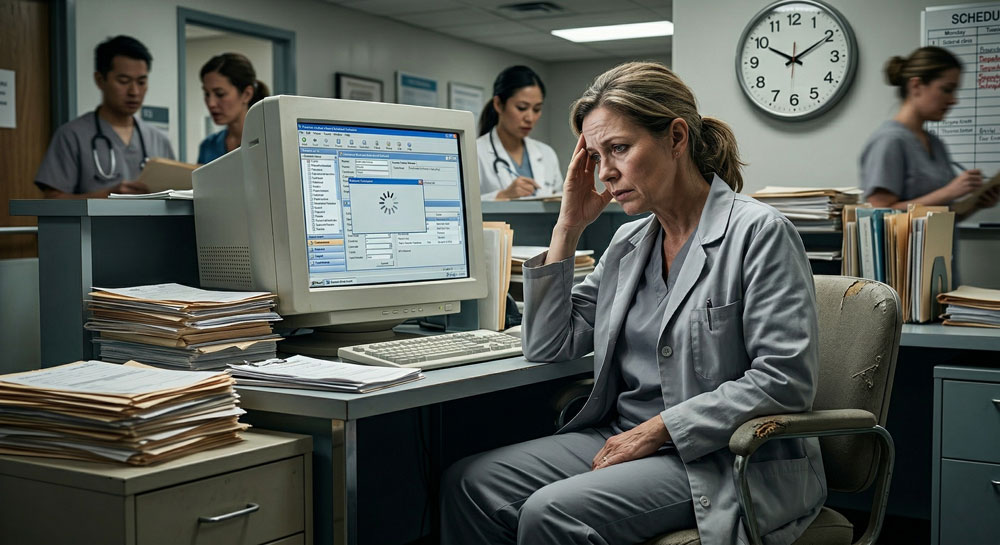
The internet drops for a few minutes. Calls do not route the way they should. A user account has the wrong access. The EHR gets slow. A shared printer stops responding. The payment terminal disconnects. Remote access works for one person but not another. A scanner in one office behaves differently than the scanner in the next location. None of these things may feel serious enough on their own to stop the whole business. But together, they create constant drag on the practice.
That is where “good enough” IT starts getting expensive.
The Cost Builds Quietly Over Time
A lot of smaller healthcare organizations live with setups that are just stable enough to get through the week. The systems work most of the time. The staff has workarounds. People know which device is more reliable, which room has weaker connectivity, and what to restart when something acts up. After a while, those workarounds stop feeling temporary and start feeling normal.
That may keep the day moving, but it still has a cost.
Every workaround takes attention. Every repeated disruption creates friction. Every avoidable delay at check-in, scheduling, room turnover, or checkout adds stress to the staff and chips away at the patient experience. The cost usually does not show up neatly on a report, so it is easy to underestimate. But anyone managing the office can feel it.
Where the Operational Damage Shows Up
The operational cost of weak IT usually shows up in a few clear areas.
First, it affects patient flow. In a medical practice, even short interruptions can create bottlenecks. If check-in slows down because a system is unstable, the rest of the schedule feels it. Staff get reactive. Providers lose time. Patients wait longer. A small delay early in the day can carry through the whole schedule.
Second, it affects communication. Medical offices depend on phones, messaging, secure communication, and vendor coordination. When those systems are inconsistent, missed calls and delayed responses become more common. Patients do not usually know why. They just experience the office as difficult to reach or harder to deal with than it should be.
Third, it affects staff morale. Few things wear people down faster than tools that do not work the same way every day. Staff want to do their jobs well, but repeated tech issues make basic tasks harder than they need to be. Over time, that kind of friction adds to stress, inconsistency, and burnout.
Fourth, it increases business risk. In healthcare, weak IT is not just annoying. Devices, user access, updates, backups, and system reliability all affect risk. A practice does not need a major cyber incident for poor technical management to cause damage. Sometimes the real problem is poor recovery planning, unmanaged devices, outdated systems, or no clear response when something breaks.
Fifth, it wastes leadership time. One of the least talked about costs in a small practice is how much time owners, administrators, and office managers spend chasing technology issues. They follow up with vendors, repeat the same problem to different people, wait on callbacks, and make decisions without full visibility. That is time that should be going toward staff, patients, growth, and smoother operations.
The Real Issue Is Ownership
The root problem usually is not a lack of software. It is a lack of ownership.
A lot of medical practices operate with a patchwork of vendors. The EHR vendor handles one piece. The internet provider handles another. The phone system is separate. Printing is separate. Security tools may be handled separately too, or barely handled at all. When a problem crosses systems, nobody really wants to own it. The practice ends up stuck in the middle.
That is especially difficult for smaller organizations because they usually do not have internal IT leadership. They have outside vendors, part-time support, or someone they call only when something breaks. That reactive model may look cheaper at first, but it usually creates more instability over time.
A Better Way to Look at IT
A better approach is to treat IT as part of practice operations, not just as a repair service.
That means having clear responsibility for the infrastructure that keeps the office running day to day. Not just the major outages, but the ordinary systems the staff relies on constantly: network reliability, device health, backup readiness, secure access, phone performance, vendor coordination, and basic security discipline.
This kind of support matters because it connects technology to real office operations. For a private practice, success is not about having the most complex setup. It is about whether the office can stay reliable, responsive, and steady during a normal busy day.
When practices improve this layer, the benefits are usually practical before they are technical. Staff lose less time. Front desk work becomes more consistent. Providers deal with fewer interruptions. Leadership spends less time reacting. Patients experience a smoother office. Risk gets easier to manage because systems are documented, supported, and maintained with more consistency.
This is not about chasing perfection. Every office will still have occasional problems. The real goal is to stop treating avoidable friction like it is just part of the job.
Why It Matters in Healthcare
In healthcare, operations matter. The patient experience starts long before the provider enters the room. It starts with the phone call, the check-in process, the communication flow, and the general sense that the office is organized and in control. Technology supports every part of that experience, even when patients never see it directly.
That is why “good enough” IT is often not good enough at all.
For a medical practice, dependable technology is not just a technical issue. It affects patient service, staff support, revenue protection, and day-to-day stability. Practices that understand this earlier usually build stronger systems, stronger teams, and a smoother experience for everyone involved.
The Question More Practices Should Ask
When healthcare leaders think about improvement, they usually look at staffing, scheduling, billing, or patient communication. They should. But they should also ask a simpler question:
Is our technology helping the practice run smoothly, or is the team quietly carrying the burden of systems that are only half working?
If the answer is the second one, it may be time to work with a team that provides managed IT support for medical practices in New Jersey and can bring more stability, accountability, and consistency to the day-to-day side of the office.
Were you satisfied with the information in this article? If yes, our blog offers even more valuable resources.
Read Also
- Can Outsourced Telepsychiatry Help Healthcare Organizations Keep Pace With Modern Mental Health Screening?
 Mental healthcare is changing quickly, but many hospitals, clinics, schools, correctional facilities, and community health organizations do not have enough psychiatric professionals available to turn new screening approaches into timely clinical care. Outsourced telepsychiatry offers one way to close that gap. FasPsych, for example, connects healthcare organizations with psychiatrists, psychiatric nurse practitioners, and other behavioral… Read more: Can Outsourced Telepsychiatry Help Healthcare Organizations Keep Pace With Modern Mental Health Screening?
 - Five operational checks for choking readiness in healthcare facilitiesA facility can have a choking poster on every wall and still be unprepared. Preparedness shows up when someone can recognize the emergency, call the right response, bring the right people and supplies to the room, and hand over clear information without losing time. That test belongs in operations as well as clinical education. The… Read more: Five operational checks for choking readiness in healthcare facilities
- Understanding the Demand for Correctional Healthcare ProfessionalsHave you ever wondered who cares for people when they get sick inside a prison? Many people do not realize that jails and prisons need skilled medical teams every single day. By reading this guide, you will learn why these important jobs are growing fast and how you can join this rewarding career field. Caring… Read more: Understanding the Demand for Correctional Healthcare Professionals
- Innovative Technologies in Oncology: The Future of Cancer TreatmentHave you ever wondered how far cancer treatment has come in recent years? Advances in technology are making a real difference in the fight against cancer. Today, more people are living longer and healthier lives after a cancer diagnosis. This is all thanks to new and groundbreaking medical advancements. The future of cancer care looks… Read more: Innovative Technologies in Oncology: The Future of Cancer Treatment
- Patient Engagement and Pharmaceutical Support Services: Building a Better Patient JourneyPatients rarely experience healthcare as a simple, linear process. They may need to understand a diagnosis, determine whether they qualify for a clinical trial, gather medical records, navigate insurance requirements, arrange transportation, learn how to use a medication, and stay engaged with treatment for months or years. Serva Health is one example of a specialist… Read more: Patient Engagement and Pharmaceutical Support Services: Building a Better Patient Journey
- Cloud-Based Healthcare Administration Solutions: A Guide for Payers, TPAs, and Provider NetworksHealthcare administration has become too complex for disconnected spreadsheets, aging on-premise applications, and manual handoffs between departments. Organizations need technology that can manage claims, enrollment, billing, provider relationships, and member data as connected parts of the same operation. MCSI – Visova is one example, offering a cloud-native vpaas designed to support HIPAA-compliant healthcare administration. Its… Read more: Cloud-Based Healthcare Administration Solutions: A Guide for Payers, TPAs, and Provider Networks
- Industrial Container Recycling and Waste Management Services: A Practical Guide for BusinessesIndustrial container recycling is an essential part of responsible waste management for manufacturers, warehouses, laboratories, automotive businesses, chemical companies, food processors, and other organizations that regularly handle bulk materials. A strong example is Kelly Drums, a Mid-Atlantic provider of reconditioned drums and comprehensive container management solutions. The company specializes in the pickup, recycling, reconditioning, and… Read more: Industrial Container Recycling and Waste Management Services: A Practical Guide for Businesses
- How Intelligent Invoice Processing Is Reshaping Healthcare AP WorkflowsWhat happens when healthcare invoice volumes outpace the AP team’s ability to review, validate, and route them, while cost per invoice keeps rising? That gap is pushing finance leaders past basic digitization. Supplier invoices across formats, systems, departments, and approval paths, and holding speed, accuracy, compliance, and visibility together gets harder at scale. Intelligent invoice… Read more: How Intelligent Invoice Processing Is Reshaping Healthcare AP Workflows