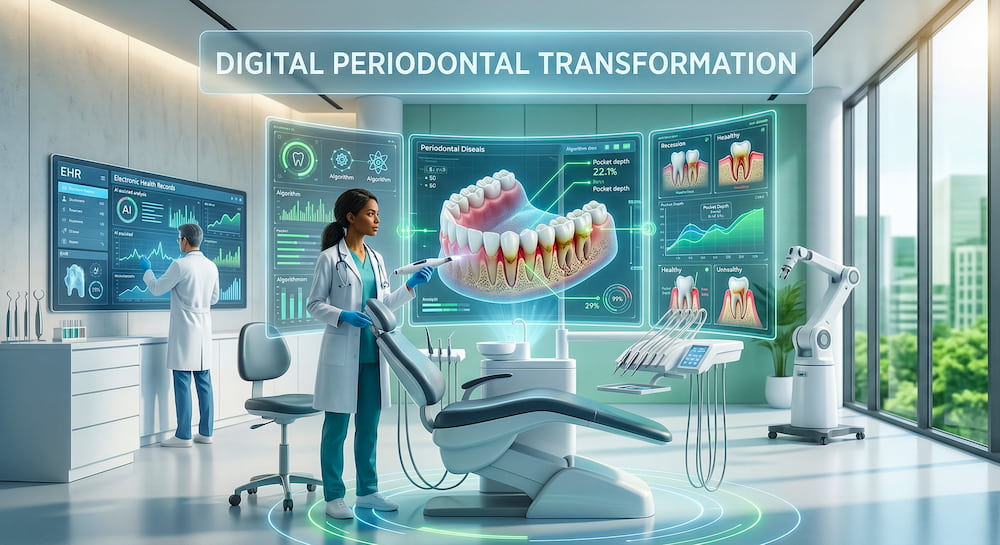
Periodontal disease remains one of the most common chronic conditions worldwide and a major cause of tooth loss in adults. Traditionally, its diagnosis and management have relied on clinical assessments such as periodontal probing and radiographic interpretation. While effective, these methods depend heavily on clinician experience.
The rapid evolution of digital technology is now reshaping how periodontal disease is detected, monitored and treated. Artificial intelligence (AI), digital imaging, data analytics and advanced diagnostic tools are transforming periodontal care into a more precise and patient-centred discipline. For healthcare providers and technology innovators, understanding these developments is essential as dentistry becomes increasingly integrated with broader digital health systems.
The Global Burden Of Periodontal Disease
Periodontal diseases affect a significant portion of the global population and place a considerable burden on healthcare systems. According to the World Health Organization, severe periodontal disease affects around 19% of adults globally, representing more than one billion cases. This prevalence highlights the scale of the challenge faced by dental professionals and healthcare providers.
Untreated periodontitis can lead to tooth loss, reduced quality of life and increased treatment costs. Increasingly, research is also highlighting associations between periodontal disease and systemic conditions including cardiovascular disease and diabetes. As healthcare moves towards more preventative and data-driven approaches, technology offers promising opportunities to identify periodontal disease earlier and manage it more effectively.
Artificial Intelligence In Periodontal Diagnosis
Technology is playing an increasingly important role in improving early detection and management. Artificial intelligence is one of the most transformative developments in modern dentistry. AI systems use machine learning algorithms to analyse dental radiographs, intraoral scans and clinical data to identify patterns associated with periodontal disease.
AI-assisted diagnostic tools are capable of identifying bone loss patterns on dental radiographs with impressive accuracy. These systems can highlight subtle structural changes around teeth that might otherwise be overlooked during routine assessments. By providing clinicians with additional diagnostic insights, AI can improve diagnostic consistency and support more confident treatment planning.
Importantly, AI is not designed to replace dental professionals. Instead, it functions as a clinical decision support tool that assists practitioners by analysing large volumes of data quickly and consistently. This combination of clinical expertise and technological support can enhance diagnostic reliability while maintaining the critical role of the clinician in interpreting findings and determining treatment.
Digital Imaging And Advanced Diagnostics
Digital imaging technologies are also advancing rapidly within periodontal care. Traditional periodontal assessment relies heavily on manual probing to measure the depth of periodontal pockets around each tooth. While this technique remains a standard clinical method, it can vary slightly depending on the pressure applied and the clinician’s technique.
Modern dental imaging systems are now integrating intraoral scanners with three-dimensional imaging technologies such as cone-beam computed tomography (CBCT). These tools allow clinicians to visualise teeth, bone and soft tissue structures in much greater detail.
With digital imaging, clinicians can assess bone levels more precisely and monitor small changes over time. This enables earlier detection of disease progression and supports more accurate treatment planning. Patients also benefit from improved visual communication, as clinicians can use digital images to explain periodontal conditions and demonstrate the potential impact of treatment.
Predictive Analytics And Risk Assessment
Another area where technology is making an impact is predictive analytics. Machine learning models can analyse a wide range of patient data including age, medical history, lifestyle factors and previous dental records to assess an individual’s risk of developing periodontal disease.
Predictive tools can help identify patients who may benefit from preventative interventions before significant damage occurs. For example, patients identified as high-risk may be advised to attend more frequent periodontal maintenance appointments or receive tailored oral hygiene guidance.
This shift towards predictive care reflects a broader transformation in healthcare, where data-driven insights support earlier intervention and better long term outcomes.
Digital Monitoring And Tele-Dentistry
Digital technologies are also extending periodontal care beyond the dental clinic. Tele-dentistry and remote monitoring tools are beginning to support ongoing patient engagement and maintenance.
Mobile applications and digital platforms can allow patients to track their oral hygiene habits, receive reminders for periodontal maintenance visits and communicate with their dental team.
Challenges And Considerations
Despite the promising benefits of digital technologies in periodontology, several challenges remain. Data security and patient confidentiality must be carefully protected as dental practices increasingly rely on digital records and AI-supported systems.
There is also a need for continued research and clinical validation to ensure that emerging technologies provide reliable and unbiased results across diverse patient populations. In addition, successful implementation depends on appropriate training for dental professionals and seamless integration into existing clinical workflows.
Technology should support clinical efficiency rather than complicate everyday practice, and careful planning is essential to achieve this balance.
The Future of Technology-Driven Periodontal Care
Looking ahead, technology is expected to play an even greater role in the future of periodontal care. Developments in artificial intelligence, digital diagnostics and personalised medicine may enable clinicians to predict disease progression with greater accuracy and design highly individualised treatment plans.
As digital health continues to evolve, dentistry is likely to become increasingly connected with wider healthcare systems.
Conclusion
Periodontal disease remains a major global health challenge, but advances in technology are transforming how it is diagnosed and managed. Artificial intelligence, digital imaging, predictive analytics and remote monitoring tools are enabling earlier detection, improved diagnostic precision and more personalised care.
Rather than replacing clinicians, these technologies are designed to enhance clinical expertise and support better decision-making. As digital innovation continues to develop, technology-driven approaches have the potential to significantly improve periodontal care and reduce the long term impact of this widespread condition.
Author Bio – Dr Simon Stern
Dr Simon Stern is a registered Specialist Periodontist at The Perio Centre in London. His qualifications include BDS MJDF RCS (Eng) MClinDent MPerio RCS (Ed). He lectures at both national and international conferences, has featured in highly-regarded podcasts and has published papers in several well-respected journals.
Were you satisfied with the information in this article? If yes, our blog offers even more valuable resources.
Read Also
- Innovative Technologies in Oncology: The Future of Cancer Treatment
 Have you ever wondered how far cancer treatment has come in recent years? Advances in technology are making a real difference in the fight against cancer. Today, more people are living longer and healthier lives after a cancer diagnosis. This is all thanks to new and groundbreaking medical advancements. The future of cancer care looks… Read more: Innovative Technologies in Oncology: The Future of Cancer Treatment
 - Cloud-Based Healthcare Administration Solutions: A Guide for Payers, TPAs, and Provider NetworksHealthcare administration has become too complex for disconnected spreadsheets, aging on-premise applications, and manual handoffs between departments. Organizations need technology that can manage claims, enrollment, billing, provider relationships, and member data as connected parts of the same operation. MCSI – Visova is one example, offering a cloud-native vpaas designed to support HIPAA-compliant healthcare administration. Its… Read more: Cloud-Based Healthcare Administration Solutions: A Guide for Payers, TPAs, and Provider Networks
- How Intelligent Invoice Processing Is Reshaping Healthcare AP WorkflowsWhat happens when healthcare invoice volumes outpace the AP team’s ability to review, validate, and route them, while cost per invoice keeps rising? That gap is pushing finance leaders past basic digitization. Supplier invoices across formats, systems, departments, and approval paths, and holding speed, accuracy, compliance, and visibility together gets harder at scale. Intelligent invoice… Read more: How Intelligent Invoice Processing Is Reshaping Healthcare AP Workflows
- From 1905 to 2026: How German Legacy Manufacturers Power Deutsche Dental Technologien’s SuccessFrom 1905 to 2026: How Busch & Co.’s Legacy Powers Deutsche Dental Technologien’s Success In an era where dental technology advances at breakneck speed, few companies embody the perfect blend of historic craftsmanship and modern business agility quite like Busch & Co. and its strategic partner Deutsche Dental Technologien. What began as a small dental bur factory in… Read more: From 1905 to 2026: How German Legacy Manufacturers Power Deutsche Dental Technologien’s Success
- Why the Future of Healthcare Administration is Cloud-NativeThe operational demands placed on modern healthcare administrators have officially outpaced the capabilities of traditional IT infrastructure. While clinical medicine continues to advance at breakneck speed, the back-office systems required to support it often remain painfully stagnant. Today’s insurers, Third-Party Administrators (TPAs), and provider networks are forced to navigate an avalanche of daily claims, aggressive… Read more: Why the Future of Healthcare Administration is Cloud-Native
- The Digital Overhaul: Why Modern Healthcare Administration Demands Advanced Technology SolutionsLet’s be honest about the current state of healthcare administration: it is staggering under its own complexity. The days of managing patient populations, claims, and provider networks with spreadsheets and disjointed legacy systems are long gone. Today, the sheer volume of data processing required just to keep a healthcare organization afloat is enough to paralyze… Read more: The Digital Overhaul: Why Modern Healthcare Administration Demands Advanced Technology Solutions
- Tech-Enabled Healthcare Innovation in Physical Therapy CarePhysical therapy is changing with the help of new technology. Digital tools are now used to support recovery and improve care. These tools help therapists track progress in a better way. Explore how technology is reshaping physical therapy with innovative digital tools. It highlights smarter recovery and patient outcomes in healthcare. Continue reading to discover… Read more: Tech-Enabled Healthcare Innovation in Physical Therapy Care
- 5 Best Payroll Error Detection Software for Healthcare in 2026Healthcare organizations operate some of the most complex payroll environments in any industry. Hospitals, skilled nursing facilities, rehabilitation centers, physician groups, and home healthcare providers must manage thousands of employees working across different shifts, departments, facilities, and compensation structures. Payroll teams are expected to process this information accurately while complying with labor regulations, organizational policies,… Read more: 5 Best Payroll Error Detection Software for Healthcare in 2026