

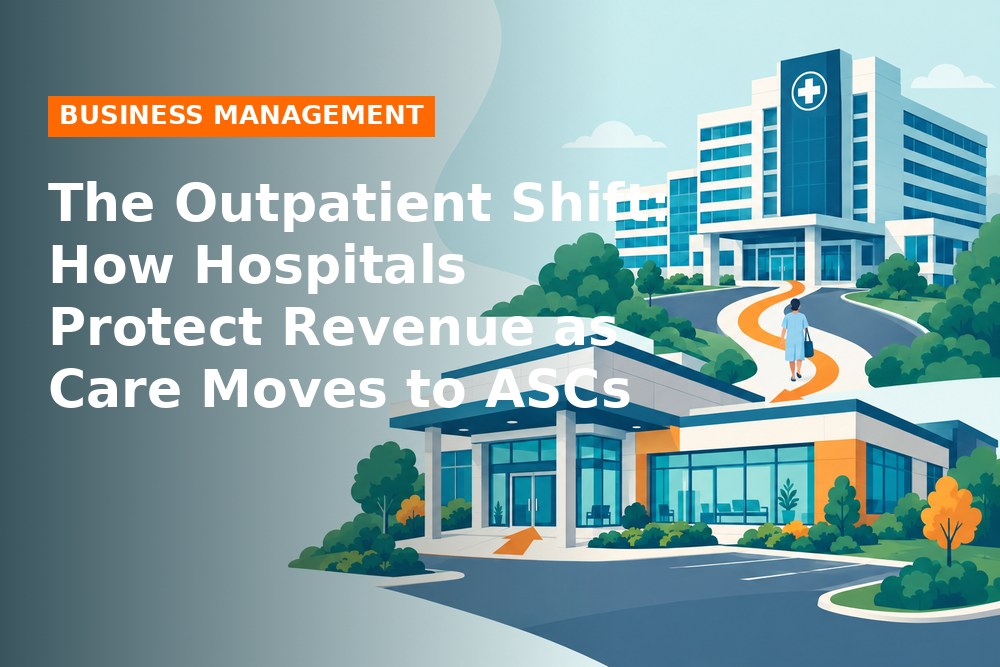
The outpatient shift is no longer a forecast; it is in the revenue line. Outpatient revenue at US hospitals is growing faster than any inpatient metric while operating margins sit below 3 percent, and federal policy is actively pushing procedures out of the hospital building. The response from health systems has escalated from pilot surgery centers to multi-billion-dollar acquisition bets, and the same logic is now visibly reshaping Gulf markets. For hospital owners, the question is no longer whether care moves out. It is how to protect revenue when it does.
The numbers behind the shift
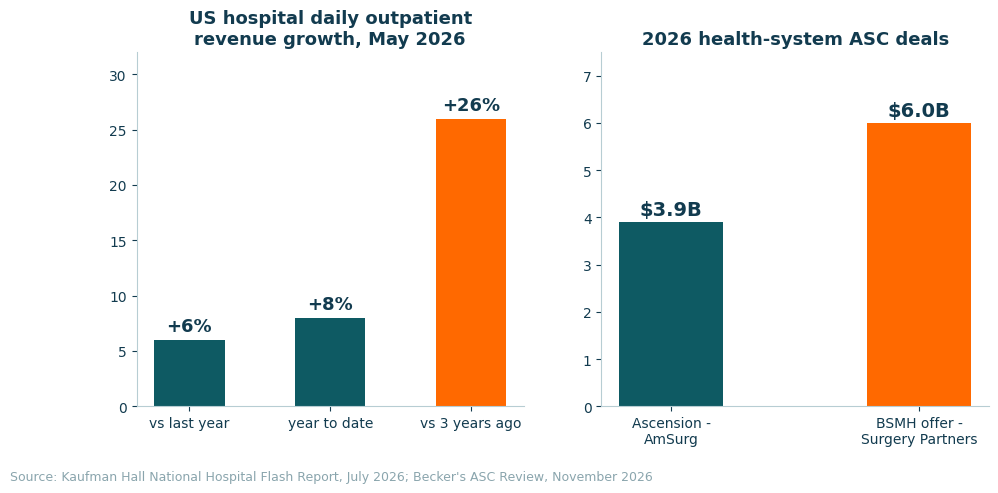
Kaufman Hall’s National Hospital Flash Report, drawing on more than 1,300 hospitals, found daily outpatient revenue up 6 percent year over year and 8 percent year to date in May, and up 26 percent against the same period three years ago. Over the same stretch, adjusted daily discharges rose just 2 percent and average length of stay fell 2 percent. The money is following the volume out of the building, and it is doing so while hospital finances remain fragile: the median operating margin index came in at 2.7 percent for May, down from 3.6 percent in April. The projection behind the trend is starker still. Vizient’s 2026 Impact of Change forecast projects overall outpatient volume to grow 20 percent over the next decade, to roughly 6.2 billion encounters, while inpatient growth softens.
Policy is pushing, not just allowing
Washington is dismantling the regulatory wall that kept procedures inside hospitals. CMS is phasing out Medicare’s inpatient-only list, which will cease to exist by 2028, and at the start of 2026 it added 276 procedures to the ambulatory surgery center covered list through criteria changes and another 271 through the inpatient-only changes. Site-neutral payment policies are compressing the premium hospitals once earned for the same procedure in an outpatient department, and the February 2026 funding law requires off-campus hospital outpatient departments to bill under separate identification numbers, a step toward further site-neutral pricing. The predictable consequence, as Kaufman Hall notes, is that the inpatient beds that remain are increasingly reserved for highly complex, high-acuity cases, which forces hospitals to restructure a cost base that was built for a broader mix.
The ASC math, and the buyers who believe it
The strategic case for ambulatory surgery centers has quietly changed, as Becker’s ASC Review reports. For years systems built ASCs to align with independent surgeons. With 82 percent of practicing US physicians now employed by hospitals or corporate entities, up from 52 percent in 2018 according to an Avalere study, that rationale has given way to unit economics: reimbursement is declining and labor costs are rising, but the cost of performing a case in a hospital outpatient department is meaningfully higher than in an ASC, so the ASC can still generate more margin per case. The capital has followed. Ascension completed its $3.9 billion acquisition of AmSurg in June, and a Bon Secours Mercy Health affiliate raised its offer for Surgery Partners to as much as $6 billion in November after an unsolicited rival bid. Payers are joining the structure too: Penn Medicine and Independence Blue Cross launched a venture with Regent in September to build at least 18 ASCs, with the insurer taking an ownership stake. The recurring failure mode is local: boardroom buy-in means little if hospital operators and the physicians currently working in hospital outpatient departments do not see the benefit.
How hospitals protect revenue on the way out
Vizient’s guidance to health systems reads as an operating manual for the transition. Let safety lead every site-of-care decision, but interrogate what it would take to move a service safely rather than defaulting to the inpatient setting. Rethink workforce deployment across the whole continuum, leaning on advanced practice providers, technicians and virtual tools so clinicians work at the top of their license. Build ambulatory operational intelligence, the real-time dashboards for capacity, supply and demand that inpatient units have had for years and ambulatory networks mostly lack. Assume no service line is immune: cardiovascular medicine alone is projected to grow 29 percent in outpatient settings over the decade. Finance leaders add two cautions of their own: site-neutral expansion will keep compressing hospital outpatient department profitability, and revenue cycle systems must handle far higher volumes of low-dollar claims, the same administrative load we examined in our prior authorization readiness guide, against already thin hospital margins.
The Gulf is building the same model now
Regional operators are not waiting to be disrupted. Burjeel Holdings has established a dedicated day-surgery platform for the UAE and Saudi Arabia, with four additional centers planned in the UAE and two in the Kingdom under unified clinical and financial management. Each Burjeel One day surgery center in Saudi Arabia requires roughly $38 million of capital expenditure and is expected to generate more than $54.5 million in annual revenue at maturity at a mid-twenties EBITDA margin. Chairman Shamsheer Vayalil’s framing matches the American lesson exactly: “Day surgery is not simply an extension of the traditional hospital model. It has its own operating dynamics, capital requirements, and growth potential.” International capital is arriving on the same thesis. Italy’s GKSD acquired a controlling stake in Riyadh’s SURGCA day surgery and ambulatory care center, launching an investment program exceeding one billion riyals aligned with Vision 2030. The Gulf’s advantage is sequencing: it can build ambulatory-first networks without first defending an oversized inpatient estate.
Conclusion
The outpatient shift is a revenue-allocation decision, not a trend to monitor. In the US, outpatient revenue is compounding while inpatient margins compress, policy is accelerating the move, and the largest systems are answering with billion-dollar ASC networks and payer partnerships. Gulf operators are building day-surgery platforms from the start. The hospitals that keep their margin will be the ones that treat ambulatory care as the operating model, with dashboards, redeployed workforces and payer alignment to match. Those defending the inpatient footprint alone are defending a shrinking share of a growing market.
Sources
- TechTarget: Care continues shift to outpatient as hospital margins dip (Kaufman Hall)
- Vizient: The ambulatory tipping point, why health systems must act
- Becker’s ASC Review: How ASCs became the center of the health system margin game
- Forbes Middle East: Burjeel Holdings launches day surgery platform for regional expansion
- GKSD Holding: Leading European group GKSD buys stake in Riyadh’s SURGCA center
Read Also
- The Outpatient Shift: How Hospitals Protect Revenue as Procedures Move to ASCs
 The outpatient shift is no longer a forecast; it is in the revenue line. Outpatient revenue at US hospitals is growing faster than any inpatient metric while operating margins sit below 3 percent, and federal policy is actively pushing procedures out of the hospital building. The response from health systems has escalated from pilot surgery… Read more: The Outpatient Shift: How Hospitals Protect Revenue as Procedures Move to ASCs
- What Pharma Companies Should Consider Before Entering a New International MarketA pharmaceutical product can be successful in one country. It may struggle to even set foot in another. The reason is simple. Global market entry is not merely a regulatory activity. A company’s product may be approved with strong clinical data backing it. The manufacturing network may be vast. However, the unexpected barriers around local… Read more: What Pharma Companies Should Consider Before Entering a New International Market
- Egypt’s Universal Health Insurance Phase II: What Private Facilities Need to KnowEgypt’s universal health insurance program is about to get much bigger, and private hospitals, clinics, labs and imaging centers are being invited into it. Phase II of the Universal Health Insurance System is rolling out across six more governorates, a new national compact with the World Bank is funding the expansion, and the health ministry… Read more: Egypt’s Universal Health Insurance Phase II: What Private Facilities Need to Know
- Electronic Prior Authorization 2027: How Clinics and Hospitals Can Get ReadyFor most clinics and hospitals, prior authorization is where patient care meets paperwork. Staff spend hours finding out whether an authorization is required, chasing payer-specific documentation rules, uploading records to different portals and tracking requests by phone and fax. In the United States, a federal rule now aims to replace much of that fragmented work… Read more: Electronic Prior Authorization 2027: How Clinics and Hospitals Can Get Ready
- How to Navigate Executive Recruitment in the Pharmaceutical SectorSuccessful leadership hiring in life sciences requires a clear and structured approach. Companies need leaders who can support growth, innovation, and operational strength. Competition for top talent is high and decisions need to be precise. The process also demands a strong understanding of both science and business needs. Many organizations struggle with finding the right… Read more: How to Navigate Executive Recruitment in the Pharmaceutical Sector
- Essential Strategies for Pre-Launch Success in Medical DevicesLaunching a medical device takes more than a good idea. It needs careful planning from the start. Many products fail because teams rush the process. They do not prepare enough before entering the market. A strong pre-launch plan helps reduce risks. It also improves product success. Good planning helps teams stay organized and focused. It… Read more: Essential Strategies for Pre-Launch Success in Medical Devices
- Key Trends in Medical Spa Marketing PerformanceMedical spa marketing is changing quickly. More clinics now compete for the same patients. People want fast results and simple booking options, and this has pushed clinics to improve their marketing strategies. A strong online presence is now very important for growth. Patients also expect clear information before they book. They want to see results,… Read more: Key Trends in Medical Spa Marketing Performance
- Dental Marketing Tactics That Improve Organic Search VisibilityMany people use search engines to find dental services online. They search for terms like “dentist near me” or “best dental clinic in Texas.” If a dental clinic appears at the top of search results, it has a better chance of getting new patients. That is why improving organic search visibility is important for every… Read more: Dental Marketing Tactics That Improve Organic Search Visibility